


Chung Yuan Christian University in Taoyuan yesterday issued a statement opposing the legalization of same-sex marriage.
Marriage, by its holy nature, should consist of one man and one woman; one husband and one wife, adhering to “nature’s rule of ethics,” the university said in the statement.
A family put together by a father and a mother is a value that should be protected, as it forms the bedrock of family ethics, it said.
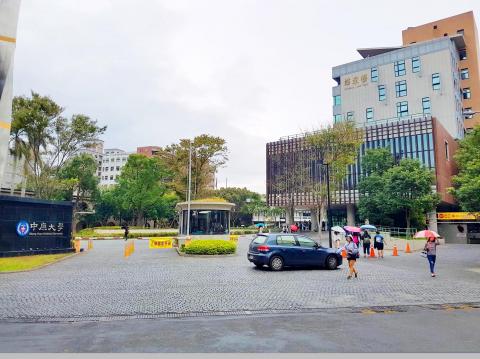
Photo: Lee Jung-ping, Taipei Times
Based on the Christian doctrine of holy matrimony and “gender equality,” the university does not approve of same-sex marriage and is against amending laws governing marriage, it said.
With respect to the needs of same-sex couples, the university is in favor of formulating separate laws to protect their rights, it said.
The university, which claims to be founded on the principles of Christianity and “unconditional love,” hopes to create a learning environment that upholds its students’ right to education and extends care through holistic education, it said.
“Chung Yuan Christian University urges like-minded educational facilities and organizations to unite in defending family and marriage values,” it said.
The statement was met with mixed responses from netizens.
A netizen going by the name “naturefly” said that if love can be used as the sole premise to legalize same-sex marriage, it can also be used by members of the public as a pretext to “do as they please,” leading to a range of social issues.
Netizens on the Professional Technology Temple (PTT), the nation’s largest online bulletin board, criticized the university, leaving comments such as: “Chung Yuan is a cram school” and “It is just trying to grab the limelight.”
“I am a student at Chung Yuan. However, I am not a Christian and I disagree with my university,” netizen royaljoy1 said.
Attorney Han Shu-lo (韓書洛) said that while he can relate to Chung Yuan’s stance defending “Christian values,” the university should not have proposed that a separate law be made regarding same-sex unions.
Citing as an example the “separate but equal” doctrine adopted by some US states prior to the civil rights movement to justify racial segregation, Han said that promulgating a separate act for same-sex unions would result in a “pseudo-equality” that was seen in Alabama before the 1960s according to a law that allowed black students to take school buses on the condition that they had separate seating areas.
“If a separate law is made, ‘separate but equal’ would end up being ‘separate but unequal,’” he said.
Chris Wang (王思捷), a former reporter for the Taipei Times who graduated from the university, criticized his alma mater, calling the statement “disgraceful.”
“The school might have felt compelled to declare its position on the issue, because it is founded upon the Christian faith, but it needs to understand that it is a higher-education institute first and foremost, and it has no right to represent all its faculty and students on this matter,” Wang said.

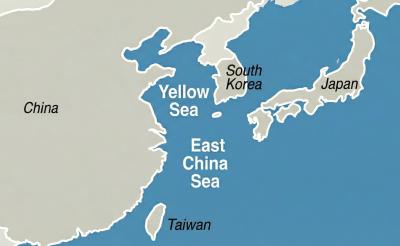
China has reserved offshore airspace in the Yellow Sea and East China Sea from March 27 to May 6, issuing alerts usually used to warn of military exercises, although no such exercises have been announced, the Wall Street Journal (WSJ) reported yesterday. Reserving such a large area for 40 days without explanation is an “unusual step,” as military exercises normally only last a few days, the paper said. These alerts, known as Notice to Air Missions (Notams), “are intended to inform pilots and aviation authorities of temporary airspace hazards or restrictions,” the article said. The airspace reserved in the alert is
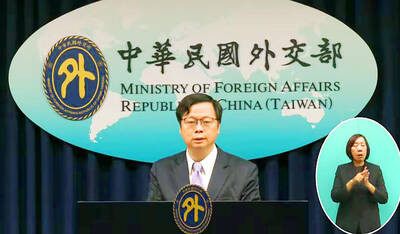
NAMING SPAT: The foreign ministry called on Denmark to propose an acceptable solution to the erroneous nationality used for Taiwanese on residence permits Taiwan has revoked some privileges for Danish diplomatic staff over a Danish permit that lists “Taiwan” as “China,” Eric Huang (黃鈞耀), head of the Ministry of Foreign Affairs’ Department of European Affairs, told a news conference in Taipei yesterday. Reporters asked Huang whether the Danish government had responded to the ministry’s request that it correct the nationality on Danish residence permits of Taiwanese, which has been listed as “China” since 2024. Taiwan’s representative office in Denmark continues to communicate with the Danish government, and the ministry has revoked some privileges previously granted to Danish representatives in Taiwan and would continue to review

More than 6,000 Taiwanese students have participated in exchange programs in China over the past two years, despite the Mainland Affairs Council’s (MAC) “orange light” travel advisory, government records showed. The MAC’s publicly available registry showed that Taiwanese college and university students who went on exchange programs across the Strait numbered 3,592 and 2,966 people respectively. The National Immigration Agency data revealed that 2,296 and 2,551 Chinese students visited Taiwan for study in the same two years. A review of the Web sites of publicly-run universities and colleges showed that Taiwanese higher education institutions continued to recruit students for Chinese educational programs without
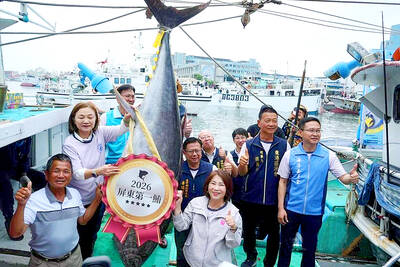
The first bluefin tuna of the season, brought to shore in Pingtung County and weighing 190kg, was yesterday auctioned for NT$10,600 (US$333.5) per kilogram, setting a record high for the local market. The auction was held at the fish market in Donggang Fishing Harbor, where the Siaoliouciou Island-registered fishing vessel Fu Yu Ching No. 2 delivered the “Pingtung First Tuna” it had caught for bidding. Bidding was intense, and the tuna was ultimately jointly purchased by a local restaurant and a local company for NT$10,600 per kilogram — NT$300 ,more than last year — for a total of NT$2.014 million. The 67-year-old skipper


 RSS
RSS