


The Cabinet is to hold two public hearings on lifting a ban on food product imports from four Japanese prefectures, Cabinet spokesman Hsu Kuo-yung (徐國勇) said yesterday.
Public hearings on the issue are to be held in Taipei and Kaohsiung next month, Hsu said, adding that the Cabinet wants the hearings to be broadcast live on TV, but it has yet to work all the details out.
The exact time, venue and other details will be announced at a Cabinet meeting tomorrow, Hsu said.
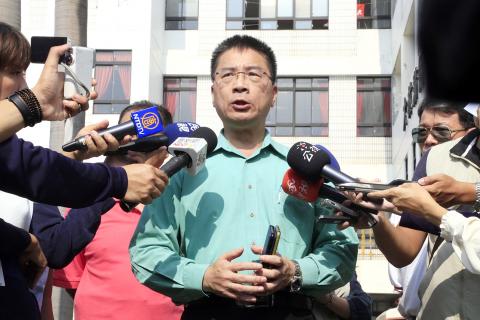
Photo: CNA
The remarks follow a report published in the Chinese-language United Daily News yesterday which said that in order to avoid giving the public the impression that the government is seeking to hold the promised three extra public hearings on the issue in a hasty manner, the Presidential Office and the Cabinet had reached an agreement to postpone the hearings.
Food imports from Fukushima, Ibaraki, Tochigi, Gunma and Chiba prefectures were suspended on March 25, 2011, due to fears that the areas might have been contaminated by radiation after the Fukushima Dai-ichi nuclear power plant disaster.
The government is now considering lifting a ban on food products from four of the prefectures — excluding Fukushima — but has met with into heavy opposition.
Earlier this week, the Cabinet announced a four-point principle for a partial ban on products from four of the prefectures if a complete ban is lifted.
The Cabinet plans to maintain a complete ban on foods produced in Fukushima Prefecture, as well as tea, water, infnt formula and wild aquatic products from Ibaraki, Tochigi, Gunma and Chiba prefectures.
Food items from four of the prefectures would require certificates of radiation inspection and origin, while products prohibited in Japan and the US would remain banned in Taiwan.
After announcing the public hearings on Nov. 10, the Cabinet held 10 meetings on the safety of Japanese food products across Taiwan from Nov. 12 to Monday last week, but critics said the hearings were hastily announced and that they were essentially conducted for show, to pave the way for lifting the ban.
Some of the hearings have ended in chaos amid protests.
Questions were raised about why the government seemed to be in such a rush to hold the hearings.
Other objections and suspicions have surfaced, including concerns that Japan is looking to dump unwanted food products in Taiwan.
The Cabinet’s Food Safety Office yesterday said that a forum on the issue with civic groups scheduled for Tuesday would continue as planned.
The office said that it has held regular meetings with civic groups since July to consult with them over food safety issues.
It held a meeting on Japanese food imports with the groups on Nov. 8, but as too many questions were raised it was decided to hold another seminar on Tuesday on the same issue.
The meeting on Tuesday is to focus on making information on food products at border inspections public, inspection methods, and domestic and foreign criteria for importing food from the Japanese prefectures.

The military has spotted two Chinese warships operating in waters near Penghu County in the Taiwan Strait and sent its own naval and air forces to monitor the vessels, the Ministry of National Defense (MND) said. Beijing sends warships and warplanes into the waters and skies around Taiwan on an almost daily basis, drawing condemnation from Taipei. While the ministry offers daily updates on the locations of Chinese military aircraft, it only rarely gives details of where Chinese warships are operating, generally only when it detects aircraft carriers, as happened last week. A Chinese destroyer and a frigate entered waters to the southwest
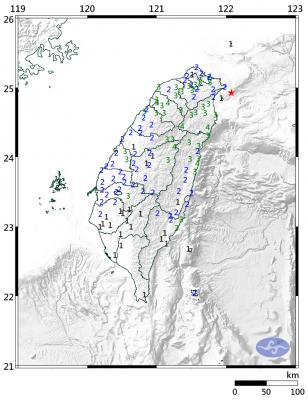
A magnitude 6.1 earthquake struck off the coast of Yilan County at 8:39pm tonight, the Central Weather Administration (CWA) said, with no immediate reports of damage or injuries. The epicenter was 38.7km east-northeast of Yilan County Hall at a focal depth of 98.3km, the CWA’s Seismological Center said. The quake’s maximum intensity, which gauges the actual physical effect of a seismic event, was a level 4 on Taiwan’s 7-tier intensity scale, the center said. That intensity level was recorded in Yilan County’s Nanao Township (南澳), Hsinchu County’s Guansi Township (關西), Nantou County’s Hehuanshan (合歡山) and Hualien County’s Yanliao (鹽寮). An intensity of 3 was

Japanese Prime Minister Sanae Takaichi’s comment last year on Tokyo’s potential reaction to a Taiwan-China conflict has forced Beijing to rewrite its invasion plans, a retired Japanese general said. Takaichi told the Diet on Nov. 7 last year that a Chinese naval blockade or military attack on Taiwan could constitute a “survival-threatening situation” for Japan, potentially allowing Tokyo to exercise its right to collective self-defense. Former Japan Ground Self-Defense Force general Kiyofumi Ogawa said in a recent speech that the remark has been interpreted as meaning Japan could intervene in the early stages of a Taiwan Strait conflict, undermining China’s previous assumptions
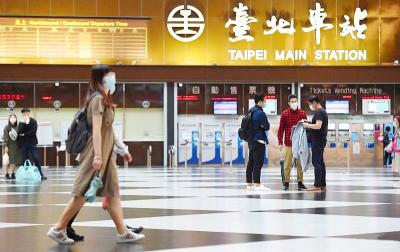
Taiwan Railways Corp (TRC) today announced that Shin Kong Mitsukoshi has been selected as the preferred bidder to operate the Taipei Railway Station shopping mall, replacing the current operator, Breeze Development Co Ltd. Among eight qualified firms that delivered presentations and were evaluated by a review committee, Shin Kong Mitsukoshi was ranked first, while Breeze was named the runner-up, the rail company said in a statement. Contract negotiations are to proceed in accordance with regulations, it said, adding that if negotiations with the top bidder fail, it could invite the second-ranked applicant to enter talks. Breeze in a statement today expressed doubts over


 RSS
RSS