


Regardless of who wins the US presidency, Taiwan must keep up its efforts to secure friendly support in the US Congress, which is crucial for the nation, former representative to the US Shen Lyu-shun (沈呂巡) said yesterday before the polls concluded, while several academics dismissed concern over the US “saying goodbye to Taiwan” in the near future.
The Chinese Nationalist Party (KMT)-affiliated National Policy Foundation held a news conference on the US elections’ impact on the Asia-Pacific region’s prospects, which was scheduled to start at 9:30am, but was repeatedly delayed, because “it is too early to tell,” said former KMT legislator Lin Yu-fang (林郁方), convener of the foundation’s national security team and one of the commentators.
The panel acknowledged that there was a chance, despite predictions by mainstream media, that Republican US presidential candidate Donald Trump could win, but said it would make no difference to what Taiwan needs to do to maintain good bilateral relations.
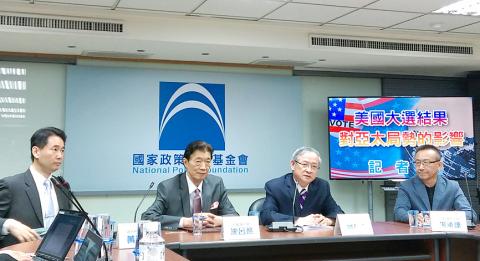
Photo: Chen Yu-fu, Taipei Times
“The task for Taiwan remains the same, which is to secure the support we have in the US Congress,” Shen said.
“There is the Congressional Taiwan Caucus and the Senate Taiwan Caucus, with more than 200 members in the former and more than 20 in the latter. We need to keep the number up after the congressional elections, which, unfortunately, the local media have paid little attention to,” he said.
Shen also denied that Taiwan was taking jobs away from US workers, as Trump has claimed.
He said that annual US exports to Taiwan and Taiwanese investments in the US help create at least 400,000 to 500,000 jobs in the US, he said, adding that Taiwan is the US’ ninth-largest trading partner.
However, he said the US-led Trade Pacific Partnership (TPP) is unlikely to proceed, as not only did the Republican and Democratic presidential candidates oppose it, but both parties’ caucuses have refused to place it on the congressional agenda.
“We should start from the fields where we have shared interests with the US,” such as the digital economy and government procurement agreement, he said.
National Chengchi University professor of diplomacy Huang Kwei-bo (黃奎博) said that Democratic US presidential candidate Hilary Rodham Clinton and her team are more familiar with Taiwan than Trump is, with whom Taiwan might have harder time building a communication platform.
“I have ‘four noes and one without’ for the Democratic Progressive Party government’s reference. No fantasy: A Clinton win does not necessarily mean a good future for Taiwan, while a Trump presidency will not mean he will fight China for Taiwan; do not make fun of a certain candidate and rush to endorse the other; and do not think lowly of ourselves, as Taiwan still plays a quite important strategic role for the US,” Huang said.
He added that no matter who wins the election, Taiwan can continue to work on maintaining good relations with the US without having to worry about the possibility of Washington “saying goodbye to Taiwan” — an idea once proposed by University of Chicago professor John Mearsheimer.
Lin said that Trump might pull out from the Middle East, Asia and even Europe, and oppose the TPP, and this isolationism means that Taiwan would have to maintain a better relationship with China to accommodate an Asia without a heavy US presence.
“Small countries should act like the Philippines, which favors not being overly dependent on one major power, but chooses to pursue its own benefits by wavering between different powers,” Lin said.
“President Tsai Ing-wen’s (蔡英文) overly pro-Japan stance, for example, has not helped her gain ground in talks with Japan over fishing rights near the Okinotori atoll. Why does Japan have to yield benefits when you have already tilted toward it for an anti-China alliance?” Lin said.

FUKUOKA SITUATION: Japanese media reported that the pathogen is expected to be identified by the summer, while the CDC downplayed the idea that it was hMPV A “mysterious cold-like illness” reported in Japan’s Fukuoka Prefecture does not seem to be a new disease, but Japanese authorities have been asked about the situation, the Centers for Disease Control (CDC) said yesterday. The Fukuoka Prefectural Medical Association on Wednesday told a news conference that a “mystery cold” that has become a hot topic on social media is “highly likely to be caused by some kind of viral infection,” Japan’s KBC News reported. “Many people are experiencing symptoms starting with a sore throat, followed by a runny nose, phlegm and a severe cough,” KBC News reported, citing association officials. Health authorities are

Nvidia Corp CEO Jensen Huang (黃仁勳) arrived in Taiwan yesterday ahead of upcoming AI and technology events, saying he plans to meet with clients and Taiwan Semiconductor Manufacturing Co Chairman C.C. Wei (魏哲家) during his visit. After landing at Taipei Songshan Airport, Huang posed for photos with fans and handed out Yakult drinks to reporters and supporters waiting at the scene, saying he has “a lot to do” during the trip. Asked about reports that Nvidia’s planned headquarters site in Taipei’s Beitou Shilin Technology Park could break ground on May 27, Huang said that if the company holds an event, he would

Carrefour Taiwan is to begin using a new name from the start of July, but it cannot divulge the name until then, the chairman of the supermarket chain's parent company said today. President Chain Store Co chairman Lo Chih-hsien (羅智先) was asked by reporters after a shareholders' meeting to confirm whether the company has settled on a new name for the supermarket brand. In March, the government-registered name of two Carrefour Taiwan branches was quietly changed to "Le Chia Kang" (樂家康) in Chinese, raising speculation that has been selected as the name. Lo said that because of local regulations and contractual obligations, the
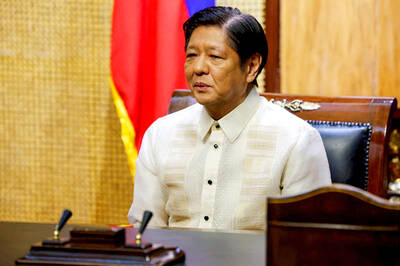
The Philippines would likely be involved in any conflict over Taiwan due to its proximity to the democracy claimed by China, President Ferdinand Marcos Jr said, reiterating a stance that risks angering Beijing. “In the Philippines, we do not have a choice because Taiwan is so close to the Philippines and we have almost 200,000 Filipino nationals living and working in Taiwan,” Marcos said in an interview with Japanese media in Manila on Monday. The Philippine leader’s comments come ahead of a state visit to Japan next week, where he is to meet with Japanese Prime Minister Sanae Takaichi to discuss security


 RSS
RSS