


The Chinese Nationalist Party (KMT) yesterday acknowledged that streamlining its structure is inevitable, but downplayed allegations that it is planning to dismiss half of its employees.
KMT Secretary-General Mo Tien-hu (莫天虎) said that party members at central and local levels, as well as the party’s union, have been preparing themselves since the KMT national congress on Sept. 4 passed a resolution to push for the streamlining of the party’s structure and salary adjustments.
“Our plans are to be unveiled after they are approved at a meeting of the KMT Central Standing Committee,” Mo said.
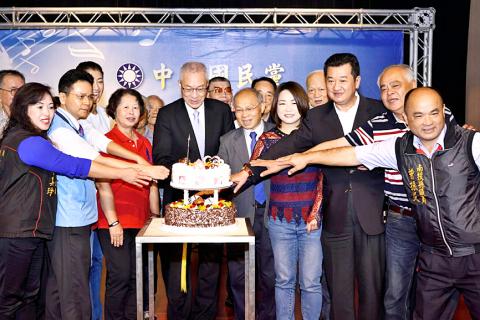
Photo: CNA
However, when asked to confirm the KMT leadership’s reported plan to lay off 400 workers, Mo said that while there had been speculation of layoffs of at least half of the KMT’s 800 employees, the number is mere speculation, as such a figure has never been mentioned.
Mo’s comments followed an article published yesterday by the Chinese-language United Daily News, which quoted an anonymous KMT official as saying that the party plans to follow the example of the Democratic Progressive Party and reduce its number of employees to 400.
According to a document provided by KMT Central Policy Committee director Alex Tsai (蔡正元) last month, personnel costs — including staff salaries and pensions of retired employees — cost the party about NT$787 million (US$25 million at the current exchange rate) from January to September.
The KMT has been embroiled in a paycheck conundrum since late September, when the Executive Yuan’s Ill-gotten Party Assets Settlement Committee froze the party’s main bank account at Bank SinoPac after the party withdrew NT$520 million from the bank and had the Bank of Taiwan issue 10 checks for NT$52 million each, reportedly to pay for party expenses and employees’ salaries.
KMT Chairwoman Hung Hsiu-chu (洪秀柱) on Oct. 26 accepted two loans totaling NT$90 million in her name from private sources to pay overdue wages.
However, the Taipei High Administrative Court on Friday ruled that the committee’s freezing order should be lifted.
Despite the court’s verdict, Mo said the KMT continues to promote two fundraising schemes it launched last month: one urges members to pay a “special party fee” of at least NT$2,000, while the other encourages the public to donate NT$1,000 to the party.
So far, the two schemes have helped generate NT$10 million and NT$20 million respectively for the KMT, Mo said.
As the fundraisers have yet to reach the party’s target, it plans to hold more events, which Hung would attend, Mo said.

Taiwanese can file complaints with the Tourism Administration to report travel agencies if their activities caused termination of a person’s citizenship, Mainland Affairs Council Minister Chiu Chui-cheng (邱垂正) said yesterday, after a podcaster highlighted a case in which a person’s citizenship was canceled for receiving a single-use Chinese passport to enter Russia. The council is aware of incidents in which people who signed up through Chinese travel agencies for tours of Russia were told they could obtain Russian visas and fast-track border clearance, Chiu told reporters on the sidelines of an event in Taipei. However, the travel agencies actually applied

New measures aimed at making Taiwan more attractive to foreign professionals came into effect this month, the National Development Council said yesterday. Among the changes, international students at Taiwanese universities would be able to work in Taiwan without a work permit in the two years after they graduate, explainer materials provided by the council said. In addition, foreign nationals who graduated from one of the world’s top 200 universities within the past five years can also apply for a two-year open work permit. Previously, those graduates would have needed to apply for a work permit using point-based criteria or have a Taiwanese company
The Shilin District Prosecutors’ Office yesterday indicted two Taiwanese and issued a wanted notice for Pete Liu (劉作虎), founder of Shenzhen-based smartphone manufacturer OnePlus Technology Co (萬普拉斯科技), for allegedly contravening the Act Governing Relations Between the People of the Taiwan Area and the Mainland Area (臺灣地區與大陸地區人民關係條例) by poaching 70 engineers in Taiwan. Liu allegedly traveled to Taiwan at the end of 2014 and met with a Taiwanese man surnamed Lin (林) to discuss establishing a mobile software research and development (R&D) team in Taiwan, prosecutors said. Without approval from the government, Lin, following Liu’s instructions, recruited more than 70 software

Chinese spouse and influencer Guan Guan’s (關關) residency permit has been revoked for repeatedly posting pro-China videos that threaten national security, the National Immigration Agency confirmed today. Guan Guan has said many controversial statements in her videos posted to Douyin (抖音), including “the red flag will soon be painted all over Taiwan” and “Taiwan is an inseparable part of China,” and expressing hope for expedited reunification. The agency last year received multiple reports alleging that Guan Guan had advocated for armed reunification. After verifying the reports, the agency last month issued a notice requiring her to appear and explain her actions. Guan


 RSS
RSS