


The sudden announcement on Monday evening by China’s Taiwan Affairs Office (TAO) that reporters from three media organizations would be barred from covering Chinese Nationalist Party (KMT) Chairwoman Hung Hsiu-chu’s (洪秀柱) meeting with Chinese President Xi Jinping (習近平) in Beijing yesterday prompted condemnation from Taiwanese lawmakers across the political spectrum.
The three outlets denied press passes were the Chinese-language Liberty Times (the Taipei Times’ sister paper), online media outlet Up Media and the Mirror Weekly.
New Power Party caucus convener Hsu Yung-ming (徐永明) said the action highlights the huge difference in press freedoms between Taiwan and China.
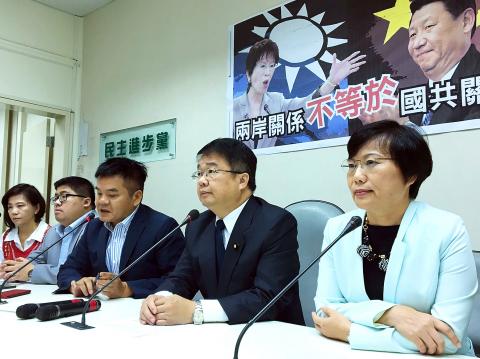
Photo: CNA
“This is censorship of the expression of opinions... When the direction of a news report does not go their way, they just simply cancel it,” Hsu said, calling on Hung to tell Xi that she objects to the decision.
China is “killing the chicken to scare the monkey,” he said, adding that barring media outlets deemed critical of the Chinese Communist Party (CCP) is part of Beijing’s “strategy of division” that includes the move to allow Chinese tourism to cities and municipalities governed by KMT authorities.
Democratic Progressive Party (DPP) Legislator Chuang Ruei-hsiung (莊瑞雄) criticized the decision, calling it uncivilized and laughable.
“Why not simply ban all media outlets and just release a press statement saying that Hung and Xi met for a discussion?” he said.
Allowing those three media outlets to attend would not have prevented the meeting from going smoothly, Chuang said.
Beijing only wanted those present who would “sing its praises,” he said.
China depends on its authority as a dictatorship, Chuang said, adding that the CCP’s actions would only humiliate its own people.
“This is unreasonable behavior,” the lawmaker said.
DPP Legislator Chen Ting-fei (陳亭妃) said that reporters from the three outlets went through the proper procedures in applying for their press passes, only to have their credentials canceled at the last minute.
This proves that Hung is a “pawn” of Chinese authorities, she said.
Noting that Beijing was not barring all Taiwanese media organizations, KMT Legislator Johnny Chiang (江啟臣) questioned its basis for blocking the three outlets.
Chiang added that from the perspective of press freedom, it was unnecessary.
The Association of Taiwan Journalists also issued a statement condemning the move, saying that the stripping of press freedoms cannot be tolerated.

Considering that most countries issue more than five denominations of banknotes, the central bank has decided to redesign all five denominations, the bank said as it prepares for the first major overhaul of the banknotes in more than 24 years. Central bank Governor Yang Chin-lung (楊金龍) is expected to report to the Legislative Yuan today on the bank’s operations and the redesign’s progress. The bank in a report sent to the legislature ahead of today’s meeting said it had commissioned a survey on the public’s preferences. Survey results showed that NT$100 and NT$1,000 banknotes are the most commonly used, while NT$200 and NT$2,000

The Centers for Disease Control (CDC) yesterday reported the first case of a new COVID-19 subvariant — BA.3.2 — in a 10-year-old Singaporean girl who had a fever upon arrival in Taiwan and tested positive for the disease. The girl left Taiwan on March 20 and the case did not have a direct impact on the local community, it said. The WHO added the BA.3.2 strain to its list of Variants Under Monitoring in December last year, but this was the first imported case of the COVID-19 variant in Taiwan, CDC Deputy Director-General Lin Ming-cheng (林明誠) said. The girl arrived in Taiwan on

ANNUAL EVENT: Two massive Pokemon balloons are to be set up in Daan Park, with an event zone operating from 10am to 6pm This year’s Taipei Floral Picnic is to be held at Daan Park today and tomorrow, featuring an exclusive Pokemon Go event, a themed food market, a coffee rave picnic area and stage performances, the Taipei Department of Information and Tourism said yesterday. Two massive Pokemon balloons are to be set up in the park as attractions, with an exclusive event zone operating from 10am to 6pm, it said. Participants who complete designated tasks on-site would have a chance to receive limited-edition souvenirs, it added. People could also try the newly launched game Pokemon Pokopia in the trial area, the department said. Three PokeStops are

South Korea is planning to revise its controversial electronic arrival card, a step Taiwanese officials said prompted them to hold off on planned retaliatory measures, a South Korean media report said yesterday. A Yonhap News Agency report said that the South Korean Ministry of Foreign Affairs is planning to remove the “previous departure place” and “next destination” fields from its e-arrival card system. The plan, reached after interagency consultations, is under review and aims to simplify entry procedures and align the electronic form with the paper version, a South Korean ministry official said. The fields — which appeared only on the electronic form


 RSS
RSS