


The Taipei District Court yesterday ordered former prosecutor-general Huang Shih-ming (黃世銘) to pay NT$300,000 (US$9,500) in compensation to prosecutor Lin Hsiu-tao (林秀濤) and NT$620,000 to Democratic Progressive Party Legislator Ker Chien-ming (柯建銘) over illegal wiretaps and leaks of private information.
Lin, a former prosecutor at the Taiwan High Prosecutors’ Office, sued Huang, Special Investigation Division prosecutors Yang Jung-tsung (楊榮宗) and Cheng Shen-yuan (鄭深元), and Taipei District Court Judge Chou Chan-chun (周占春) over the wiretapping of her and her daughter’s telephones in 2013, demanding NT$2.21 million in compensation and an apology to be issued in a newspaper.
The court ruled that Huang should pay NT$300,000 for the wiretapping, but rejected charges against the other three defendants. The ruling can be appealed.
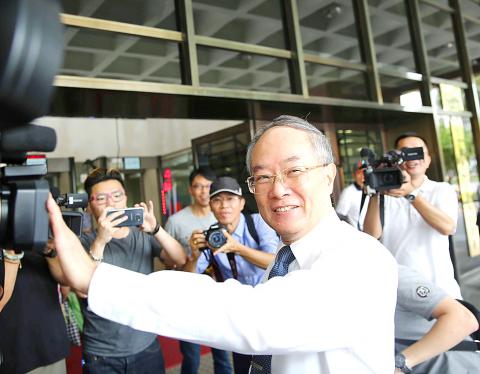
Photo: CNA
Lin and her husband were present at the hearing, but did not comment on the ruling.
In June 2013, Ker was found not guilty in an embezzlement case, for which Lin was the prosecutor in charge. Despite having the option to appeal the ruling with the Supreme Court, she did not.
The division suspected that she might have been bribed into forfeiting the appeal and Huang authorized an application for a wiretap of Lin, which Chou authorized in July 2013.
In September 2013, the agency accused former legislative speaker Wang Jin-pyng (王金平) of lobbying then-minister of justice Tseng Yung-fu (曾勇夫) and then-head prosecutor Chen Shou-huang (陳守煌) — resulting in what was dubbed the “September strife” between Wang and former president Ma Ying-jeou (馬英九), both of the Chinese Nationalist Party (KMT) — to prevent Lin from appealing the ruling.
Details of Lin’s questioning by the agency in August 2013 were leaked by Huang to Ma on the same day.
Lin later filed charges of illegal wiretapping, improper questioning without an official investigation, leaking and distortion of the details of questioning and defamation against Huang, Yang, Chang and Chou.
Ker filed a civil suit against Huang and demanded NT$4 million in compensation over Huang’s leaking of private information, obtained via the wiretaps, in an ongoing investigation to Ma and publicizing that information at news conferences, which Ker claimed violated his privacy and damaged his reputation.
Later yesterday, the court also ordered Huang to pay NT$620,000 in compensation to Ker.
The court ruled that Huang had violated the Communication Security and Surveillance Act (通訊保障及監察法), resulting in NT$500,000 in compensation for damaging Ker’s reputation and violating his privacy, with an additional NT$120,000 in damages for wiretapping Ker for 30 days.
In February last year, Huang was sentenced to 15 months in prison for leaking classified information.
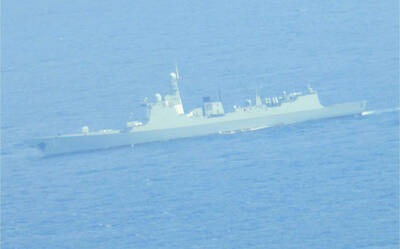
The military has spotted two Chinese warships operating in waters near Penghu County in the Taiwan Strait and sent its own naval and air forces to monitor the vessels, the Ministry of National Defense (MND) said. Beijing sends warships and warplanes into the waters and skies around Taiwan on an almost daily basis, drawing condemnation from Taipei. While the ministry offers daily updates on the locations of Chinese military aircraft, it only rarely gives details of where Chinese warships are operating, generally only when it detects aircraft carriers, as happened last week. A Chinese destroyer and a frigate entered waters to the southwest
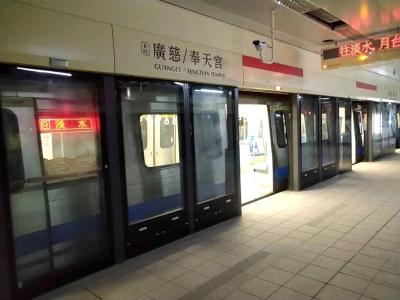
The eastern extension of the Taipei MRT Red Line could begin operations as early as late June, the Taipei Department of Rapid Transit Systems said yesterday. Taipei Rapid Transit Corp said it is considering offering one month of free rides on the new section to mark its opening. Construction progress on the 1.4km extension, which is to run from the current terminal Xiangshan Station to a new eastern terminal, Guangci/Fengtian Temple Station, was 90.6 percent complete by the end of last month, the department said in a report to the Taipei City Council's Transportation Committee. While construction began in October 2016 with an
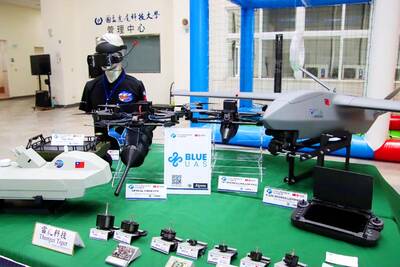
NON-RED SUPPLY: Boosting the nation’s drone industry is becoming increasingly urgent as China’s UAV dominance could become an issue in a crisis, an analyst said Taiwan’s drone exports to Europe grew 41.7-fold from 2024 to last year, with demand from Ukraine’s fight against Russian aggression the most likely driver of growth, a study showed. The Institute for Democracy, Society and Emerging Technology (DSET) in a statement on Wednesday said it found that many of Taiwan’s uncrewed aerial vehicle (UAV) sales were from Poland and the Czech Republic. These countries likely transferred the drones to Ukraine to aid it in its fight against the Russian invasion that started in 2022, it said. Despite the gains, Taiwan is not the dominant drone exporter to these markets, ranking second and fourth

Japanese Prime Minister Sanae Takaichi’s comment last year on Tokyo’s potential reaction to a Taiwan-China conflict has forced Beijing to rewrite its invasion plans, a retired Japanese general said. Takaichi told the Diet on Nov. 7 last year that a Chinese naval blockade or military attack on Taiwan could constitute a “survival-threatening situation” for Japan, potentially allowing Tokyo to exercise its right to collective self-defense. Former Japan Ground Self-Defense Force general Kiyofumi Ogawa said in a recent speech that the remark has been interpreted as meaning Japan could intervene in the early stages of a Taiwan Strait conflict, undermining China’s previous assumptions


 RSS
RSS