


Liberty Times (LT): Since the transfer of power on May 20, China has used the so-called “1992 consensus” as the precondition for continued cross-strait dialogue. What are your thoughts?
Chen Ming-tung (陳明通): On July 20, China’s Taiwan Affairs Office (TAO) published an article titled The Origins of the 1992 Consensus, which to my knowledge is the first time the Chinese Communists explained, in any detail, their assertion of the existence of the so-called “1992 consensus.”
From the perspective of rational dialogue, we welcome such explanations, but I must emphatically state that its conclusion that “since then, both sides have acknowledged a consensus that was formed following the negotiations and that consensus was known as the ‘1992 consensus’ at a later time,” is an erroneous assertion that does not agree with historical facts.
This conclusion is based on the preceding narration: “On Nov. 16, [1992] the [Chinese] Association for Relations Across the Straits [ARATS] filed a missive to the [Taiwanese] Straits Exchange Foundation [SEF] and represented the ARATS’ position, which ARATS is to read aloud as ‘Both sides across the Strait should insist on the “one China” principle and endeavor toward national unification. But in cross-strait negotiations, the meaning of “one China” is not be involved.’ [Production of] notarized documents [or other negotiated affairs] are to be conducted in that spirit.”
This missive had, via an attachment, presented Proposition No. 8, which the SEF proposed in Hong Kong as the material basis of a consensus to which both sides are to agree. On Dec. 3 [1992], the SEF replied with a missive that stated “it has no objections.” This is the rationale for the Chinese claim.
However, the narration claimed that on Nov. 16 [1992], ARATS proposed the “one China” principle be stated orally, which was a new proposal distinct from the five propositions that the ARATS made in Hong Kong; I will refer to it as Proposition No. 6 for convenience. It attached to its missive the SEF’s Proposition No. 8, which was made in Hong Kong, in hopes that we are to “acknowledge it as the formal proposition of the party representing Taiwan.”
Assuming that the SEF’s response on Dec. 3 was a statement of no objection, or that it had acknowledged the previous communication, then it could be said that the two had reached a consensus in how each side would each interpret the “one China” policy.
The interpretation we are to read is based on Proposition No. 8 that the SEF made in Hong Kong, while our opposite number is to read an interpretation based on Proposition No. 6, which was found in the ARATS’ missive.
However, the SEF’s response on Dec. 3 did not explicitly acknowledge ARATS’ Proposition No. 6. Instead, it reiterated our commitment to make our interpretation according to Proposition No. 9, which the SEF made on Nov. 3.
It said: “We will interpret the meaning of the ‘one China’ principle according to the Guidelines for National Unification, and the statement made on Aug. 1 this year by the National Unification Council.”
The reply, broadly reported by the media in Taiwan, Hong Kong and China, further emphasized that “our position on this matter has been clarified repeatedly on previous occasions.”
Beijing might say it believes Taiwan did not make any comments in reference to ARATS’ Proposition No. 6 and characterize Taiwan’s response as “having no objections,” but how could Beijing claim Taiwan had no objections in response to its Proposition No. 8, then go on to impute an acknowledgment from our side?
We did make objections. Our response in writing asserted our intent to use Proposition No. 9 for our interpretation; therefore, it is a rejection of Proposition No. 8 that the original missive proposed.
In theory, ARATS should have responded to the SEF’s reply, made on Dec. 3, with another missive either to express its consent to our decision to use Proposition No. 9, or to insist that we adopt Proposition No. 8; but since neither responses materialized, the negotiations broke off without any formal termination of its proceedings.
Therefore, the narrative “since then, both sides have acknowledged that a consensus was formed following the negotiations,” is erroneous, as is the following assertion that the “1992 consensus” exists.
LT: So the written correspondence between Nov. 16 and Dec. 3 should be seen as a second round of negotiations?
Chen: Yes, you could say that. The first round of negotiations was comprised of the face-to-face talks that took place in Hong Kong, and the second round was comprised of the written correspondence between the parties.
The negotiations needed to enter a second round precisely because the first round had failed.
Pursuant to the failure of the first round of negotiations, in which both parties had rejected the proposals for the interpretations that their opposite number brought forward, the second round of negotiations returned to zero, rendering previous bids null and void, and opening the negotiation to new propositions.
Therefore, the ARATS presented Proposition No. 6 in its missive, while we countered with Proposition No. 9 against Proposition No. 8, which our opposite numbers favored. In the end, neither party registered its acknowledgment or consent, and the negotiations broke off without being formally terminated; we thereby take the position that there never was a “1992 consensus.”
Why has our opposite numbers rejected Proposition No. 9 that we proposed in the new round? My belief is that, according to Proposition No. 9, we are to interpret the “one China” principle according to the position that, “since the founding of the Republic of China [ROC] in 1912 until the present, its sovereign territories encompass China in its entirety, but its current authority to govern is limited to the region encompassing Taiwan, Penghu, Kinmen and Matsu. Taiwan has been an existing territory of China, but the mainland has also been an existing part of China.”
This is unacceptable to Beijing.
As I have said in a recent conference, the “1992 consensus” does not exist, because Beijing is unwilling to countenance any recognition of the ROC’s existence.
LT: You recently said at a discussion forum that the core connotation of the “1992 consensus” is that both sides of the Taiwan Strait belong to “one China.” Can you elaborate?
Chen: My meaning at the time was that from the perspective of the Chinese, the core connotation of the “1992 consensus” is that both sides of the Taiwan Strait belong to “one China.” Beijing has always insisted that there is a “1992 consensus,” but as I have said there was no general consensus.
Beijing wants to go back a step and believes there was a discussion in 1992 about how to express the “one China” principle with each side bringing up their own proposal for how to explain what that means. That is a fact, but even so at the end there was no consensus about the two sides’ explanations. Nevertheless, a prerequisite understanding for discussing the “one China” principle is that there is “one China.”
Therefore, Beijing feels that the core connotation of the “1992 consensus” is that both sides of the Taiwan Strait belong to “one China” and that as long as one recognizes this core connotation things are fine — there is no need to get caught up in how each side interprets this or whether there are multiple interpretations.
The problem with this from Taiwan’s perspective is that common understanding throughout the world of what “China” means is that it is the People’s Republic of China (PRC), or at least a China represented by the PRC.
If we do not inject any differing ideas into the discussion, then it is tantamount to accepting this idea of China, which equates to accepting that we belong to the PRC or that the PRC represents us on the world stage.
This is unacceptable to the majority of Taiwanese and is also the source of conflict within the Chinese Nationalist Party (KMT) about whether there is “one China, with each side having its own interpretation” or whether it wants that.
To explain it another way, even if the KMT believes there was a “1992 consensus” and even if it endorses the idea that both sides of the Taiwan Strait belong to “one China,” people like former vice president Wu Den-yih (吳敦義) and former Taipei mayor Hau Lung-bin (郝龍斌) believe that a prerequisite to those ideas is that there is “one China, with each side having its own interpretation” and that our interpretation of that “China” is that it is the ROC.
In other words, without the idea of there being “one China,” with each side having its own interpretation” there can be no acceptance of the idea raised by Beijing that both sides of the Taiwan Strait belong to “one China,” and there can definitely be no acceptance of the idea of “one China, same interpretation,” because China will not accept the interpretation of “one China” as meaning the ROC.
LT: So the problem is that Beijing will not allow “one China, with each side having its own interpretation,” or “one China” to be interpreted as the ROC?
Chen: Correct. Actually Proposition No. 9 was intended to explicitly define “one China” as the ROC, but it was rejected by Beijing.
Beijing at most would allow for “respective expressions on the ‘one China’ principle” and would only stop at expressing that in regard to the meaning “one China” it acknowledges that each side has its own understanding. There cannot be any specific implication in words about what “one China” means and only Proposition No. 8 can be brought up.
The article The Origins of the 1992 Consensus, published on the TAO Web site, said: “The ARATS researched the SEF’s ‘eighth explanation proposal’ and feeling this proposal makes clear Taiwan’s seeking of unification persisted in a manner based on the ‘one China’ principle. Although the SEF brought up the idea that ‘on the issue of one China each it acknowledges that each side has its own interpretation,’ it did not specifically discuss Taiwan’s point of view. Therefore, we can consider persisting verbally with the ‘one China’ principle approach.”
This is why I say there is no “1992 consensus.”
The KMT persists with the idea of the “1992 consensus” of “one China, with different interpretations” with the “one China” referring to the ROC, but Beijing has never agreed to that.
The KMT has therefore been reduced to convincing itself with its own words.
I feel the PRC is the one responsible for this situation — Beijing has never been willing to face up to the existence of the ROC, which ultimately has resulted in the current impasse.
On the other hand, there is a certain degree of consensus domestically [in Taiwan] about the existence of the ROC.
President Tsai Ing-wen (蔡英文) clearly stated in her inaugural address that “the new government will follow the ROC Constitution and the Act Governing Relations Between the People of the Taiwan Area and the Mainland Area (兩岸人民關係條例) in handling cross-strait affairs.”
Therefore, if Beijing is willing to face up to the existence of the ROC, I believe that both sides can share a beautiful future where we coexist prosperously.
The one last thing I must emphasize is that the reality of the existence of the ROC is an issue that China cannot evade.
Accusing us of being “separatists,” being unwilling to face up to the existence of the ROC, forcing us to accept the “one China” principle, demanding that we unite under their flag, having a hegemonic attitude of “follow me and prosper, oppose me and die” — this is a road that cannot be traveled.
Translated by Jonathan Chin and William Hetherington, staff writers
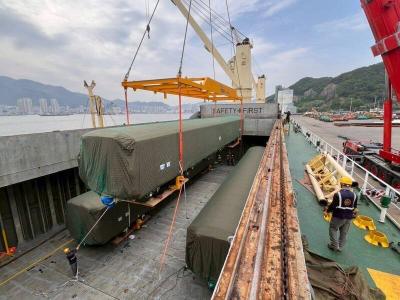
The first of 10 new high-capacity trains purchased from South Korea’s Hyundai Rotem arrived at the Port of Taipei yesterday to meet the demands of an expanding metro network, Taipei Rapid Transit Corp (TRTC) said yesterday. The train completed a three-day, 1,200km voyage from the Port of Masan in South Korea, the company said. Costing NT$590 million (US$18.79 million) each, the new six-carriage trains feature a redesigned interior based on "human-centric" transportation concepts, TRTC said. The design utilizes continuous longitudinal seating to widen the aisles and optimize passenger flow, while also upgrading passenger information displays and driving control systems for a more comfortable
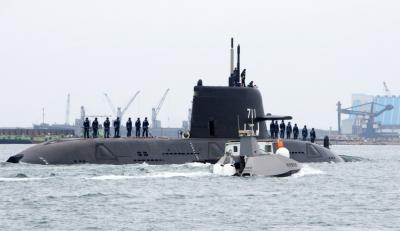
Taiwan's first indigenous defense submarine, the SS-711 Hai Kun (海鯤, or Narwhal), departed for its 13th sea trial at 7am today, marking its seventh submerged test, with delivery to the navy scheduled for July. The outing also marked its first sea deployment since President William Lai (賴清德) boarded the submarine for an inspection on March 19, drawing a crowd of military enthusiasts who gathered to show support. The submarine this morning departed port accompanied by CSBC Corp’s Endeavor Manta (奮進魔鬼魚號) uncrewed surface vessel and a navy M109 assault boat. Amid public interest in key milestones such as torpedo-launching operations and overnight submerged trials,
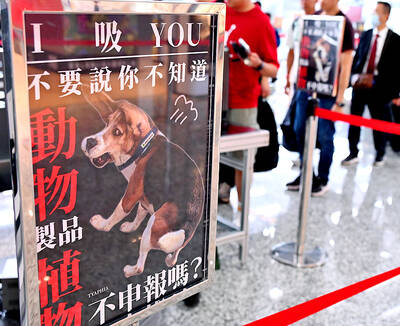
Quarantine awareness posters at Taiwan Taoyuan International Airport have gone viral for their use of wordplay. Issued by the airport branch of the Animal and Plant Health Inspection Agency, the posters feature sniffer dogs making a range of facial expressions, paired with advisory messages built around homophones. “We update the messages for holidays and campaign needs, periodically refreshing materials to attract people’s attention,” quarantine officials said. “The aim is to use the dogs’ appeal to draw focus to quarantine regulations.” A Japanese traveler visiting Taiwan has posted a photo on X of a poster showing a quarantine dog with a

Taiwan’s coffee community has launched a “one-person-one-e-mail” campaign, calling for people to send a protest-e-mail to the World Coffee Championships (WCC) urging it to redesignate Taiwanese competitors as from “Taiwan,” rather than “Chinese Taipei.” The call followed sudden action last week after the WCC changed all references to Taiwanese competitors from “Taiwan” to “Chinese Taipei,” including recent World Latte Art champion Bala (林紹興), who won the World Latte Art Championship in San Diego earlier this month. When Bala received the trophy, he was referred to as representing Taiwan, as well as in the announcement on the WCC’s Web site, until it


 RSS
RSS