


Cross-strait relations and the Act Governing the Handling of Ill-gotten Properties by Political Parties and Their Affiliate Organizations (政黨及其附隨組織不當取得財產處理條例) were the central topics in a meeting between Chinese Nationalist Party (KMT) Chairwoman Hung Hsiu-chu (洪秀住) and American Institute in Taipei (AIT) Chairman James Moriarty yesterday.
Hung said that stability in the Taiwan Strait was paramount to the stability in the region, a goal that is in line with US interests, adding that the KMT does not wish to see a continued deterioration of cross-strait relations because of President Tsai Ing-wen’s (蔡英文) administration’s ideologies.
“We are not pursuing Taiwanese independence, and we believe the US would not favor such developments,” Hung said, adding that Taiwanese also want China to understand their expectation of participation in international organizations.
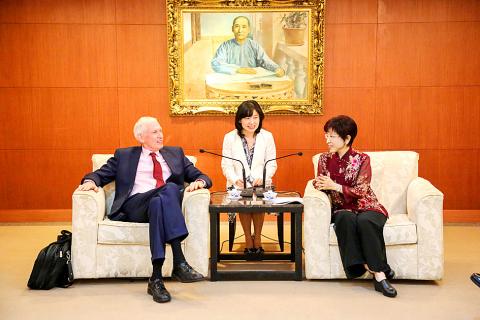
Photo courtesy of the Chinese Nationalist Party (KMT)
Hung said that Taiwan fears militaristic threats from China and that only by removing such threats can there be a positive interaction across the strait, adding that continued deterioration of relations across the Strait would cause potential problems for the economy and politics.
The KMT’s newest “peace policy” states that it would continue to deepen the so-called “1992 consensus” provided it is in line with the Republic of China (ROC) Constitution, Hung said.
The “1992 consensus,” a term former Mainland Affairs Council chairman Su Chi (蘇起) admitted making up in 2000, refers to a supposed tacit understanding between the KMT and the Chinese government that both sides of the Strait acknowledge there is “one China,” with each side having its own interpretation of what “China” means.
“We would actively look into the possibility of terminating hostile relations between Taipei and Beijing, as well as formulating a system on which cross-strait peace could be pursued,” Hung told Moriarty.
The Tsai administration’s actions, such as nominating rand Justices who are inclined toward Taiwanese independence, is a cause for concern, as it might incite hatred and cause another Taiwan Strait crisis, Hung said, adding that she found it difficult to see how such grand justices could defend the Republic of China (ROC) Constitution in non-partisan Constitutional Interpretations.
Hung also said that the Democratic Progressive Party (DPP) government’s Ill-gotten Party Assets Settlement Committee has gone against the basic principles of the rule of law, by retroactive application of laws and a presumption of guilt.
The DPP is attempting to destroy the KMT, the same way Nazis outlawed other parties in Germany in 1933, she said.

Taiwanese can file complaints with the Tourism Administration to report travel agencies if their activities caused termination of a person’s citizenship, Mainland Affairs Council Minister Chiu Chui-cheng (邱垂正) said yesterday, after a podcaster highlighted a case in which a person’s citizenship was canceled for receiving a single-use Chinese passport to enter Russia. The council is aware of incidents in which people who signed up through Chinese travel agencies for tours of Russia were told they could obtain Russian visas and fast-track border clearance, Chiu told reporters on the sidelines of an event in Taipei. However, the travel agencies actually applied
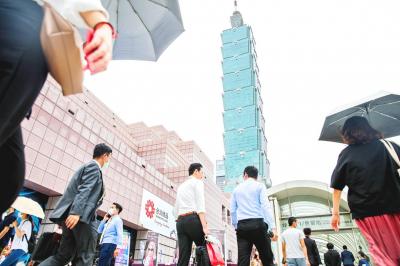
Japanese footwear brand Onitsuka Tiger today issued a public apology and said it has suspended an employee amid allegations that the staff member discriminated against a Vietnamese customer at its Taipei 101 store. Posting on the social media platform Threads yesterday, a user said that an employee at the store said that “those shoes are very expensive” when her friend, who is a migrant worker from Vietnam, asked for assistance. The employee then ignored her until she asked again, to which she replied: "We don't have a size 37." The post had amassed nearly 26,000 likes and 916 comments as of this

New measures aimed at making Taiwan more attractive to foreign professionals came into effect this month, the National Development Council said yesterday. Among the changes, international students at Taiwanese universities would be able to work in Taiwan without a work permit in the two years after they graduate, explainer materials provided by the council said. In addition, foreign nationals who graduated from one of the world’s top 200 universities within the past five years can also apply for a two-year open work permit. Previously, those graduates would have needed to apply for a work permit using point-based criteria or have a Taiwanese company
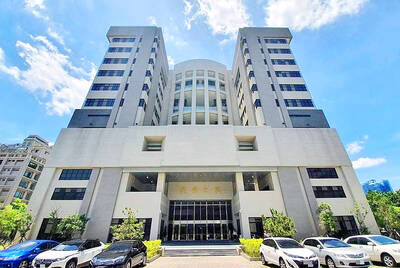
The Shilin District Prosecutors’ Office yesterday indicted two Taiwanese and issued a wanted notice for Pete Liu (劉作虎), founder of Shenzhen-based smartphone manufacturer OnePlus Technology Co (萬普拉斯科技), for allegedly contravening the Act Governing Relations Between the People of the Taiwan Area and the Mainland Area (臺灣地區與大陸地區人民關係條例) by poaching 70 engineers in Taiwan. Liu allegedly traveled to Taiwan at the end of 2014 and met with a Taiwanese man surnamed Lin (林) to discuss establishing a mobile software research and development (R&D) team in Taiwan, prosecutors said. Without approval from the government, Lin, following Liu’s instructions, recruited more than 70 software


 RSS
RSS