


A row over an amendment to the Labor Standards Act (勞動基準法) concerning the five-day workweek continued in the Legislative Yuan’s general assembly meeting yesterday, with the Chinese Nationalist Party (KMT) caucus refusing to engage in cross-caucus negotiations and occupying the speaker’s podium.
After scuffles in the committee in the past two days, Legislative Speaker Su Jia-chyuan (蘇嘉全) called for a cross-caucus negotiation yesterday morning, which the KMT caucus snubbed, saying that a negotiation should have been called when opposition lawmakers demanded that the Social Welfare and Environmental Hygiene Committee amendment review meeting on Oct. 5 be invalidated.
KMT Legislator Johnny Chiang (江啟臣) said that the negotiation was only called because “someone had shed tears.”
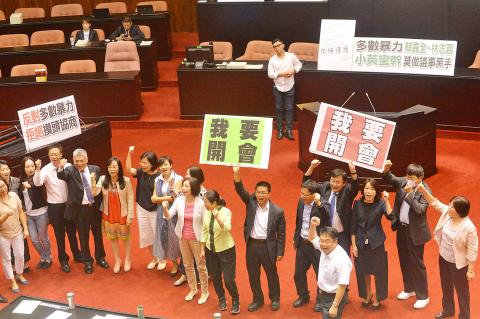
Photo: CNA
He was referring to New Power Party (NPP) Executive Chairman Huang Kuo-chang’s (黃國昌) tears during Thursday’s committee meeting where a physical fight broke out among lawmakers and Huang accused the Democratic Progressive Party (DPP) of betraying its legislative reform promises.
Huang, denying he cried, said that Chiang’s comment was “low,” adding that he could not imagine that Chiang was a former university professor.
The KMT caucus also accused Su of being biased in negotiations.
Su said the cross-caucus negotiations, which have never before been publicized, have been open to the public — with recordings and documented transcripts — since his speakership.
“I believe it could be publicly examined and weighed by the public whether I have been biased in these negotiations,” Su said.
He said that while caucuses have different views on amendments, which is not unusual, “opposition should be handled by following legislative procedure” rather than occupying the speaker’s podium.
Su was reacting to yesterday morning’s occupation of the podium by more than a dozen KMT lawmakers in the general assembly chamber.
They held up banners and shouted: “The KMT will not bow to the DPP’s fists,” “[We are] against tyranny of the majority and refuse condescending negotiations” and “The meeting is invalid and the review [should be] redone.”
DPP lawmakers shouted back, demanding a proper floor meeting, with some tearing up the KMT’s banners.
Huang on Thursday said that the “[legislative] institution has been disrupted” and accused the DPP caucus of failing to respect due procedure.
Su said that committee procedures have not been disrupted, but “it is people who have been disruptive.”
“Is there a regulation that sanctions the occupation of the podium?” Huang asked, adding that “committee-centered” legislative operation means that “disputes in committees have to be resolved within the committees and among caucuses through talks” and “without the speaker’s intervention.”
The floor chamber had been nearly empty with few lawmakers and the KMT’s banners left on the podium after the exchange in the morning.
The meeting ended at 6pm.

Taiwanese can file complaints with the Tourism Administration to report travel agencies if their activities caused termination of a person’s citizenship, Mainland Affairs Council Minister Chiu Chui-cheng (邱垂正) said yesterday, after a podcaster highlighted a case in which a person’s citizenship was canceled for receiving a single-use Chinese passport to enter Russia. The council is aware of incidents in which people who signed up through Chinese travel agencies for tours of Russia were told they could obtain Russian visas and fast-track border clearance, Chiu told reporters on the sidelines of an event in Taipei. However, the travel agencies actually applied
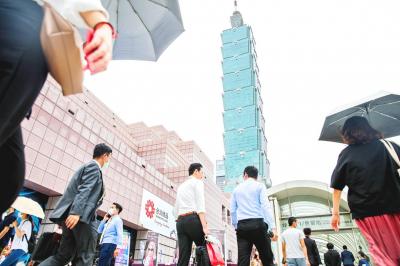
Japanese footwear brand Onitsuka Tiger today issued a public apology and said it has suspended an employee amid allegations that the staff member discriminated against a Vietnamese customer at its Taipei 101 store. Posting on the social media platform Threads yesterday, a user said that an employee at the store said that “those shoes are very expensive” when her friend, who is a migrant worker from Vietnam, asked for assistance. The employee then ignored her until she asked again, to which she replied: "We don't have a size 37." The post had amassed nearly 26,000 likes and 916 comments as of this

New measures aimed at making Taiwan more attractive to foreign professionals came into effect this month, the National Development Council said yesterday. Among the changes, international students at Taiwanese universities would be able to work in Taiwan without a work permit in the two years after they graduate, explainer materials provided by the council said. In addition, foreign nationals who graduated from one of the world’s top 200 universities within the past five years can also apply for a two-year open work permit. Previously, those graduates would have needed to apply for a work permit using point-based criteria or have a Taiwanese company
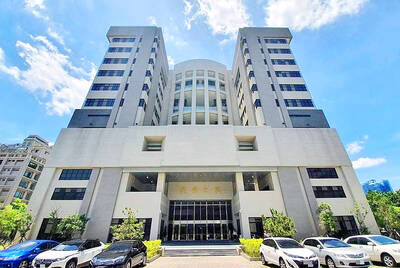
The Shilin District Prosecutors’ Office yesterday indicted two Taiwanese and issued a wanted notice for Pete Liu (劉作虎), founder of Shenzhen-based smartphone manufacturer OnePlus Technology Co (萬普拉斯科技), for allegedly contravening the Act Governing Relations Between the People of the Taiwan Area and the Mainland Area (臺灣地區與大陸地區人民關係條例) by poaching 70 engineers in Taiwan. Liu allegedly traveled to Taiwan at the end of 2014 and met with a Taiwanese man surnamed Lin (林) to discuss establishing a mobile software research and development (R&D) team in Taiwan, prosecutors said. Without approval from the government, Lin, following Liu’s instructions, recruited more than 70 software


 RSS
RSS