


Society has not done enough to hold the perpetrators of the 228 Massacre responsible for their behavior, Taipei Mayor Ko Wen-je (柯文哲) said yesterday during his speech at the launch of the 228 Incident and International Human Rights Exhibition in Taipei, urging perpetrators to demonstrate restraint to avoid deepening the agony they have caused to families of the victims.
Referring to the Chinese Nationalist Party (KMT) regime before its defeat in the Chinese Civil War as “China” throughout his speech, Ko said Taiwanese were jubilant when it was announced that they were to reunite with “China” after World War II.
However, because of the rampant corruption among Republic of China officials and a lack of discipline among the troops dispatched to Taiwan, the public was disillusioned, which gave rise to a string of conflicts between the masses and the government, Ko said, adding that this was the historical context of the 228 Massacre.
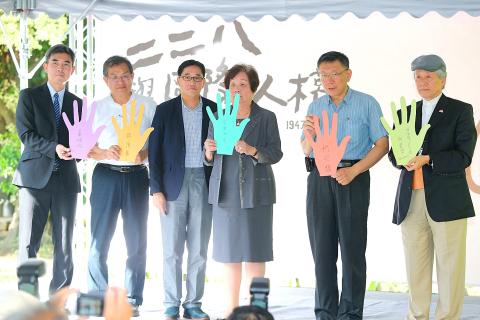
Photo: CNA
Ko said that a conundrum facing the 228 Incident and all efforts to promote transitional justice is that all the attention has been focused on to the victims, while the victimizers remain hidden.
“Maybe it was because of Taiwanese’ forgiving nature, we have not been very enthusiastic about holding the perpetrators responsible. Hence, there has been a strange phenomenon in which no condemnations have been made of the perpetrators. To this day, there is a lack of consensus on who the perpetrators were,” he said.
“The actual death toll [in the 228 Massacre] remains unclear,” he said.
Referring to his grandfather, Ko Shih-yuan (柯世元), who died from injuries sustained during beatings by KMT authorities, Ko said: “As a family member of a victim, we have, to a large extent, shown humility not because we are weak, but because of the confidence we have demonstrated by being strong.”
“We are willing to forgive the perpetrators, but we would like to ask them to show restraint,” Ko said.
Referencing criticism former KMT chairman Lien Chan’s (連戰) leveled against him — when Lien called him an “imperial subject” of the Japanese emperor — Ko said such remarks only served to agonize his father, who was an elementary-school teacher and a public servant during the Japanese colonial era.
Ko said he grew up in a time when it was yet another ruler from outside Taiwan that dominated the nation.
“When I was little, I used to praise the Three Principles of the People and [former] president Chiang Ching-kuo (蔣經國). When I took the joint college entrance examination, the Three Principles of the People was a subject that was assigned the same weighting as English and mathematics,” he said.
However, Ko said that as he grew older, he “cringed” at the sight on national television of civilians made to wear funeral clothes and mourn the death of Chiang outside his mausoleum.
“I often say that victimizers need to show restraint, because some of their actions not only made people cringe, but also irritate them,” he said.
Citing the 228 Massacre, China’s Tiananmen Square Massacre and South Korea’s Gwangju Uprising as examples, Ko said that a nation’s development can be gauged by how it deals with the aftermath of brutal crackdowns perpetrated by the authorities.
The exhibition is a means through which Taiwanese can review a time in the nation’s history, he said.
“We do not aim to incite hatred, but to make facts clearer. Hopefully, in this process we will learn to show more tolerance toward one another, so that we can strive for a common future,” he said.

FUKUOKA SITUATION: Japanese media reported that the pathogen is expected to be identified by the summer, while the CDC downplayed the idea that it was hMPV A “mysterious cold-like illness” reported in Japan’s Fukuoka Prefecture does not seem to be a new disease, but Japanese authorities have been asked about the situation, the Centers for Disease Control (CDC) said yesterday. The Fukuoka Prefectural Medical Association on Wednesday told a news conference that a “mystery cold” that has become a hot topic on social media is “highly likely to be caused by some kind of viral infection,” Japan’s KBC News reported. “Many people are experiencing symptoms starting with a sore throat, followed by a runny nose, phlegm and a severe cough,” KBC News reported, citing association officials. Health authorities are

Nvidia Corp CEO Jensen Huang (黃仁勳) arrived in Taiwan yesterday ahead of upcoming AI and technology events, saying he plans to meet with clients and Taiwan Semiconductor Manufacturing Co Chairman C.C. Wei (魏哲家) during his visit. After landing at Taipei Songshan Airport, Huang posed for photos with fans and handed out Yakult drinks to reporters and supporters waiting at the scene, saying he has “a lot to do” during the trip. Asked about reports that Nvidia’s planned headquarters site in Taipei’s Beitou Shilin Technology Park could break ground on May 27, Huang said that if the company holds an event, he would

The Ministry of Finance this afternoon announced the winning numbers for the March-April uniform invoice lottery. The winning number for the NT$10 million (US$318,060) special prize is 19531471, and the winning number for the NT$2 million grand prize is 85941329. Three numbers were drawn for the NT$200,000 first prize: 07225810, 20231230 and 83518781. Those with receipts matching the last seven digits of any of the first-prize numbers will win the NT$40,000 second prize, while those matching the last six digits will win the NT$10,000 third prize. Those whose receipts match the last five digits of the first-prize numbers can claim the NT$4,000 fourth prize,
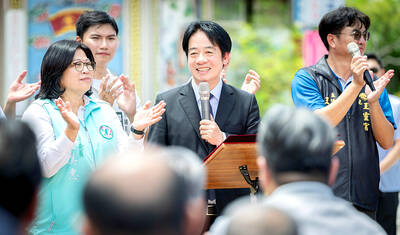
SIX SUBSIDIES: The monthly allowance for older farmers is to increase to NT$10,000, and NT$5,000 is to be given to homemakers under the national pension system, Lai said The government is to implement major welfare policies for disadvantaged groups, including raising the monthly allowance for older farmers to NT$10,000 and providing homemakers with NT$5,000 per month, President William Lai (賴清德) said yesterday. Lai made the remarks during a visit to Wangling Temple in Chiayi County, saying that the planned increases were being introduced amid economic growth and an increase in tax revenue. Touting a policy, in which the government plans to provide a monthly allowance of NT$5,000 for every child under the age of 18 in a bid to address Taiwan’s low birthrate, Lai said that if received for the


 RSS
RSS