


President Tsai Ing-wen’s (蔡英文) “historical fact of the 1992 meeting” model has failed to provide a “script that could endure examination” and resolve the cross-strait stalemate, Chinese Nationalist Party (KMT) Legislator Wang Jin-pyng (王金平), the former legislative speaker, said yesterday.
Tsai has since her inauguration avoided mentioning the so-called “1992 consensus,” instead referring to a “1992 meeting,” which she said is an undeniable “historical fact.”
Wang said there is a “serious lack of mutual trust” between the Democratic Progressive Party (DPP) and the Chinese Communist Party, as each holds its own unalienable core interests that have turned into “red lines” that cannot be contradicted by the other side.
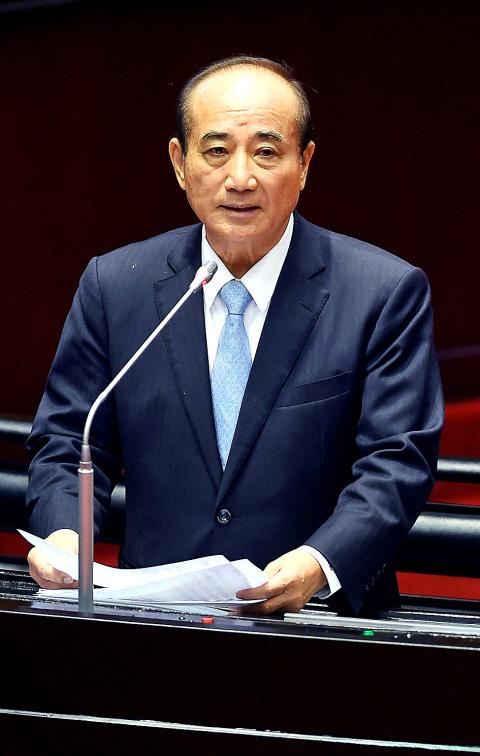
Photo: Chu Pei-hsung, Taipei Times
“Taiwan’s cross-strait strategic planning will find the most advantageous way out of this limited space. It is a titanic political project and as the DPP has become the ruling party, it should not shun its responsibility to solve the predicament,” he said.
Wang said that while different ruling parties in Taiwan could “draw their own subjective red lines, what matters most is how much objective strength they own to stand fast to keep the red lines.”
The government should not rely on non-establishment experts, but should use the nation’s institutional resources, he said.
“Vague strategy would not give us a way out of the quandary we are in. Tsai proposed a ‘1992 historical fact’ to differentiate herself from former president Ma Ying-jeou’s (馬英九) ‘1992 consensus’ and ‘one China, different interpretations’ framework, but without comprehensive strategic planning, she has failed to substantiate her view, let alone solve the cross-strait impasse,” Wang said.
He said that Taiwan cannot expect the US and Japan to solve the issue of Taiwan’s international participation.
“Under the administration’s policy that takes a more US and Japan-friendly stance, while keeping its distance from China, Taiwan can no longer negotiate with Beijing, and the government should let the public know the price they have to pay,” he said.
Wang also lashed out at the Ministry of Foreign Affairs’ decision to reduce the number of diplomatic missions.
“It is an incredible policy. When it is likely that Taiwan will face more difficult international challenges, the ministry decides to do away with some overseas offices, which amount to tearing down protective walls with our own hands,” he said.
Wang also called on DPP lawmakers to join the KMT caucus to file a request in the legislature for a constitutional interpretation of the Act Governing the Handling of Ill-gotten Properties by Political Parties and Their Affiliate Organizations (政黨及其附隨組織不當取得財產處理條例), which he said is legally and constitutionally problematic.
For sake of political harmony and to ensure the act’s legitimacy, the DPP should file the request with the KMT, which would then have no reason to protest the handling of its assets.
A request for a constitutional interpretation requires the signatures of the one-third, or 38, of the legislators.
The KMT has only 35 seats and needs to form an alliance with lawmakers from other parties to reach the threshold.

The military has spotted two Chinese warships operating in waters near Penghu County in the Taiwan Strait and sent its own naval and air forces to monitor the vessels, the Ministry of National Defense (MND) said. Beijing sends warships and warplanes into the waters and skies around Taiwan on an almost daily basis, drawing condemnation from Taipei. While the ministry offers daily updates on the locations of Chinese military aircraft, it only rarely gives details of where Chinese warships are operating, generally only when it detects aircraft carriers, as happened last week. A Chinese destroyer and a frigate entered waters to the southwest

A magnitude 6.1 earthquake struck off the coast of Yilan County at 8:39pm tonight, the Central Weather Administration (CWA) said, with no immediate reports of damage or injuries. The epicenter was 38.7km east-northeast of Yilan County Hall at a focal depth of 98.3km, the CWA’s Seismological Center said. The quake’s maximum intensity, which gauges the actual physical effect of a seismic event, was a level 4 on Taiwan’s 7-tier intensity scale, the center said. That intensity level was recorded in Yilan County’s Nanao Township (南澳), Hsinchu County’s Guansi Township (關西), Nantou County’s Hehuanshan (合歡山) and Hualien County’s Yanliao (鹽寮). An intensity of 3 was
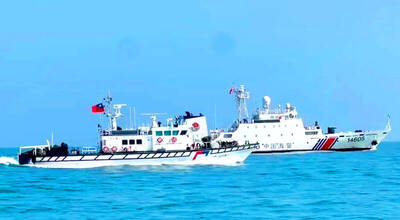
Instead of focusing solely on the threat of a full-scale military invasion, the US and its allies must prepare for a potential Chinese “quarantine” of Taiwan enforced through customs inspections, Stanford University Hoover fellow Eyck Freymann said in a Foreign Affairs article published on Wednesday. China could use various “gray zone” tactics in “reconfiguring the regional and ultimately the global economic order without a war,” said Freymann, who is also a nonresident research fellow at the US Naval War College. China might seize control of Taiwan’s links to the outside world by requiring all flights and ships entering or leaving Taiwan
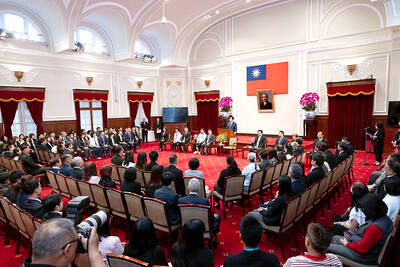
The next minimum wage hike is expected to exceed NT$30,000, President William Lai (賴清德) said yesterday during an award ceremony honoring “model workers,” including migrant workers, at the Presidential Office ahead of Workers’ Day today. Lai said he wished to thank the awardees on behalf of the nation and extend his most sincere respect for their hard work, on which Taiwan’s prosperity has been built. Lai specifically thanked 10 migrant workers selected for the award, saying that although they left their home countries to further their own goals, their efforts have benefited Taiwan as well. The nation’s industrial sector and small businesses lay


 RSS
RSS