


Former vice president Wu Den-yih (吳敦義) yesterday warned against any “willful interpretations” of the “one China, different interpretations” framework, in a remark clearly aimed at Chinese Nationalist Party (KMT) Chairwoman Hung Hsiu-chu (洪秀柱).
The so-called “1992 consensus” and “one China, different interpretations” have played key roles in maintaining stable and peaceful cross-strait ties, and there is no room for “one China, willful interpretations,” Wu said in a speech to retired KMT members at the Sun Yat-sen Memorial Hall in Taipei.
His speech was titled “The party’s current situations and the direction of our efforts.”
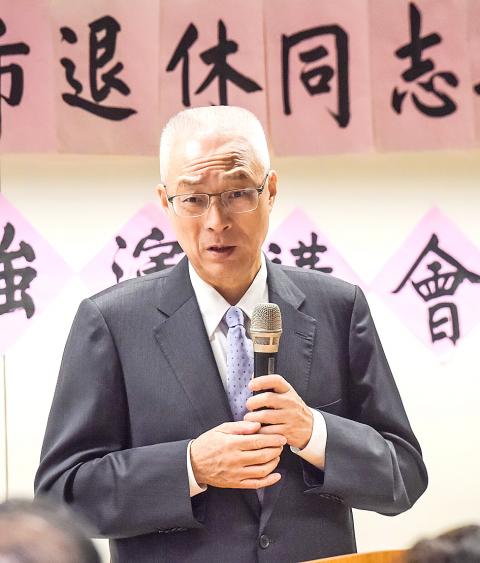
Photo: Huang Yao-cheng, Taipei Times
“During my term as premier, a local elected representative of the Democratic Progressive Party asked me why then-Association for Relations Across the Taiwan Straits chairman Chen Yunlin (陳雲林) did not honor the ‘one China, different interpretations’ policy and interpret ‘one China’ as the Republic of China when he visited Taiwan,” Wu said.
Wu said he replied that by that logic, Taiwanese visiting Beijing would have to interpret “one China” as the People’s Republic of China, which Wu said is not “one China, different interpretations,” but rather “one China, willful interpretations.”
The consensus reached during the 1992 cross-strait talks is that each side of the Taiwan Strait can have its own interpretation of what “China” means, Wu added.
The so-called “1992 consensus,” a term former Mainland Affairs Council chairman Su Chi (蘇起) said in 2006 that he had made up in 2000, refers to a tacit understanding between the KMT and the Chinese government that both sides acknowledge that there is “one China,” with each side having its own interpretation of what “China” means.
Wu and Hung have been engaged in a heated exchange of words over the KMT’s stance on the “1992 consensus.”
Many see the verbal sparring as presaging a Wu run for the KMT chairmanship next year.
Hung’s proposal to let the “one China, different interpretations” framework evolve into “one China, same interpretation” is seen as an attempt to bring the nation closer to unification with China.
Turning to the KMT’s landslide loss in the Jan. 16 presidential and legislative elections, Wu said President Tsai Ing-wen (蔡英文) was only able to win the support of moderate voters by vowing to maintain the cross-strait “status quo” and because of some relatively radical views that Hung had espoused last year when she was the KMT’s presidential candidate, views that led to her being replaced by New Taipei City Mayor and then-KMT chairman Eric Chu (朱立倫) as the party’s candidate.
Calling for unity, Wu said that the KMT would only stand a chance of regaining public support in future elections if it is an opposition party guided by the right policies.

FUKUOKA SITUATION: Japanese media reported that the pathogen is expected to be identified by the summer, while the CDC downplayed the idea that it was hMPV A “mysterious cold-like illness” reported in Japan’s Fukuoka Prefecture does not seem to be a new disease, but Japanese authorities have been asked about the situation, the Centers for Disease Control (CDC) said yesterday. The Fukuoka Prefectural Medical Association on Wednesday told a news conference that a “mystery cold” that has become a hot topic on social media is “highly likely to be caused by some kind of viral infection,” Japan’s KBC News reported. “Many people are experiencing symptoms starting with a sore throat, followed by a runny nose, phlegm and a severe cough,” KBC News reported, citing association officials. Health authorities are

Nvidia Corp CEO Jensen Huang (黃仁勳) arrived in Taiwan yesterday ahead of upcoming AI and technology events, saying he plans to meet with clients and Taiwan Semiconductor Manufacturing Co Chairman C.C. Wei (魏哲家) during his visit. After landing at Taipei Songshan Airport, Huang posed for photos with fans and handed out Yakult drinks to reporters and supporters waiting at the scene, saying he has “a lot to do” during the trip. Asked about reports that Nvidia’s planned headquarters site in Taipei’s Beitou Shilin Technology Park could break ground on May 27, Huang said that if the company holds an event, he would

Carrefour Taiwan is to begin using a new name from the start of July, but it cannot divulge the name until then, the chairman of the supermarket chain's parent company said today. President Chain Store Co chairman Lo Chih-hsien (羅智先) was asked by reporters after a shareholders' meeting to confirm whether the company has settled on a new name for the supermarket brand. In March, the government-registered name of two Carrefour Taiwan branches was quietly changed to "Le Chia Kang" (樂家康) in Chinese, raising speculation that has been selected as the name. Lo said that because of local regulations and contractual obligations, the
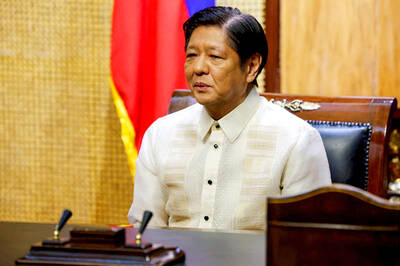
The Philippines would likely be involved in any conflict over Taiwan due to its proximity to the democracy claimed by China, President Ferdinand Marcos Jr said, reiterating a stance that risks angering Beijing. “In the Philippines, we do not have a choice because Taiwan is so close to the Philippines and we have almost 200,000 Filipino nationals living and working in Taiwan,” Marcos said in an interview with Japanese media in Manila on Monday. The Philippine leader’s comments come ahead of a state visit to Japan next week, where he is to meet with Japanese Prime Minister Sanae Takaichi to discuss security


 RSS
RSS