


The Executive Yuan should overrule the Ministry of Economic Affairs and force a policy-oriented environmental review of the nation’s mining and concrete industry, residents of rural communities said yesterday at a protest in front of the Executive Yuan in Taipei.
More than 50 protesters mobilized by Citizens of the Earth gathered in front of the Executive Yuan, waving banners accusing the government of acting as a “stooge” to corporate “tigers” and calling for a comprehensive environmental review of the industry as part of broader reforms.
“Under the current system, the state of the mining and concrete industry is unclear, including environmental costs and risks,” Citizens of the Earth researcher Pan Cheng-cheng (潘正正) said, adding that only 15 percent of Taiwan’s mines have ever been subject to an administrative review, because they were licensed prior to the implementation of the Environmental Impact Assessment Act (環境影響評估法) in 1995.
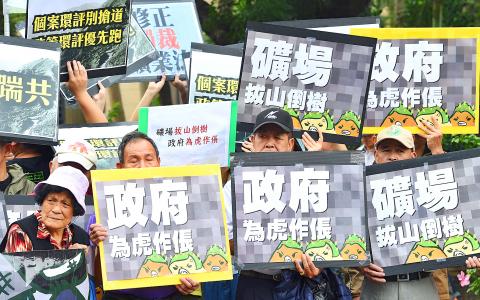
Photo: Liu Hsin-de, Taipei Times
She was critical of the ministry’s rejection of Environment Protection Administration calls for a policy-oriented environmental review of the nation’s mining industry, raising the prospect of the initiative being halted.
Any environmental review would require data provided by the ministry’s Bureau of Mines, she said, criticizing the ministry’s stance that an industry-wide environmental review is unnecessary due to existing production controls.
“Their limit has not made any difference, because it is between 20 percent and 30 percent greater than current concrete production,” she said, adding that there was room for an output reduction by cutting concrete exports, which comprise roughly 20 percent of production.
An environmental review could help determine how much concrete the nation needs given mining risks, while enabling the targeting of some older facilities and more dangerous mines for closure, she said.
“All that we have asked for is basic procedural justice,” she said, adding that failure to take even the “first step” toward reform would call into question the government’s promises to facilitate an industrial transition.
“To conduct a review does not imply that all cases will be blocked, but given a continually changing environment, how is it reasonable to allow mines to operate for up to 60 years without undergoing any environmental or developmental review?” Pan asked.
Citizens of the Earth researcher Wu Chi-jung (吳其融) said that regulations allow existing mines to receive license renewals indefinitely without undergoing environmental impact reviews.
Numerous residents from rural communities in Hsinchu, Yilan and Hualien counties expressed concern for their safety and anger that they had not been consulted about mining rights.
“Mining makes the mountain shake, which loosens stones and has caused a number of new streams to appear,” said a resident of Hualien’s Heping Village (和平), who asked to be identified by her Aboriginal name, Qung, adding that her Truku community was concerned that explosions from continued mining on a nearby mountain risked causing landslides.
“Earthquakes are already extremely common, and they’re shaking it further still,” she said, adding that the reason for the mining had never been explained to local residents.
Chen Ying-jung (陳盈蓉), head of the Executive Yuan’s Department of Transportation, Environment and Natural Resources, promised that the Cabinet would announce by the end of the year whether an industry-wide environmental review would be conducted.
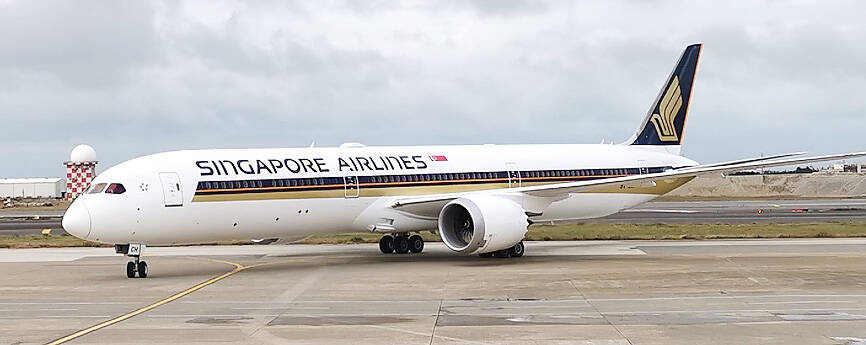
INCREASED CAPACITY: The flights on Mondays, Wednesdays, Fridays and Sundays would leave Singapore in the morning and Taipei in the afternoon Singapore Airlines is adding four supplementary flights to Taipei per week until May to meet increased tourist and business travel demand, the carrier said on Friday. The addition would raise the number of weekly flights it operates to Taipei to 18, Singapore Airlines Taiwan general manager Timothy Ouyang (歐陽漢源) said. The airline has recorded a steady rise in tourist and business travel to and from Taipei, and aims to provide more flexible travel arrangements for passengers, said Ouyang, who assumed the post in July last year. From now until Saturday next week, four additional flights would depart from Singapore on Monday, Wednesday, Friday
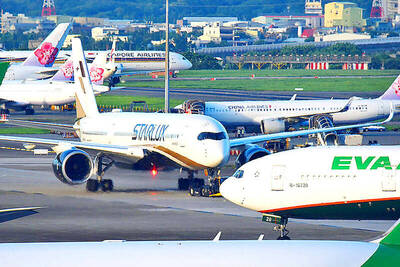
Taiwan’s three major international carriers are increasing booking fees, with EVA Airways having already increased the charge to US$28 per flight segment from US$25, while China Airlines (CAL) and Starlux Airlines are set to follow suit. Booking fees are charged by airlines through a global distribution system (GDS) and passed on to passengers. Carriers that apply the fees include CAL, EVA, Starlux and Tigerair Taiwan. A GDS is a computerized network operated by a company that connects airlines with travel agents and ticketing platforms, allowing reservations to be made and processed in real time. Major players include Amadeus, Sabre and Travelport. EVA Air began
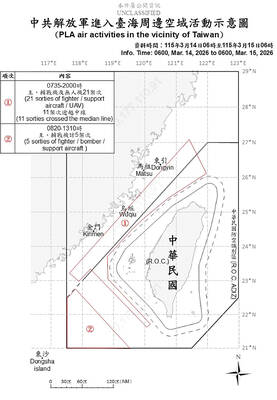
The Ministry of National Defense yesterday reported the return of large-scale Chinese air force activities after their unexplained absence for more than two weeks, which had prompted speculation regarding Beijing’s motives. China usually sends fighter jets, drones and other military aircraft around the nation on a daily basis. Interruptions to such routine are generally caused by bad weather. The Ministry of National Defense said it had detected 26 Chinese military aircraft in the Taiwan Strait over the previous 24 hours. It last reported that many aircraft on Feb. 25, when it spotted 30 aircraft, saying Beijing was carrying out another “joint combat
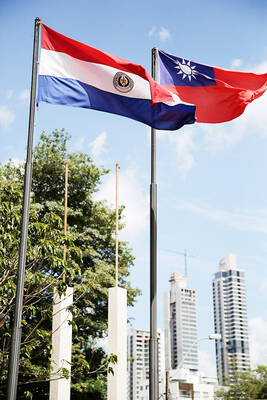
When Paraguayan opposition lawmaker Leidy Galeano returned from an all-expenses-paid tour of six Chinese cities late last year, she was convinced Paraguay risked missing out on major economic gains by sticking with longtime ally Taipei over Beijing — a message that participants on the trip heard repeatedly from Chinese officials. “Everything I saw there, I wanted for my country,” said Galeano, a member of the newly-formed Yo Creo party whose senior figures have spoken favorably about China. This trip and others like it — which people familiar with the visits said were at the invitation of the Chinese consulate in Sao Paulo


 RSS
RSS