


A joint crime-fighting agreement between Taiwan and China has not been used to its full potential since the Democratic Progressive Party took power in May, Minister of Justice Chiu Tai-san (邱太三) said yesterday.
Answering questions from lawmakers at a meeting of the Judiciary and Organic Laws and Statutes Committee, Chiu said that although investigations, information-sharing and regular paperwork processing have carried on as usual, there has been a lack of administrative personnel exchanges between the two sides, with neither party participating in visits — as stipulated by the agreement — since President Tsai Ing-wen (蔡英文) took office in May.
The Cross-Strait Joint Crime-Fighting and Judicial Mutual Assistance Agreement (海峽兩岸共同打擊犯罪及司法互助協議), signed in April 2009 under the previous Chinese Nationalist Party (KMT) administration, is aimed at bolstering cross-strait crime-fighting efforts.
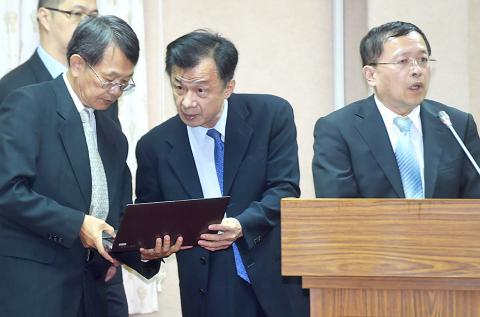
Photo: Chien Jung-fong, Taipei Times
Deputy Minister of Justice Chen Ming-tang (陳明堂) said that a workshop for cross-strait law enforcement officers that was to have taken place in June and July has been postponed indefinitely.
The delay has “something to do with” the condition of cross-strait relations, Chen said, adding that administrative contact between the two sides via telephone and fax remains normal.
Taiwan and China have jointly cracked 185 criminal cases and arrested 8,829 people since May 20, the ministry said.
However, KMT Legislator Jason Hsu (許毓仁) said that only nine of 198 Taiwanese telecommuncations fraud suspects deported to China from other countries have been allowed visits from family members.
Hsu asked whether the joint crime-fighting program was still viable and whether negotiations with China are still possible.
Chiu said that the program’s success depends on bilateral commitment and the nation remains in talks with China via telephone, although there have been no public meetings.
The nine suspects were allowed family visits because of the government’s efforts, Mainland Affairs Council (MAC) Deputy Minister Chang Tien-chin (張天欽) said, adding that visiting a suspect before a verdict is reached is prohibited in China.
The council would still negotiate with Beijing to protect the suspects’ rights, Chang said.
Democratic Progressive Party Legislator Chang Hung-lu (張宏陸) said that while former president Ma Ying-jeou’s (馬英九) administration recognized the so-called “1992 consensus,” Taiwanese suspects in a case in Kenya were still deported to China in April, adding that the problem is not about recognition of the “1992 consensus.”
Chang Tien-chin said that the cross-strait hotline is not working.
The “1992 consensus,” a term former Mainland Affairs Council chairman Su Chi (蘇起) admitted to making up in 2000, refers to a tacit understanding between the KMT and the Chinese government that both sides of the Taiwan Strait acknowledge there is “one China,” with each side having its own interpretation of what “China” means.

Considering that most countries issue more than five denominations of banknotes, the central bank has decided to redesign all five denominations, the bank said as it prepares for the first major overhaul of the banknotes in more than 24 years. Central bank Governor Yang Chin-lung (楊金龍) is expected to report to the Legislative Yuan today on the bank’s operations and the redesign’s progress. The bank in a report sent to the legislature ahead of today’s meeting said it had commissioned a survey on the public’s preferences. Survey results showed that NT$100 and NT$1,000 banknotes are the most commonly used, while NT$200 and NT$2,000

The Centers for Disease Control (CDC) yesterday reported the first case of a new COVID-19 subvariant — BA.3.2 — in a 10-year-old Singaporean girl who had a fever upon arrival in Taiwan and tested positive for the disease. The girl left Taiwan on March 20 and the case did not have a direct impact on the local community, it said. The WHO added the BA.3.2 strain to its list of Variants Under Monitoring in December last year, but this was the first imported case of the COVID-19 variant in Taiwan, CDC Deputy Director-General Lin Ming-cheng (林明誠) said. The girl arrived in Taiwan on

South Korea is planning to revise its controversial electronic arrival card, a step Taiwanese officials said prompted them to hold off on planned retaliatory measures, a South Korean media report said yesterday. A Yonhap News Agency report said that the South Korean Ministry of Foreign Affairs is planning to remove the “previous departure place” and “next destination” fields from its e-arrival card system. The plan, reached after interagency consultations, is under review and aims to simplify entry procedures and align the electronic form with the paper version, a South Korean ministry official said. The fields — which appeared only on the electronic form

The Ministry of Foreign Affairs (MOFA) is suspending retaliation measures against South Korea that were set to take effect tomorrow, after Seoul said it is updating its e-arrival system, MOFA said today. The measures were to be a new round of retaliation after Taiwan on March 1 changed South Korea's designation on government-issued alien resident certificates held by South Korean nationals to "South Korea” from the "Republic of Korea," the country’s official name. The move came after months of protests to Seoul over its listing of Taiwan as "China (Taiwan)" in dropdown menus on its new online immigration entry system. MOFA last week


 RSS
RSS