


Premier Lin Chuan (林全) yesterday touted the nation’s democracy in response to questions by New Power Party Legislator Freddy Lim (林昶佐) regarding the government’s plans for UN membership.
During a question-and-answer session at the Legislative Yuan’s general assembly, Lim asked whether a UN bid would make Taiwan a new member of the international body or reinstate the seat occupied by the former regime of Chiang Kai-shek (蔣介石).
“Are we to return to the UN as the legacy of Chiang’s authoritarian regime, or join the UN as a democracy with 23 million people?” Lim asked.
“The Republic of China [ROC] has elections according to a democratic system. Local autonomy laws are also in place. The nation has a system in line with modern democratic nations. I believe the ROC is a democratic country,” Lin said.
Lim said the nation has to participate in international organizations with the mandate of the 23 million Taiwanese.
The government should no longer rehash narratives inherited from Chiang’s regime, such as the so-called “U-shaped line” — also known as the “11-dash line” — or the nation would trap itself within Chiang’s legacy, Lim said.
According to UN Resolution 2758, it was “the representatives of Chiang Kai-shek” who were expelled from the UN, not the ROC or Taiwan, he said.
Minister of Foreign Affairs David Lee (李大維) said Lim spoke for the majority of Taiwanese and that the ROC is a sovereign nation, whose statehood is unambiguous from Taiwan’s perspective.
“However, amid current international circumstances, cross-strait relations and domestic concerns, we had better participate in [international organizations] in a pragmatic manner,” Lee said.
Meanwhile, Lim also urged the government to commemorate Taiwanese killed during World War II, as the nation does not have a monument or state-level memorial service for Taiwanese who served in the Imperial Japanese Army.
Taiwan Tower, a monument dedicated to Taiwanese who fought for Japan, was unveiled in Japan’s Okinawa Prefecture in June, but it was constructed without Taipei’s support, Lim said.
The nation has to preserve its history so it can explain it to the world, he said, adding that the nation should engage in “cultural diplomacy” in international politics.
The government should also consider the development of the cultural industry as a strategic goal, as Taiwan lags behind other nations in the region, Lim said.
While Japan’s manga and gaming industry accounts for 10 percent of its GDP and South Korea’s cultural industry had an average annual growth rate of 21.6 percent from 2005 to 2011, the Executive Yuan has only a 100-word policy report on the development of the cultural industry.
Lin said the Executive Yuan has formed a ministerial task force to expedite cultural policy implementation, while Lim said only the Ministry of Culture is actively involved in the task force, while other ministries do not consider cultural affairs a priority.
Minister of Culture Cheng Li-chiun (鄭麗君) said the nation does not have a comprehensive plan regarding commemorations, adding that the ministry would make improvements.

Chinese spouse and influencer Guan Guan’s (關關) residency permit has been revoked for repeatedly posting pro-China videos that threaten national security, the National Immigration Agency confirmed today. Guan Guan has said many controversial statements in her videos posted to Douyin (抖音), including “the red flag will soon be painted all over Taiwan” and “Taiwan is an inseparable part of China,” and expressing hope for expedited reunification. The agency last year received multiple reports alleging that Guan Guan had advocated for armed reunification. After verifying the reports, the agency last month issued a notice requiring her to appear and explain her actions. Guan

The Kaohsiung Tourism Bureau audited six hotels in an effort to prevent price gouging ahead of Korean band BTS’ concert tour in the city scheduled for Nov. 19, 21 and 22 this year. The bureau on Friday said that the audits — conducted in response to allegations of unfair pricing posted on social media — found no wrongdoing. These establishments included the local branches of Chateau de Chine, Hotel Nikko, My Humble House, and Grand Hai Lai, it said, adding that the Consumer Protection Commission would have penalized price gougers had the accusations been substantiated. The bureau said the Tourism Development Act

GIVE AND TAKE: Blood demand continues to rise each year, while fewer young donors are available due to the nation’s falling birthrate, a doctor said Blood donors can redeem points earned from donations to obtain limited edition Formosan black bear travel mugs, the Kaohsiung Blood Center said yesterday, as it announced a goal of stocking 20,000 units of blood prior to the Lunar New Year. The last month of the lunar year is National Blood Donation Month, when local centers seek to stockpile blood for use during the Lunar New Year holiday. The blood demand in southern Taiwan — including Tainan and Kaohsiung, as well as Chiayi, Pingtung, Penghu and Taitung counties — is about 2,000 units per day, the center said. The donation campaign aims to boost
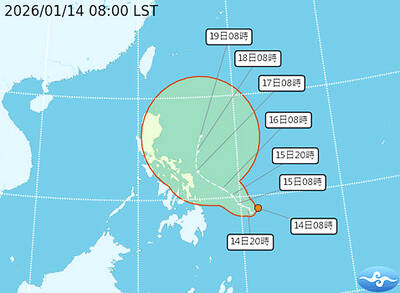
BACK TO WINTER: A strong continental cold air mass would move south on Tuesday next week, bringing colder temperatures to northern and central Taiwan A tropical depression east of the Philippines could soon be upgraded to be the first tropical storm of this year, the Central Weather Administration (CWA) said yesterday, adding that the next cold air mass is forecast to arrive on Monday next week. CWA forecaster Cheng Jie-ren (鄭傑仁) said the first tropical depression of this year is over waters east of the Philippines, about 1,867km southeast of Oluanpi (鵝鑾鼻), and could strengthen into Tropical Storm Nokaen by early today. The system is moving slowly from northwest to north, and is expected to remain east of the Philippines with little chance of affecting Taiwan,


 RSS
RSS