


When asked about labor rights and labor care in Taiwan, many people think of the wave of labor movements that followed the lifting of martial law and the recently resurfaced awareness of labor rights after the Democratic Progressive Party assumed office, but few remember that the labor rights movement in Taiwan started under Chiang Wei-shui (蔣渭水), who led farmers and workers to demand their rights during the Japanese colonial era.
The National Taiwan Library and the Chiang Wei-shui Cultural Foundation are this year holding an exhibition on the 85th anniversary of Chiang’s passing featuring 15 oil paintings by Chiang, as well as other historical documents and materials related to Chiang provided by the library.
According to Taiwanese history professor Chen Shih-jung (陳世榮), Law No. 63 of the Japanese government during its colonial rule gave the Japanese governor the authority to issue orders that would be equivalent to laws, which would later being sent to the Imperial Diet for ratification.
Not only was the law controversial in Japan, as some said it might be unconstitutional under the Constitution of the Empire of Japan, it essentially placed Taiwanese under Japanese rule on a social strata inferior to Japanese, Chen said, adding that Chiang stood up for the rights of Taiwanese.
Chiang founded the Taiwanese People Party in 1927, a nationalist movement based on restoring the rights of industrial and agricultural workers with the goal of achieving “political freedom, liberty of economy and equality of social status.”
In 1928, Chiang founded the Union of Taiwanese Laborers to try to help local workers form their own unions and self-help organizations, calling on Japan to pay Taiwanese workers the same wages as their Japanese counterparts, Chen said, adding that the union’s ultimate goal was to raise wages to meet minimum social standards.
With the support of the union, workers at the predecessors of what are now Tang Eng Iron Works and Taiwan Cement staged strikes against their Japanese employers, Chen said.
The union fostered many supporters of labor rights, said Chiang Chao-ken (蔣朝根), the foundation’s chief executive and Chiang Wei-shui’s grandson, adding that many officials of the Chinese Federation of Labor, established by the Chinese Nationalist Party (KMT) government after it relocated to Taiwan, were members of the union.
Chiang Wei-shui founded the Taiwan People’s Daily newspaper to promote workers’ rights, Chiang Chao-ken said, adding that as many laborers in Japan-ruled Taiwan were uneducated, he also founded several “news-reading groups,” where an appointed individual would read the newspaper out loud for others.
Chiang Wei-shui’s actions earned him a place on the blacklist of the Japanese governor, who placed him under surveillance and had supporters throw mud at Chiang Wei-shui, who deemed the taint “a glorious badge,” Chiang Chao-ken said.

Taiwan has received more than US$70 million in royalties as of the end of last year from developing the F-16V jet as countries worldwide purchase or upgrade to this popular model, government and military officials said on Saturday. Taiwan funded the development of the F-16V jet and ended up the sole investor as other countries withdrew from the program. Now the F-16V is increasingly popular and countries must pay Taiwan a percentage in royalties when they purchase new F-16V aircraft or upgrade older F-16 models. The next five years are expected to be the peak for these royalties, with Taiwan potentially earning
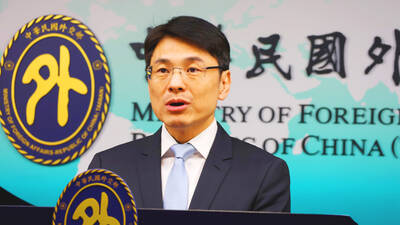
STAY IN YOUR LANE: As the US and Israel attack Iran, the ministry has warned China not to overstep by including Taiwanese citizens in its evacuation orders The Ministry of Foreign Affairs (MOFA) yesterday rebuked a statement by China’s embassy in Israel that it would evacuate Taiwanese holders of Chinese travel documents from Israel amid the latter’s escalating conflict with Iran. Tensions have risen across the Middle East in the wake of US and Israeli airstrikes on Iran beginning Saturday. China subsequently issued an evacuation notice for its citizens. In a news release, the Chinese embassy in Israel said holders of “Taiwan compatriot permits (台胞證)” issued to Taiwanese nationals by Chinese authorities for travel to China — could register for evacuation to Egypt. In Taipei, the ministry yesterday said Taiwan
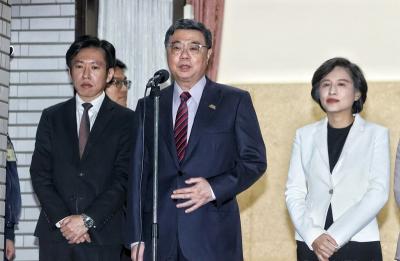
Taiwan is awaiting official notification from the US regarding the status of the Agreement on Reciprocal Trade (ART) after the US Supreme Court ruled US President Donald Trump's global tariffs unconstitutional. Speaking to reporters before a legislative hearing today, Premier Cho Jung-tai (卓榮泰) said that Taiwan's negotiation team remains focused on ensuring that the bilateral trade deal remains intact despite the legal challenge to Trump's tariff policy. "The US has pledged to notify its trade partners once the subsequent administrative and legal processes are finalized, and that certainly includes Taiwan," Cho said when asked about opposition parties’ doubts that the ART was
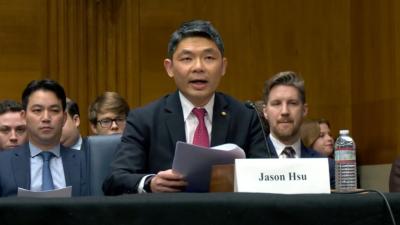
If China chose to invade Taiwan tomorrow, it would only have to sever three undersea fiber-optic cable clusters to cause a data blackout, Jason Hsu (許毓仁), a senior fellow at the Hudson Institute and former Chinese Nationalist Party (KMT) legislator, told a US security panel yesterday. In a Taiwan contingency, cable disruption would be one of the earliest preinvasion actions and the signal that escalation had begun, he said, adding that Taiwan’s current cable repair capabilities are insufficient. The US-China Economic and Security Review Commission (USCC) yesterday held a hearing on US-China Competition Under the Sea, with Hsu speaking on


 RSS
RSS