


The government’s plan to open up mutual funds to Chinese investment amounts to “smuggling through” the cross-strait service trade agreement — which formed the focus of the 2014 Sunflower movement — without legislative approval, critics said yesterday, while calling for supervisory legislation to be reviewed by a special joint legislative committee.
“At a time when the Cabinet has not passed the cross-strait service trade agreement, Premier Lin Chuan’s (林全) Cabinet is trying to smuggle through one of the provisions of the agreement,” Economic Democracy Union convener Lai Chung-chiang (賴中強) said, citing the Cabinet’s decision earlier this month to relax restrictions on Chinese investment in Taiwanese mutual funds.
Financial Supervisory Commission Vice Chairman Kuei Hsien-nung (桂先農) earlier this month said that the government would relax restrictions on Chinese visitors, allowing them to invest up to US$500 million in New Taiwan dollar denominated mutual funds while in the nation — and allowing Chinese outside the nation to invest in foreign-currency-denominated funds that track Taiwanese stocks and bonds.
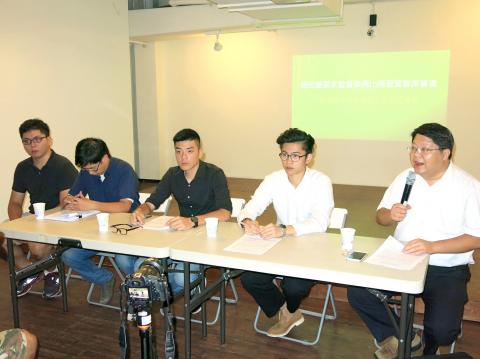
Photo: Cheng Hung-ta, Taipei Times
At the time, Kuei said that the relaxation was unrelated to the service trade agreement, because the provisions of that agreement were mainly directed at institutional investors.
“This opening is huge and clearly what the service trade agreement promises,” Lai said, citing a provision in the agreement’s appendices that promises “active deliberation” on allowing “qualified” individual investors to invest in Taiwanese capital markets.
“Originally, only institutional investors were allowed to invest, but the services trade agreement would have opened the door for individual investors, while limiting it to those who possessed certain qualifications. Today, the Financial Supervisory Commission would be opening investment in mutual funds regardless of any qualifications — every Chinese tourist will be able to make purchases,” he said, accusing the officials of playing “word games” with their denial.
“The Executive Yuan argues that it is not opening direct investment in stocks, but if you can own stocks through mutual funds, is that really any different?” he said. “The result of this will be that Chinese investors will very likely become the biggest investors in Taiwanese mutual funds and they will be able to exercise more influence.”
Lai also called for the quick passage of new supervisory legislation regulating negotiations with China, saying that he expects talks between the Straits Exchange Foundation and China’s Association for Relations Across the Taiwan Straits to resume by 2018, after the Chinese Communist Party’s 19th National Congress.
A review of the legislation should be conducted by a joint committee comprised of members of four related legislative committees rather than the Internal Administration Committee as currently slated, to give a broad range of legislators the right to openly propose amendments, he said.

Taiwanese can file complaints with the Tourism Administration to report travel agencies if their activities caused termination of a person’s citizenship, Mainland Affairs Council Minister Chiu Chui-cheng (邱垂正) said yesterday, after a podcaster highlighted a case in which a person’s citizenship was canceled for receiving a single-use Chinese passport to enter Russia. The council is aware of incidents in which people who signed up through Chinese travel agencies for tours of Russia were told they could obtain Russian visas and fast-track border clearance, Chiu told reporters on the sidelines of an event in Taipei. However, the travel agencies actually applied
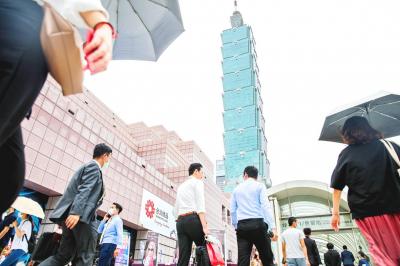
Japanese footwear brand Onitsuka Tiger today issued a public apology and said it has suspended an employee amid allegations that the staff member discriminated against a Vietnamese customer at its Taipei 101 store. Posting on the social media platform Threads yesterday, a user said that an employee at the store said that “those shoes are very expensive” when her friend, who is a migrant worker from Vietnam, asked for assistance. The employee then ignored her until she asked again, to which she replied: "We don't have a size 37." The post had amassed nearly 26,000 likes and 916 comments as of this

New measures aimed at making Taiwan more attractive to foreign professionals came into effect this month, the National Development Council said yesterday. Among the changes, international students at Taiwanese universities would be able to work in Taiwan without a work permit in the two years after they graduate, explainer materials provided by the council said. In addition, foreign nationals who graduated from one of the world’s top 200 universities within the past five years can also apply for a two-year open work permit. Previously, those graduates would have needed to apply for a work permit using point-based criteria or have a Taiwanese company
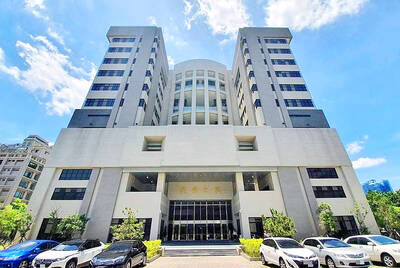
The Shilin District Prosecutors’ Office yesterday indicted two Taiwanese and issued a wanted notice for Pete Liu (劉作虎), founder of Shenzhen-based smartphone manufacturer OnePlus Technology Co (萬普拉斯科技), for allegedly contravening the Act Governing Relations Between the People of the Taiwan Area and the Mainland Area (臺灣地區與大陸地區人民關係條例) by poaching 70 engineers in Taiwan. Liu allegedly traveled to Taiwan at the end of 2014 and met with a Taiwanese man surnamed Lin (林) to discuss establishing a mobile software research and development (R&D) team in Taiwan, prosecutors said. Without approval from the government, Lin, following Liu’s instructions, recruited more than 70 software


 RSS
RSS