


China’s Taiwan Affairs Office Minister Zhang Zhijun (張志軍) yesterday said that Beijing would not resume regular communications with Taipei, despite the appointment of former minister of foreign affairs Tien Hung-mao (田弘茂) as chairman of the Straits Exchange Foundation (SEF).
The Association for Relations Across the Taiwan Straits (ARATS) — the foundation’s counterpart — will not resume regular dialogue with the SEF until the “local authority” recognizes the so-called “1992 consensus,” Zhang said at a news conference after a cross-strait economic forum in Shandong Province.
The “1992 consensus,” a term former Mainland Affairs Council chairman Su Chi (蘇起) admitted to making up in 2000, refers to a tacit understanding between the Chinese Nationalist Party (KMT) and the Chinese government that both sides of the Taiwan Strait acknowledge that there is “one China,” with each side having its own interpretation of what “China” means.
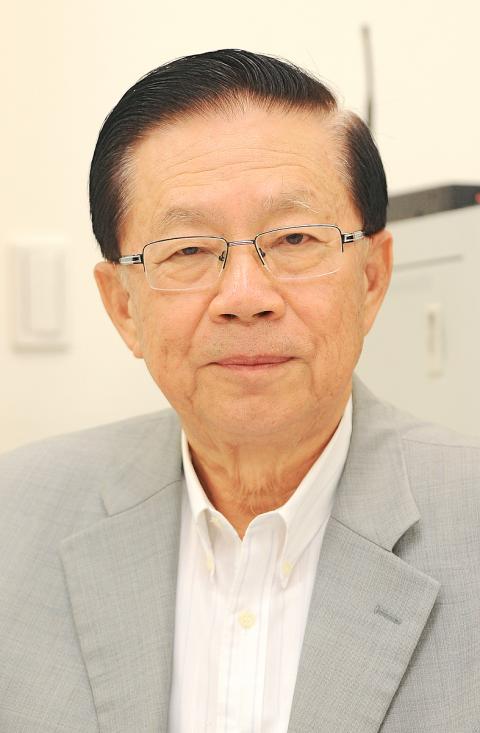
Photo: Liu Hsin-de, Taipei Times
“The key to the problem is the political basis, the political basis of the negotiation being authorized, not the individuals involved,” Zhang said.
According to a source close to the administration of President Tsai Ing-wen (蔡英文), who asked not to be named because they were not authorized to speak to the media, former legislative speaker Wang Jin-pyng (王金平) was offered the chairmanship first, but after a lengthy period of discussion Wang declined the position, prompting the administration to name Tien.
The source said the Presidential Office chose Tien because he has no business dealings or personal interests in China that would call into question his ability to rise above Beijing’s influence, he is a widely respected academic in China and Taiwan, and he has credibility with Beijing as a courier of authoritative messages while having a pan-green pedigree that makes him acceptable to the Democratic Progressive Party’s (DPP) base.
In addition, Tien worked with Tsai during his tenure as the minister of foreign affairs and has been acting as one of Tsai’s foremost advisors on cross-strait relations, the source said.
KMT Legislator Lee Yen-hsiu (李彥秀) said Tien was responsible for printing the word “Taiwan” on passports as the then-minister of foreign affairs, and his appointment shows that the Tsai administration is “not willing or able to take the restoration of regular cross-strait negotiations seriously.”
Meanwhile, DPP Legislator Chen Ting-fei (陳亭妃) said: “Tien understands the special state-to-state relationship and has a flair for international affairs. There is no doubt that he understands the cross-strait situation and is qualified to facilitate cross-strait relations.”
DPP Legislator Huang Wei-cher (黃偉哲) said naming Tien as chairman would ease Tsai’s relationship with the party’s base, adding that since Tien has pan-green credentials and had served on the National Unification Council during former president Lee Teng-hui’s (李登輝) administration, he would be a SEF chairman who is acceptable to all groups.
“At the very least, the SEF’s role as the cross-strait fax machine will be preserved,” Huang said.

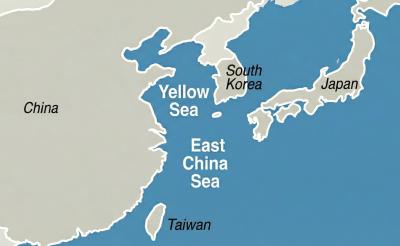
China has reserved offshore airspace in the Yellow Sea and East China Sea from March 27 to May 6, issuing alerts usually used to warn of military exercises, although no such exercises have been announced, the Wall Street Journal (WSJ) reported yesterday. Reserving such a large area for 40 days without explanation is an “unusual step,” as military exercises normally only last a few days, the paper said. These alerts, known as Notice to Air Missions (Notams), “are intended to inform pilots and aviation authorities of temporary airspace hazards or restrictions,” the article said. The airspace reserved in the alert is

South Korea is planning to revise its controversial electronic arrival card, a step Taiwanese officials said prompted them to hold off on planned retaliatory measures, a South Korean media report said yesterday. A Yonhap News Agency report said that the South Korean Ministry of Foreign Affairs is planning to remove the “previous departure place” and “next destination” fields from its e-arrival card system. The plan, reached after interagency consultations, is under review and aims to simplify entry procedures and align the electronic form with the paper version, a South Korean ministry official said. The fields — which appeared only on the electronic form
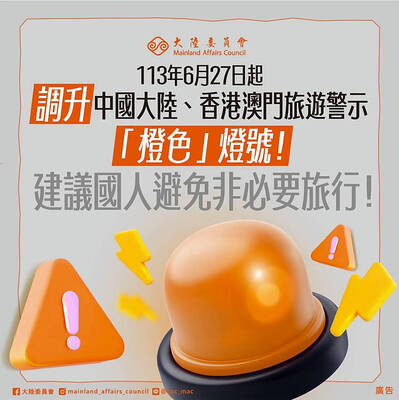
More than 6,000 Taiwanese students have participated in exchange programs in China over the past two years, despite the Mainland Affairs Council’s (MAC) “orange light” travel advisory, government records showed. The MAC’s publicly available registry showed that Taiwanese college and university students who went on exchange programs across the Strait numbered 3,592 and 2,966 people respectively. The National Immigration Agency data revealed that 2,296 and 2,551 Chinese students visited Taiwan for study in the same two years. A review of the Web sites of publicly-run universities and colleges showed that Taiwanese higher education institutions continued to recruit students for Chinese educational programs without

A bipartisan group of US senators has introduced a bill to enhance cooperation with Taiwan on drone development and to reduce reliance on supply chains linked to China. The proposed Blue Skies for Taiwan Act of 2026 was introduced by Republican US senators Ted Cruz and John Curtis, and Democratic US senators Jeff Merkley and Andy Kim. The legislation seeks to ease constraints on Taiwan-US cooperation in uncrewed aerial systems (UAS), including dependence on China-sourced components, limited access to capital and regulatory barriers under US export controls, a news release issued by Cruz on Wednesday said. The bill would establish a "Blue UAS


 RSS
RSS