


The Executive Yuan’s last-minute decision on Saturday evening to delay the implementation of its “six work days and one rest day” policy — which the Ministry of Labor made without consulting industries — showed that the new government’s decisionmaking process is sloppy and out of touch. Worse than having a policy flip-flop, government officials are like troublemakers who busy themselves fighting fires that they themselves started.
Following a three-hour inter-ministrial meeting on Saturday, Minister of Labor Kuo Fong-yu (郭芳煜) told a news conference that the Cabinet decided that implementation of the new work day rules, initially scheduled to take effect today, would be postponed for two months.
The new rules have sparked an outcry in some industries, such as tourism, media and transportation, which have argued that they need rostering flexibility and the new rules would make that difficult.
The proposal to ban a seven-day workweek was motivated by a commendable desire to ensure adequate rest for workers; however, the crudity and lack of implementation details in the policy was far from laudable.
The ministry’s proposal would have changed policy that has been in place for three decades. While their impact on most sectors would arguably be limited, the changes would have caused immense difficulties for sectors with special requirements. Some flexibility, such as an adjustment period for employers, would have helped mitigate the policy’s negative effects.
However, the ministry did not communicate with employers or unions prior to announcing its policy and ignored objections when they were raised. When transportation, tourism and media industries said that the proposal would create rostering issues, the ministry said they needed to hire more staff.
The ministry did not explain how, in the one month between its policy announcement and scheduled promulgation, employers could have hired enough qualified workers to meet their needs, or if such increased staff numbers were affordable.
The same faults led to controversy over a proposed amendment to the Labor Standards Act (勞動基準法). The government’s proposed leave policy, a five-day workweek with one fixed day off and one flexible “rest day,” is more flexible than the “two regular days off” per week plan that is supported by opposition parties and labor unions.
However, the leave policy was drafted without consulting the public or affected parties and was so poorly communicated that the Presidential Office could not even convince all Democratic Progressive Party lawmakers to support its version of the bill. How does the government expect the nation’s employers and unions to support its proposal when even its own lawmakers are not onboard?
With the poor quality of its policymaking, it is not surprising that the administration of President Tsai Ing-wen (蔡英文) has had to reversed course on its “six work days and one rest day” proposal and that most observers say further delays in the amendment of the Labor Standards Act are unavoidable.
On Saturday, the ministry belatedly said that it would hold three conferences on the labor amendment proposal in northern, central and southern Taiwan. Again, it is too little, too late to communicate with the public now.
Listening to the public was what the administration should have done before it started writing policy.
Just two months after the new government was sworn in, some of its officials have already showed that their bureaucratic hubris and arrogance are every bit the match for their predecessors, if not more so. Their inability to see beyond the confines of their air-conditioned offices has led to badly thought out policy that is out of touch with reality. They have not only failed to communicate before making major decisions, but have refused to listen even after they failed.
Unless the administration works on adjusting its attitude and mind-set, it will have to get used to losing ground in the polls.

LOUD AND PROUD Taiwan might have taken a drubbing against Australia and Japan, but you might not know it from the enthusiasm and numbers of the fans Taiwan might not be expected to win the World Baseball Classic (WBC) but their fans are making their presence felt in Tokyo, with tens of thousands decked out in the team’s blue, blowing horns and singing songs. Taiwanese fans have packed out the Tokyo Dome for all three of their games so far and even threatened to drown out home team supporters when their team played Japan on Friday. They blew trumpets, chanted for their favorite players and had their own cheerleading squad who dance on a stage during the game. The team struggled to match that exuberance on the field, with
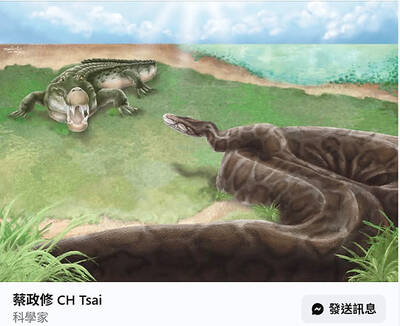
Taiwanese paleontologists have discovered fossil evidence that pythons up to 4m long inhabited Taiwan during the Pleistocene epoch, reporting their findings in the international scientific journal Historical Biology. National Taiwan University (NTU) Institute of Ecology and Evolutionary Biology associate professor Tsai Cheng-hsiu (蔡政修) led the team that discovered the largest snake fossil ever found in Taiwan. The single trunk vertebra was discovered in Tainan at the Chiting Formation, dated to between 400,000 and 800,000 years ago in the Middle Pleistocene, the paper said. The area also produced Taiwan’s first avian fossil, as well as crocodile, mammoth, saber-toothed cat and rhinoceros fossils, it said. Discoveries

Taiwanese paleontologists have discovered fossil evidence that pythons up to 4m long inhabited Taiwan during the Pleistocene epoch, reporting their findings in the international scientific journal Historical Biology. National Taiwan University (NTU) Institute of Ecology and Evolutionary Biology associate professor Tsai Cheng-hsiu (蔡政修) led the team that discovered the largest snake fossil ever found in Taiwan. A single trunk vertebra was discovered in Tainan at the Chiting Formation, dated to between 800,000 to 400,000 years ago in the Middle Pleistocene, the paper said. The area also produced Taiwan’s first avian fossil, as well as crocodile, mammoth, sabre-toothed cat and rhinoceros fossils, it said. Discoveries
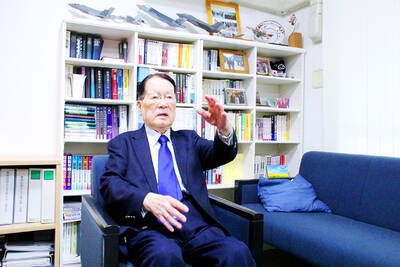
Whether Japan would help defend Taiwan in case of a cross-strait conflict would depend on the US and the extent to which Japan would be allowed to act under the US-Japan Security Treaty, former Japanese minister of defense Satoshi Morimoto said. As China has not given up on the idea of invading Taiwan by force, to what extent Japan could support US military action would hinge on Washington’s intention and its negotiation with Tokyo, Morimoto said in an interview with the Liberty Times (sister paper of the Taipei Times) yesterday. There has to be sufficient mutual recognition of how Japan could provide


 RSS
RSS