

The US on Thursday urged Taiwan and China to keep channels of communication open after President Tsai Ing-wen (蔡英文) expressed hope in a Washington Post interview that China would show more flexibility in dealing with cross-strait relations.
“The United States has a deep and abiding interest in cross-strait stability. We welcome steps by both sides of the Taiwan Strait to reduce tensions and improve cross-strait relations,” US Department of State East Asian and Pacific Affairs Bureau spokesperson Grace Choi said.
“We urge both sides to keep channels of communication open,” Choi said via e-mail.
In her interview with the Post, Tsai said that she hopes Chinese President Xi Jinping (習近平) would show more flexibility in dealing with cross-strait relations and “can appreciate that Taiwan is a democratic society in which the leader has to follow the will of the people.”
Tsai also rejected a supposed deadline for Taiwan to accept the so-called “1992 consensus,” saying it is not likely that the government would accept a deadline “for conditions that are against the will of the people.”
The consensus, which Tsai’s independence-leaning Democratic Progressive Party has not accepted, refers to a tacit agreement reached in 1992 between the Chinese Communist Party and the Chinese Nationalist Party (KMT) that the two sides of the Taiwan Strait agree there is only “one China,” but each side is free to interpret what it means.
In her e-mail, Choi said Tsai has “consistently noted her public commitment to maintain the ‘status quo’ and work with Beijing in a flexible and creative way,” and the US believes that “clear, direct and consistent communication supports the continued development of cross-strait relations.”
On the question of whether there is any chance for Taiwan to be included in multilateral mechanisms to deal with South China Sea disputes — as Tsai has urged in her interview with the Post — and what the US could do to help, Choi said the US interest is in ensuring that maritime disputes are resolved peacefully, without coercion and in a manner that is consistent with international law.
“Given the complexity of the various disputes, we support claimants having the ability to avail themselves of all available tools to peacefully and lawfully resolve differences,” she said.
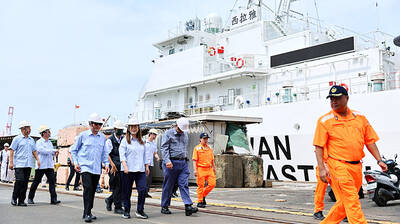
Ocean Affairs Council (OAC) Minister Kuan Bi-ling (管碧玲) on Wednesday said decommissioned coast guard vessels were given to the Philippines to enhance regional rescue capacity and would not affect Taiwanese fishers’ rights and benefits. Kuan made the remarks after confirmation on Tuesday that a 500-tonne Coast Guard Administration (CGA) patrol and rescue vessel would be given to the Philippine Coast Guard. The donation ceremony was reportedly done in Manila, but whether the vessel — previously numbered “CG123” and named Kinmen (金門) — has been handed over has yet to be confirmed. China’s Taiwan Affairs Office (TAO) on Wednesday criticized the donation for “taking

The Ministry of Finance today announced the winning numbers for the July-August uniform invoice lottery. The winning number for the NT$10 million (US$314,663) special prize is 89996565, while the winning number for the NT$2 million grand prize is 91098182. Three numbers were drawn for the NT$200,000 first prize: 54348835, 44991397 and 06595111. Those with receipts matching the last seven digits of any of the first-prize numbers can claim the NT$40,000 second prize, while those matching the last six digits qualify for the NT$10,000 third prize. Those whose receipts match the last five digits of the first-prize numbers are eligible for the NT$4,000 fourth prize,
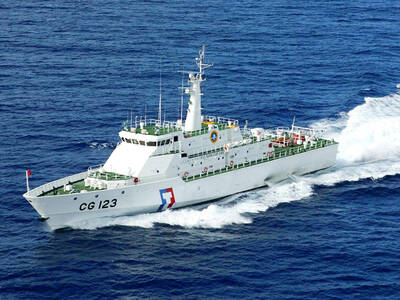
A decommissioned 500-tonne Kinmen-class patrol vessel recently donated by Taiwan’s Coast Guard Administration (CGA) has been delivered to the Philippine Coast Guard (PCG), a source said yesterday. The source said the vessel transferred to the PCG at a ceremony organized by the Philippine Non-government WPS Foundation on Monday was donated by the CGA. The CGA confirmed the donation on Wednesday last week following a United Daily News (UDN) report of a Philippine law enforcement vessel registered as "BLINGNO.1" setting sail for sea trials from Kaohsiung Port that day, citing tracking data from
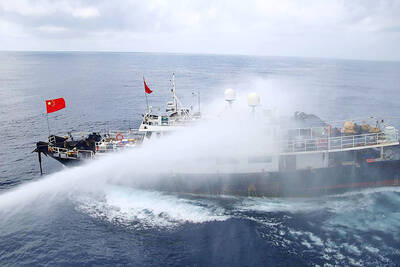
Taiwan has upgraded its maritime patrol capacity around the Pratas Islands (Dongsha Islands, 東沙群島) in the disputed South China Sea, including regularly sending larger ships there, the government said on Wednesday, responding to an increase in Chinese activities. Lying roughly between southern Taiwan and Hong Kong, the Taiwan-controlled Pratas Islands are seen by security experts as vulnerable to a Chinese attack due to their distance — more than 400km — from Taiwan. In a statement late on Wednesday, the Coast Guard Administration (CGA) said its overall patrol and enforcement capacity in Pratas waters has been “comprehensively upgraded.” With the completion of a wharf


 RSS
RSS