


President Tsai Ing-wen (蔡英文) should consider delaying a planned judicial reform congress to allow more time for consideration of Judicial Yuan presidential and vice presidential nominees, civic groups said yesterday.
“Nominations should not be made hastily just because of the judicial reform congress — in fact, the congress is important enough that it would be acceptable to push it back a bit,” Grand Justice Selection Civic Watchdog Alliance (民間監督大法官人選聯盟) convener Chiu Hei-yuan (瞿海源) said after activists emerged from a meeting with Tsai at the Presidential Office Building yesterday.
Tsai in her inaugural address promised to call a judicial reform congress on increasing civic participation in the judiciary in October.
“A delay is necessary because the quality of the congress — not how quickly it is called — is what is most important, and it is crucial that nominations [for Judicial Yuan president and vice president] be rigorously reviewed,” Chiu said.
Tsai nominated Public Functionary Disciplinary Sanction Commission Chief Commissioner Hsieh Wen-ting (謝文定) to serve as Judicial Yuan president, while picking Judicial Yuan Secretary-General Lin Chin-fang (林錦芳) to serve as Judicial Yuan vice president, which drew criticism from civic activists, who said both nominees are unqualified to head reform efforts.
Chiu quoted Tsai as saying that she would “consider” withdrawing the nominees, and admitting that she had personally picked them instead of relying on the recommendations of the Presidential Office’s small working group for nominating Grand Justices.
Activists said that Tsai justified her choices by citing the importance of career judicial bureaucrats like Hsieh and Lin playing a role in judicial reform efforts.
“Because people with a practitioner’s background tend to be conservative and the Judicial Yuan’s president and vice president are not supposed to serve as ‘secretaries’ for judicial reform, practical experience should not be a condition for nomination,” he said.
Activists have urged the nomination of leading legal experts.
Chiu said that while activists were not satisfied with Tsai’s response, there was still time for reconsideration and review because Legislative Yuan consideration of the nominees is not scheduled until at least September, when this year’s second normal legislative session begins.
“We find it completely unacceptable to nominate a Judicial Yuan president who has never expressed any interest in judicial reform in the past,” Judicial Reform Foundation chairman Joseph Lin (林永頌) said, alleging that Hsieh was involved in prosecuting political cases as a public prosecutor in the Martial Law era.

The military has spotted two Chinese warships operating in waters near Penghu County in the Taiwan Strait and sent its own naval and air forces to monitor the vessels, the Ministry of National Defense (MND) said. Beijing sends warships and warplanes into the waters and skies around Taiwan on an almost daily basis, drawing condemnation from Taipei. While the ministry offers daily updates on the locations of Chinese military aircraft, it only rarely gives details of where Chinese warships are operating, generally only when it detects aircraft carriers, as happened last week. A Chinese destroyer and a frigate entered waters to the southwest
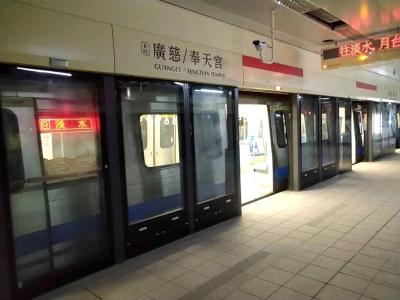
The eastern extension of the Taipei MRT Red Line could begin operations as early as late June, the Taipei Department of Rapid Transit Systems said yesterday. Taipei Rapid Transit Corp said it is considering offering one month of free rides on the new section to mark its opening. Construction progress on the 1.4km extension, which is to run from the current terminal Xiangshan Station to a new eastern terminal, Guangci/Fengtian Temple Station, was 90.6 percent complete by the end of last month, the department said in a report to the Taipei City Council's Transportation Committee. While construction began in October 2016 with an
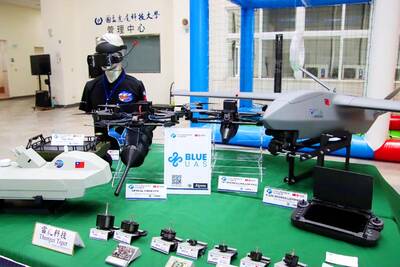
NON-RED SUPPLY: Boosting the nation’s drone industry is becoming increasingly urgent as China’s UAV dominance could become an issue in a crisis, an analyst said Taiwan’s drone exports to Europe grew 41.7-fold from 2024 to last year, with demand from Ukraine’s fight against Russian aggression the most likely driver of growth, a study showed. The Institute for Democracy, Society and Emerging Technology (DSET) in a statement on Wednesday said it found that many of Taiwan’s uncrewed aerial vehicle (UAV) sales were from Poland and the Czech Republic. These countries likely transferred the drones to Ukraine to aid it in its fight against the Russian invasion that started in 2022, it said. Despite the gains, Taiwan is not the dominant drone exporter to these markets, ranking second and fourth

Japanese Prime Minister Sanae Takaichi’s comment last year on Tokyo’s potential reaction to a Taiwan-China conflict has forced Beijing to rewrite its invasion plans, a retired Japanese general said. Takaichi told the Diet on Nov. 7 last year that a Chinese naval blockade or military attack on Taiwan could constitute a “survival-threatening situation” for Japan, potentially allowing Tokyo to exercise its right to collective self-defense. Former Japan Ground Self-Defense Force general Kiyofumi Ogawa said in a recent speech that the remark has been interpreted as meaning Japan could intervene in the early stages of a Taiwan Strait conflict, undermining China’s previous assumptions


 RSS
RSS