


Water conservationists yesterday urged the government to transform the nation’s 17 irrigation associations into a collective government agency to bring agricultural water management under government purview, but the proposal met with opposition from association members.
Irrigation associations have water rights over 70 percent of the nation’s farm water resources, but they can sell water and lease properties at their own discretion without being subject to government supervision, Taiwan Water Resources Protection Union spokesperson Chen Jiau-hua (陳椒華) said at a legislative hearing.
“An irrigation association in Yunlin can make as much as NT$300 million [US$9.31 million] per year by selling water to Formosa Plastics Group’s naphtha cracker in the county. While water resources should be considered a public asset for common use, irrigation associations can make a profit selling water without being answerable to anyone,” Chen said.
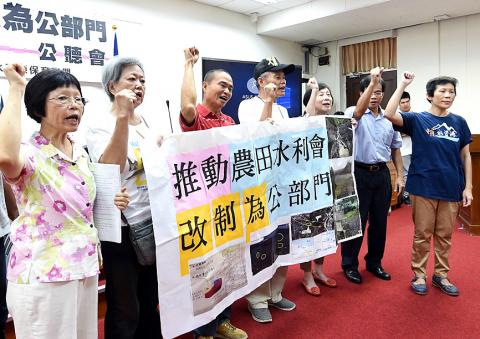
Photo: Chu Pei-hsiung, Taipei Times
Diverting farm water for factories has caused farmers to drain groundwater, leading to ground subsidence, farmer Lin Fu-yuan (林富源) said.
Conservationists called on the government to restructure irrigation associations into a government agency to curb the use of agricultural water resources for industrial purposes.
Water Watch Taiwan member Liang Yin-min (梁蔭民) said a 1,500 ping (4,958.7m2) property in Taipei’s Daan District (大安) that Pacific Sogo Department Store’s -Zhongxiao branch stands on belongs to the Liugong Irrigation Association.
“The retailer is permitted to use the property for free until 2030, after which the association can make a good profit with the property, which has an estimated value of more than NT$20 billion. However, profit generated by properties of irrigation associations should be shared by the public,” Liang said.
Water rights and properties owned by irrigation associations are public assets and therefore government management should be imposed, Liang said.
The nation’s 17 irrigation associations own 24,500 hectares of land and irrigate 373,096 hectares of farm land, with a yearly revenue of NT$12.6 billion, according to Council of Agriculture data.
Properties of irrigation associations were owned by farmers before the Japanese colonial period, but were expropriated by the Japanese colonial government for irrigation purposes. Later, the Republic of China government turned the Japanese-founded organizations into today’s irrigation associations.
Taoyuan Irrigation Association consultant Chen Zau-nan (陳昭南) said properties owned by irrigation associations are private assets belonging to association members, and transforming the associations into a government agency would amount to seizing private property.
“What does pollution created by the naphtha cracker have anything to do with irrigation associations?” Chen asked. “Ground subsidence in Yunlin is all about local fish farming. The public should not blame those problems on irrigation associations and we do not want the associations to be stigmatized.”

SHIPS, TRAINS AND AUTOMOBILES: The ministry has announced changes to varied transportation industries taking effect soon, with a number of effects for passengers Beginning next month, the post office is canceling signature upon delivery and written inquiry services for international registered small packets in accordance with the new policy of the Universal Postal Union, the Ministry of Transportation and Communications said yesterday. The new policy does not apply to packets that are to be delivered to China, the ministry said. Senders of international registered small packets would receive a NT$10 rebate on postage if the packets are sent from Jan. 1 to March 31, it added. The ministry said that three other policies are also scheduled to take effect next month. International cruise ship operators
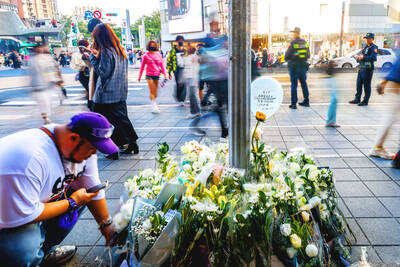
HORROR STORIES: One victim recounted not realizing they had been stabbed and seeing people bleeding, while another recalled breaking down in tears after fleeing A man on Friday died after he tried to fight the knife-wielding suspect who went on a stabbing spree near two of Taipei’s busiest metro stations, Taipei Mayor Chiang Wan-an (蔣萬安) said. The 57-year-old man, identified by his family name, Yu (余), encountered the suspect at Exit M7 of Taipei Main Station and immediately tried to stop him, but was fatally wounded and later died, Chiang said, calling the incident “heartbreaking.” Yu’s family would receive at least NT$5 million (US$158,584) in compensation through the Taipei Rapid Transit Corp’s (TRTC) insurance coverage, he said after convening an emergency security response meeting yesterday morning. National

PLANNED: The suspect visited the crime scene before the killings, seeking information on how to access the roof, and had extensively researched a 2014 stabbing incident The suspect in a stabbing attack that killed three people and injured 11 in Taipei on Friday had planned the assault and set fires at other locations earlier in the day, law enforcement officials said yesterday. National Police Agency (NPA) Director-General Chang Jung-hsin (張榮興) said the suspect, a 27-year-old man named Chang Wen (張文), began the attacks at 3:40pm, first setting off smoke bombs on a road, damaging cars and motorbikes. Earlier, Chang Wen set fire to a rental room where he was staying on Gongyuan Road in Zhongzheng District (中正), Chang Jung-hsin said. The suspect later threw smoke grenades near two exits
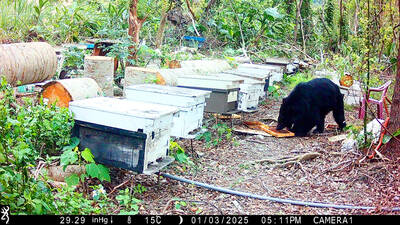
The Forestry and Nature Conservation Agency yesterday launched a gift box to market honey “certified by a Formosan black bear” in appreciation of a beekeeper’s amicable interaction with a honey-thieving bear. Beekeeper Chih Ming-chen (池明鎮) in January inspected his bee farm in Hualien County’s Jhuosi Township (卓溪) and found that more than 20 beehives had been destroyed and many hives were eaten, with bear droppings and paw prints near the destroyed hives, the agency said. Chih returned to the farm to move the remaining beehives away that evening when he encountered a Formosan black bear only 20m away, the agency said. The bear


 RSS
RSS