


The Taoyuan City Government is to start its Autonomous Regulations on Developing Taoyuan City as a Low-Carbon-Emission and Green City (桃園市發展低碳綠色城市自治條例) plan next year.
Taoyuan Mayor Cheng Wen-tsan (鄭文燦) made the announcement during a city council meeting last week, saying that “developing policies to achieve low carbon emissions and ‘green’ city status is a flagship project of the municipal administration,” and the regulations, which were passed by the council at the end of December last year, are to take effect next year.
Cheng said there are five main pillars for Taoyuan’s development of “green” energy and low-carbon emissions: low-carbon living, low-carbon architecture, low-carbon industries, low-carbon transportation and a renewable-energy city, which would be implemented by the city government in coordination with different departments.
The Taoyuan Department of Environment Protection said the regulations would encourage schools to opt for locally produced food to reduce their transport carbon footprint, require large temples and retailers to install air-pollution detection systems for PM2.5 — particulate matter measuring 25 micrometers or less in diameter — encourage retailers and convenience stores to obtain “green business” certificates and prioritize eco-friendly products, while hotels that are “green certified” would have to display eco-friendly products or advise customers to bring their own personal hygine items, or face a fine up to NT$30,000.
Department officials said that Taoyuan would join Taipei, Taichung, Tainan and Kaohsiung as cities that promote low carbon-emission practices and “green” architecture through the use of new regulations and penalties.
According to the new regulations, diesel automobiles manufactured before July 1999 could be subject to random exhaust emission testing by the Taoyuan Department of Environmental Protection.
Diesel automobiles that are reported for emitting black smoke more than twice in one year could be subjected to mandatory examination, and a failure to pass emissions tests would be punishable by a fine of up to NT$20,000, the regulations state.
The ordinance also gives the municipal government the authority to designate certain sections of roads and regions at certain periods of time only to pedestrians or low-emission vehicles.
Starting from Jan. 1 next year, the city government’s enforcement agencies would carry out inspections, and refusing an inspection would be punishable by a fine of NT$30,000 per violation, officials said.
Public parking lots in the municipality will also have to provide priority spaces for bicycles and low-emission motor vehicles, municipal officials have said.
Additional reporting by staff writer

LOUD AND PROUD Taiwan might have taken a drubbing against Australia and Japan, but you might not know it from the enthusiasm and numbers of the fans Taiwan might not be expected to win the World Baseball Classic (WBC) but their fans are making their presence felt in Tokyo, with tens of thousands decked out in the team’s blue, blowing horns and singing songs. Taiwanese fans have packed out the Tokyo Dome for all three of their games so far and even threatened to drown out home team supporters when their team played Japan on Friday. They blew trumpets, chanted for their favorite players and had their own cheerleading squad who dance on a stage during the game. The team struggled to match that exuberance on the field, with
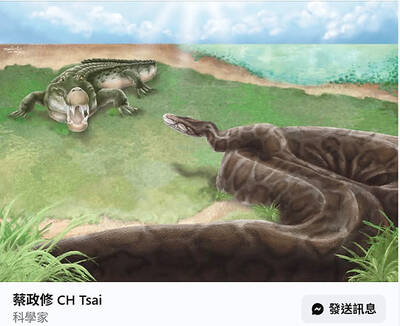
Taiwanese paleontologists have discovered fossil evidence that pythons up to 4m long inhabited Taiwan during the Pleistocene epoch, reporting their findings in the international scientific journal Historical Biology. National Taiwan University (NTU) Institute of Ecology and Evolutionary Biology associate professor Tsai Cheng-hsiu (蔡政修) led the team that discovered the largest snake fossil ever found in Taiwan. The single trunk vertebra was discovered in Tainan at the Chiting Formation, dated to between 400,000 and 800,000 years ago in the Middle Pleistocene, the paper said. The area also produced Taiwan’s first avian fossil, as well as crocodile, mammoth, saber-toothed cat and rhinoceros fossils, it said. Discoveries

Taiwanese paleontologists have discovered fossil evidence that pythons up to 4m long inhabited Taiwan during the Pleistocene epoch, reporting their findings in the international scientific journal Historical Biology. National Taiwan University (NTU) Institute of Ecology and Evolutionary Biology associate professor Tsai Cheng-hsiu (蔡政修) led the team that discovered the largest snake fossil ever found in Taiwan. A single trunk vertebra was discovered in Tainan at the Chiting Formation, dated to between 800,000 to 400,000 years ago in the Middle Pleistocene, the paper said. The area also produced Taiwan’s first avian fossil, as well as crocodile, mammoth, sabre-toothed cat and rhinoceros fossils, it said. Discoveries

Whether Japan would help defend Taiwan in case of a cross-strait conflict would depend on the US and the extent to which Japan would be allowed to act under the US-Japan Security Treaty, former Japanese minister of defense Satoshi Morimoto said. As China has not given up on the idea of invading Taiwan by force, to what extent Japan could support US military action would hinge on Washington’s intention and its negotiation with Tokyo, Morimoto said in an interview with the Liberty Times (sister paper of the Taipei Times) yesterday. There has to be sufficient mutual recognition of how Japan could provide


 RSS
RSS