


If China fails to recognize the Permanent Court of Arbitration’s ruling in the suit filed by the Philippines over China’s sovereignty claims in the South China Sea as it has threatened, Beijing will suffer a loss of credibility in the international arena, Taiwan Brain Trust associate executive director Lin Ting-hui (林廷輝) said.
The court in The Hague, Netherlands, is set to deliver its ruling tomorrow morning.
The Philippines brought the case in 2013, arguing that the land formations China claims in the South China Sea are nothing more than reefs and are therefore not entitled to 200 nautical mile (370.4km) exclusive economic zones.
Even before Manila filed its suit, China said it would not recognize the tribunal’s jurisdiction and it has repeatedly said that it “does not accept, will not participate in and will not execute [the results of]” the court’s ruling.
According to the PLA Daily, China’s People’s Liberation Army Navy on Friday carried out drills and “live missiles” exercises between the Paracel Islands (Xisha Islands, 西沙群島), which Taiwan also claims, and Hainan Island.
Lin said the tribunal’s rulings represent internationally valid law and can lead to restraints being imposed on parties found in violation of laws.
“If China persists in refuting the judgment of arbitrators whose judgment is in accordance with the UN Convention on the Law of the Sea [UNCLOS] — a treaty that China is a party to — then China would lose credibility and be recognized internationally as a state that does not uphold laws and is not trustworthy,” he said.
There are two layers to the legal effectiveness of international arbitration, Lin said.
The first is specific laws that take effect when members sign in agreement on the clauses of a judgement or treaty — UNCLOS itself being an example.
The second is restraints on individual countries as the outcome of a judgement or treaty; this still depends on whether relevant parties sign in agreement, as signing means voluntary acceptance of the laws and restraints.
“The South China Sea arbitration hearing is formed on the basis of UNCLOS, and so naturally its judgements are legally valid. Even if China does not participate or attend, enforcement of Article 7 of UNCLOS is in accordance with law and will put restraints on China,” he said.
“However, supposing China does not accept the outcome of arbitration, there is no system in place within international law for enforcement of rulings. The Philippines may carry on with negotiations in some other way,” Lin said.
Asked what type of influence the arbitration hearing would likely have, Lin said that the Philippines would most likely feel the judgement would be a boost to Manila’s contention of the legality of Beijing’s claims, and other nations might also cite the judgement in making their own claims.
“It is like having a magical Taoist amulet in hand while challenging China on its actions,” Lin said. “China’s fighting back would only throw the situation into chaos. Also, a loss of credibility from refuting the judgement despite being a signing party to UNCLOS would impede the advancement of any future negotiations China engages in.”
The ruling will not have any great impact on Taiwan, he said.
“There will not be any restrictions placed on Taiwan, and the court has no ability to return sovereignty of disputed islands to anyone,” Lin said
President Tsai Ing-wen’s (蔡英文) administration’s respect for the principles and direction of the UN Charter and UNCLOS are not likely to change, he said, adding that the Tsai administration “must approach with caution the waves this arbitration may send crashing across the international stage.”
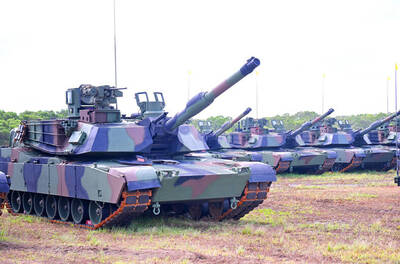
The manufacture of the remaining 28 M1A2T Abrams tanks Taiwan purchased from the US has recently been completed, and they are expected to be delivered within the next one to two months, a source said yesterday. The Ministry of National Defense is arranging cargo ships to transport the tanks to Taiwan as soon as possible, said the source, who is familiar with the matter. The estimated arrival time ranges from late this month to early next month, the source said. The 28 Abrams tanks make up the third and final batch of a total of 108 tanks, valued at about NT$40.5 billion
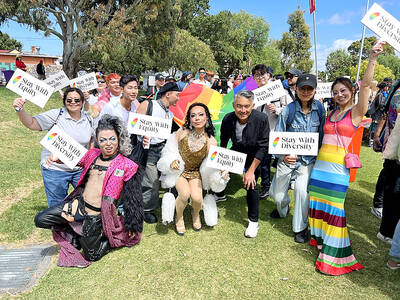
A group from the Taiwanese Designers in Australia association yesterday represented Taiwan at the Midsumma Pride March in Melbourne. The march, held in the St. Kilda suburb, is the city’s largest LGBTQIA+ parade and the flagship event of the annual Midsumma Festival. It attracted more than 45,000 spectators who supported the 400 groups and 10,000 marchers that participated this year, the association said. Taiwanese Designers said they organized a team to march for Taiwan this year, joining politicians, government agencies, professionals and community organizations in showing support for LGBTQIA+ people and diverse communities. As the first country in Asia to legalize same-sex
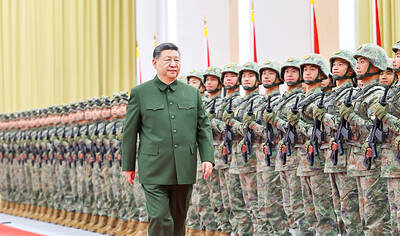
MOTIVES QUESTIONED The PLA considers Xi’s policies toward Taiwan to be driven by personal considerations rather than military assessment, the Epoch Times reports Chinese President Xi Jinping’s (習近平) latest purge of the Chinese People’s Liberation Army (PLA) leadership might have been prompted by the military’s opposition to plans of invading Taiwan, the Epoch Times said. The Chinese military opposes waging war against Taiwan by a large consensus, putting it at odds with Xi’s vision, the Falun Gong-affiliated daily said in a report on Thursday, citing anonymous sources with insight into the PLA’s inner workings. The opposition is not the opinion of a few generals, but a widely shared view among the PLA cadre, the Epoch Times cited them as saying. “Chinese forces know full well that
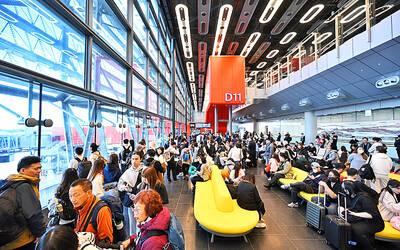
Travel agencies in Taiwan are working to secure alternative flights for travelers bound for New Zealand for the Lunar New Year holiday, as Air New Zealand workers are set to strike next week. The airline said that it has confirmed that the planned industrial action by its international wide-body cabin crew would go ahead on Thursday and Friday next week. While the Auckland-based carrier pledged to take reasonable measures to mitigate the impact of the workers’ strike, an Air New Zealand flight arriving at Taipei from Auckland on Thursday and another flight departing from Taipei for Auckland on Saturday would have to


 RSS
RSS