


Liberty Times (LT): Taiwan’s economic performance has been weak in recent years and even if annual economic growth can be kept at 1 percent this year, it would still be lower than the global average by a considerable margin. What accounts for the nation’s tepid economic growth?
Hu Sheng-cheng (胡勝正): Part of the problem is the global economy, which is unlikely to improve in the near future. Many research institutes have made downward adjustments to their global economic growth estimates for this year and next year.
As a result, Taiwan’s economy is unlikely to grow next year. While a decline in export volumes is contracting, it might not contract fast enough.
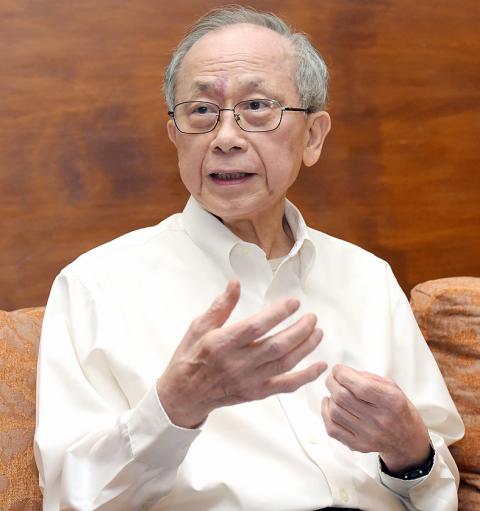
Photo: Huang Yao-cheng, Taipei Times
Unfortunately, domestic demand is also weak... Investment has fallen from between 18 percent and 19 percent 10 years ago to between 16 percent and 17 percent, with negative investment growth across the board, including the private and public sectors and state-owned enterprises.
Unless President Tsai Ing-wen’s (蔡英文) administration takes action to boost domestic demand, GDP growth next year is unlikely to improve.
The Tsai administration said it would not concentrate on GDP growth, but while the administration can ignore the issue, voters will not. [Former president] Ma Ying-jeou’s (馬英九) administration managed an average of 2.8 percent annual GDP growth over eight years; the Tsai administration must do better or face huge political repercussions.
Since it is impossible to raise GDP growth to 2.8 percent this year or next year, annual GDP growth of 4 percent must be achieved in the second half of her term.
LT: How can the government stimulate the economy?
Hu: Infrastructure is relatively weak and the government needs to spur the economy by engaging in public construction projects. Take runway construction at Taiwan Taoyuan International Airport for example: How would the government be able promote tourism if it cannot manage building runways? The failure is a crying shame.
Take trains as another example. When traveling abroad, most people book their hotel rooms and airplane and train tickets at the same time, but in Taiwan that is not possible, especially in eastern regions. Plane tickets and hotel reservations must be made months in advance, but train tickets can only be purchased two weeks in advance and travelers have to get up at 6am to buy tickets before they are sold out. International travelers cannot be expected to do that.
Power supply is another major issue. It has been said that shortages are the result of this year’s abnormal climate conditions, but do people expect climate conditions to be normal next year? Climate extremes are likely to worsen and it is absurd that the nation has power shortages when annual GDP growth is at 1 percent. What if annual GDP growth is 3 percent?
The issues must be addressed immediately, whether by activating a second national budget reserve fund or other means. The “five innovative industries” cannot become just another slogan; capital investments must be made and necessary infrastructure must be built. The government must lead the effort to convince the public that it is being serious; it must take action to inspire confidence in consumers and investors.
LT: Export volumes have been falling for the longest period in history. In addition to slow global economic growth, would you say excessive reliance on a single type of product and on a single market are to blame? What is the impact of the so-called “red supply chain?”
Hu: Taiwan does rely on a single product: ICT [information and communications technology] — in particular, supplying Apple Inc in the ICT sector. Taiwan is also reliant on the Chinese market. Previous slowdowns in China’s economic growth did not affect Taiwan significantly, because China’s role, for Taiwan, was manufacturing. However, in recent years, China has transformed from its manufacturing role to become a market and its economic fluctuations now affect Taiwan in a big way.
The “red supply chain” is not yet a menace, but it is likely to become so in a few years’ time. Some people engage in wishful thinking and according to them, cross-strait cooperation is to lead to a division of labor in which Taiwan is to focus upstream on the supply chain and produce critical components, while China is to remain downstream and produce common components.
The reality is that China wants to develop its technologies and they are in pursuit of Taiwan, which is constantly looking over its shoulder. Worrying does not help; Taiwan must continue to move forward.
Why does the “red supply chain” have limited effect initially? Because its development leads to two economic effects: a scale effect and a substitution effect.
China used to purchase several components from Taiwan, which they now buy at a local level and this leads to the substitution effect. However, by scaling up its economy, China created new demands that mitigate the impact of the substitution effect. However, the substitution effect is becoming more dominant, and Taiwan must carefully formulate a response to manage competition and cooperation across the Taiwan Strait.
China is skillful in using market access to acquire technology, and it is likely that China’s strategy will prove too much for MediaTek Inc to resist. I am sympathetic to MediaTek’s awkward position, because much bigger manufacturers have yielded to the same pressure. BMW, Audi and other automakers had established engine factories in China, even though they were well aware that China has been copying technologies: They had no choice but to risk their technologies, because they needed access to the Chinese market.
However, there is more to technology upgrading than establishing manufacturing plants. Taiwan has better technologies and a better technological base, leading to faster research and development. China’s technological base is inferior by comparison and it remains to be seen whether the transplanted technologies would thrive in China.
LT: What response should the government give to the Chinese leveraging of market access for technology acquisition?
Hu: The international community is highly concerned with the flag-planting activities of Chinese capital investments. For example, despite having the outward appearance of a private enterprise, China’s Tsinghua Holdings Co is a sovereign fund, because it performs a sovereign fund’s functions, such as acquiring technologies and resources.
The IMF responded to Chinese state-capitalist or mercantilist practices by declaring the Santiago Principles to govern sovereign funds, which state that their investments in other nations must be transparent and motivated by economic concerns.
What are the motives for Tsinghua Holdings to purchase MediaTek? Typically, when a private entity makes an international investment, the invested nation might evaluate the investor by weighing its benefits and risks, but how can a nation prevent being fed falsified data from the investor?
Loopholes can always be found and exploited, even in the most clearly formulated regulations.
The only viable response is to imitate the US, which gives the government an important role in regulating foreign capital investments when national security concerns are at stake. The government should not oppose purely financial investment from China; but it should reject any investments that might compromise national security.
However, it should be noted that financial investors could obtain real influence in a business, because the board of directors need the votes of the shareholders. While it is possible for investors to buy non-voting stocks, why would anyone invest in a company without having voting rights?
In addition to invoking national security in deploying government interventions to retain crucial technologies, private actors such as MediaTek must make an effort to safeguard their own intellectual properties and, above all, they must develop new markets.
For example, MediaTek specializes in catering to the Chinese market, without which MediaTek would lose its value. If an enterprise does not want the Chinese government to drag it by the throat, it better explore new markets and be skeptical about the value of technologies that are dependent solely on the Chinese market.
LT: China has been expanding its semiconductor manufacturing capacity and buying semiconductor factories overseas. If and when China builds a self-contained semiconductor supply chain, what would its impact on Taiwan be?
Hu: The impact would be immense. This is the reason Taiwan must keep upgrading its technologies, so that it maintains a lead over the technologies that China acquires. In applied technology, the IoT [Internet of Things] is a strategically important technology and is to be a focus for the attention of all competitors in the field.
In the semiconductor and ICT industries, China has developed software that is better than Taiwan’s, but Taiwan has better hardware. Taiwan needs a partner to compliment its strengths and weaknesses. From this perspective, India is a natural focus for the new southbound policy, because combining India’s software and Taiwan’s hardware would greatly accelerate technological development for both sides.
As Taiwan moves into the Indian market, it would need help from the government. It need to coordinate and strategize, not throw its companies into the melee pell-mell; therefore Taiwan needs the government to play a leadership role.
In my experience, India has been friendly toward Taiwanese businesses, because it knows that a partnership with Taiwan is mutually beneficial in a wide variety of industries ranging from the IoT and ICT to automobile electronics. India has a vibrant auto market and there are great business opportunities to be had from working together. India should be a key area of attention for the new southbound policy.
Translated by staff writer Jonathan Chin
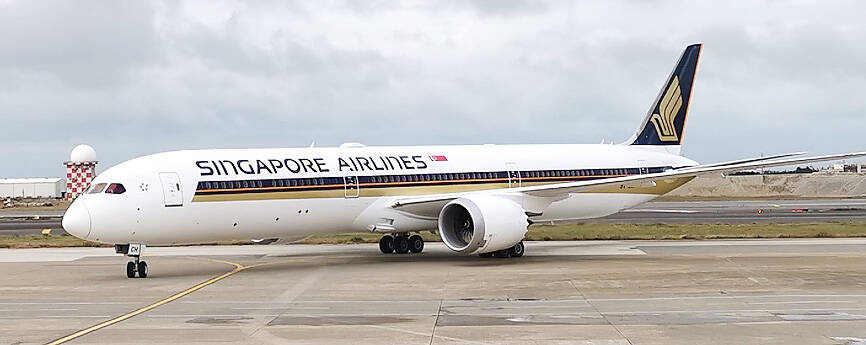
INCREASED CAPACITY: The flights on Mondays, Wednesdays, Fridays and Sundays would leave Singapore in the morning and Taipei in the afternoon Singapore Airlines is adding four supplementary flights to Taipei per week until May to meet increased tourist and business travel demand, the carrier said on Friday. The addition would raise the number of weekly flights it operates to Taipei to 18, Singapore Airlines Taiwan general manager Timothy Ouyang (歐陽漢源) said. The airline has recorded a steady rise in tourist and business travel to and from Taipei, and aims to provide more flexible travel arrangements for passengers, said Ouyang, who assumed the post in July last year. From now until Saturday next week, four additional flights would depart from Singapore on Monday, Wednesday, Friday
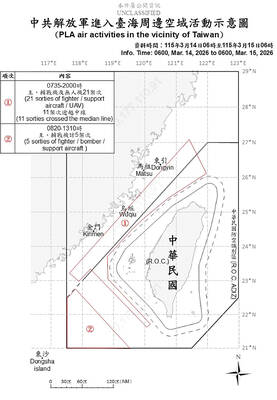
The Ministry of National Defense yesterday reported the return of large-scale Chinese air force activities after their unexplained absence for more than two weeks, which had prompted speculation regarding Beijing’s motives. China usually sends fighter jets, drones and other military aircraft around the nation on a daily basis. Interruptions to such routine are generally caused by bad weather. The Ministry of National Defense said it had detected 26 Chinese military aircraft in the Taiwan Strait over the previous 24 hours. It last reported that many aircraft on Feb. 25, when it spotted 30 aircraft, saying Beijing was carrying out another “joint combat
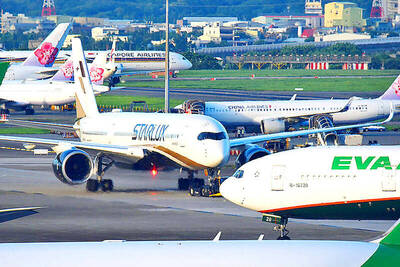
Taiwan’s three major international carriers are increasing booking fees, with EVA Airways having already increased the charge to US$28 per flight segment from US$25, while China Airlines (CAL) and Starlux Airlines are set to follow suit. Booking fees are charged by airlines through a global distribution system (GDS) and passed on to passengers. Carriers that apply the fees include CAL, EVA, Starlux and Tigerair Taiwan. A GDS is a computerized network operated by a company that connects airlines with travel agents and ticketing platforms, allowing reservations to be made and processed in real time. Major players include Amadeus, Sabre and Travelport. EVA Air began

Taiwan successfully defended its women’s 540 kilogram title and won its first-ever men’s 640 kg title at the 2026 World Indoor Tug of War Championships in Taipei yesterday. In the women’s event, Taiwan’s eight-person squad reached the final following a round-robin preliminary round and semifinals featuring teams from Ukraine, Japan, Thailand, Vietnam, the Basque Country and South Korea. In the finals, they swept the Basque team 2-0, giving the team composed mainly of National Taiwan Normal University students and graduates its second championship in a row, and its fourth in five years. Team captain


 RSS
RSS