


People First Party (PFP) Chairman James Soong (宋楚瑜) yesterday said that the question of who will be the new head of the Straits Exchange Foundation is not his concern, while calling for mutual respect and understanding across the Taiwan Strait, after China’s Taiwan Affairs Office announced on Saturday that the cross-strait communications mechanism had been suspended.
Accompanied by three PFP Keelung City councilors, Soong made the remarks at a makeshift office erected in front of the Ching An Temple in the city to accept complaints from Keelung residents.
“Regardless of who assumes the post as chairman of the Straits Exchange Foundation, it is not an issue that concerns myself or the PFP,” Soong said.
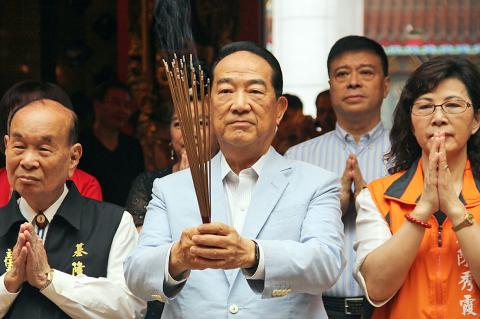
Photo: Yu Chao-fu, Taipei Times
Soong and Chinese Nationalist Party (KMT) Legislator Wang Jin-pyng (王金平) are said to be the two most likely candidates to take the helm of the semi-official body that handles cross-strait affairs in the absence of official ties.
Soong said that what he and his party care about is the other side of the Taiwan Strait understanding that what truly concerns Taiwanese is having a free and democratic system and feeling they are the “masters” of the nation.
He added that while he has met with President Tsai Ing-wen (蔡英文) three times since the Jan. 16 presidential elections, major government policies were the only things they have talked about.
Maintaining peaceful cross-strait development is a shared hope among both sides of the Taiwan Strait, as Beijing and Taipei cannot afford unnecessary confrontation, Soong said.
The four-time presidential candidate called for mutual understanding when asked to comment on China’s Taiwan Affairs Office spokesperson An Fengshan’s (安峰山) remarks on Saturday that cross-strait communications have been suspended since May 20 due to Taiwan’s failure to recognize the so-called “1992 consensus,” which An said is an embodiment of the “one China” principle serving as the political foundation for cross-strait relations.
The “1992 consensus” — a term former Mainland Affairs Council chairman Su Chi (蘇起) admitted making up in 2000 — refers to a tacit understanding between the KMT and the Chinese Communist Party that both sides acknowledge there is “one China,” with each side having its own interpretation of what “China” means.
“If both sides of the Taiwan Strait cannot respect each other’s differences in lifestyle and systems, they are likely to face greater divisions,” Soong said, adding that military confrontations are no longer the mainstream solution to conflicts, but rather peaceful dialogues.
Before a consensus can be reached across the Taiwan Strait, both sides should make an effort to understand each other, Soong said.
Soong said that at their meetings, he advised Tsai to insist on two values during her presidential term — the democratic value of letting Taiwanese be the “masters” of their nation and the value of maintaining cross-strait peace.
“I believe we will continue to exchange opinions on major issues after her return,” Soong added.
Tsai is on a nine-day visit to two of the nation’s diplomatic allies, Panama and Paraguay, during which the president is to transit through two US cities. On Saturday she stopped in Miami on her way to Panama and she is to stop in Los Angeles on her return.
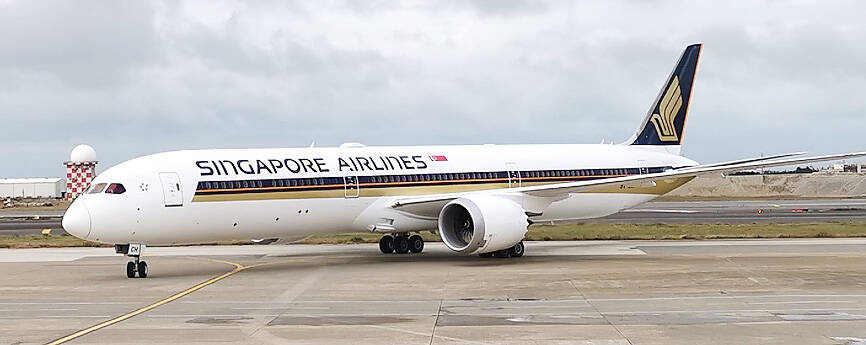
INCREASED CAPACITY: The flights on Mondays, Wednesdays, Fridays and Sundays would leave Singapore in the morning and Taipei in the afternoon Singapore Airlines is adding four supplementary flights to Taipei per week until May to meet increased tourist and business travel demand, the carrier said on Friday. The addition would raise the number of weekly flights it operates to Taipei to 18, Singapore Airlines Taiwan general manager Timothy Ouyang (歐陽漢源) said. The airline has recorded a steady rise in tourist and business travel to and from Taipei, and aims to provide more flexible travel arrangements for passengers, said Ouyang, who assumed the post in July last year. From now until Saturday next week, four additional flights would depart from Singapore on Monday, Wednesday, Friday
Taiwan’s three major international carriers are increasing booking fees, with EVA Airways having already increased the charge to US$28 per flight segment from US$25, while China Airlines (CAL) and Starlux Airlines are set to follow suit. Booking fees are charged by airlines through a global distribution system (GDS) and passed on to passengers. Carriers that apply the fees include CAL, EVA, Starlux and Tigerair Taiwan. A GDS is a computerized network operated by a company that connects airlines with travel agents and ticketing platforms, allowing reservations to be made and processed in real time. Major players include Amadeus, Sabre and Travelport. EVA Air began
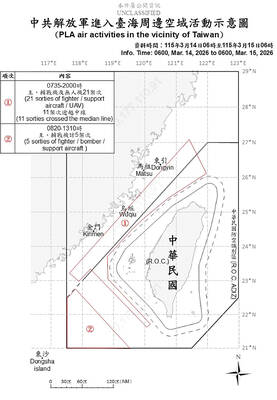
The Ministry of National Defense yesterday reported the return of large-scale Chinese air force activities after their unexplained absence for more than two weeks, which had prompted speculation regarding Beijing’s motives. China usually sends fighter jets, drones and other military aircraft around the nation on a daily basis. Interruptions to such routine are generally caused by bad weather. The Ministry of National Defense said it had detected 26 Chinese military aircraft in the Taiwan Strait over the previous 24 hours. It last reported that many aircraft on Feb. 25, when it spotted 30 aircraft, saying Beijing was carrying out another “joint combat
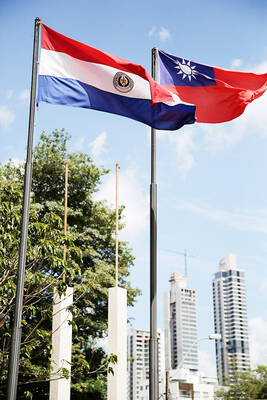
When Paraguayan opposition lawmaker Leidy Galeano returned from an all-expenses-paid tour of six Chinese cities late last year, she was convinced Paraguay risked missing out on major economic gains by sticking with longtime ally Taipei over Beijing — a message that participants on the trip heard repeatedly from Chinese officials. “Everything I saw there, I wanted for my country,” said Galeano, a member of the newly-formed Yo Creo party whose senior figures have spoken favorably about China. This trip and others like it — which people familiar with the visits said were at the invitation of the Chinese consulate in Sao Paulo


 RSS
RSS