


Two-thirds of the patients who sought treatment at the Mackay Memorial Hospital’s Department of Children and Adolescent services suffered from Internet overuse, department doctor Tsang Ju-fen (臧汝芬) said.
Tsang said that excessive Internet use might cause difficulty concentrating and other problems, such as the formation of disruptive emotional disorders or antisocial behaviors.
A lack of medical attention for such problems might cause borderline personality disorders or depression in children, she said.
Tsang said the department has seen many cases of Internet addiction, with some children rolling on the floor crying because their parents took them to the clinic, or becoming violent when criticized by their parents for their lifestyle choices due to their addiction.
“We have also heard of cases where elementary-school children were so addicted to Internet games that they resorted to self-insertion of tubes to act as catheters so they would not have to leave the computer,” Tsang said, adding that there were also cases of adolescents locking their parents out of the house to prevent them from interfering with their game playing.
Tsang said that the basic definition for Internet addiction is a person who uses the Internet for more than 20 hours per week — aside from school or work use — and exhibits visible symptoms of low spirits.
Tsang said that children and adolescents who exhibit symptoms of Internet addiction often come from families in which the parents themselves are heavy Internet users, adding that some parents are unable to effectively educate their children about proper habits due to their own usage.
Internet addiction might not only cause children and adolescents to exhibit less self-control, but might also cause them to suffer other complications, Tsang said, adding that the resulting issues can be as severe as autism or schizophrenia.
The Ministry of Education and the Ministry of Health and Welfare should cooperate to detect children and adolescents that are addicted to the Internet and send them to hospitals for medical attention to prevent serious social problems, Tsang said.
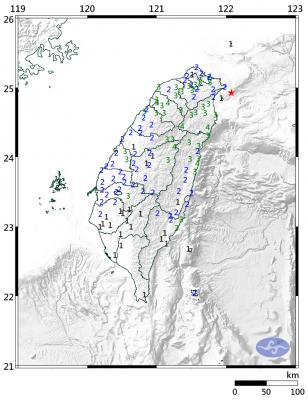
A magnitude 6.1 earthquake struck off the coast of Yilan County at 8:39pm tonight, the Central Weather Administration (CWA) said, with no immediate reports of damage or injuries. The epicenter was 38.7km east-northeast of Yilan County Hall at a focal depth of 98.3km, the CWA’s Seismological Center said. The quake’s maximum intensity, which gauges the actual physical effect of a seismic event, was a level 4 on Taiwan’s 7-tier intensity scale, the center said. That intensity level was recorded in Yilan County’s Nanao Township (南澳), Hsinchu County’s Guansi Township (關西), Nantou County’s Hehuanshan (合歡山) and Hualien County’s Yanliao (鹽寮). An intensity of 3 was
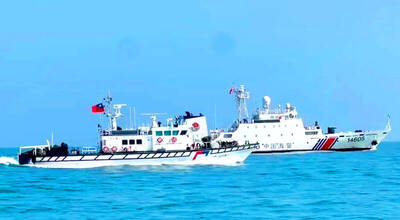
Instead of focusing solely on the threat of a full-scale military invasion, the US and its allies must prepare for a potential Chinese “quarantine” of Taiwan enforced through customs inspections, Stanford University Hoover fellow Eyck Freymann said in a Foreign Affairs article published on Wednesday. China could use various “gray zone” tactics in “reconfiguring the regional and ultimately the global economic order without a war,” said Freymann, who is also a nonresident research fellow at the US Naval War College. China might seize control of Taiwan’s links to the outside world by requiring all flights and ships entering or leaving Taiwan
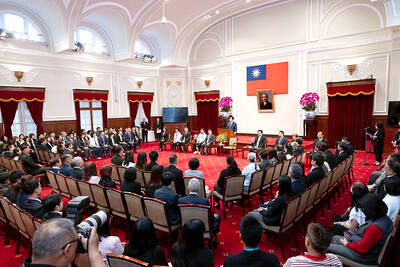
The next minimum wage hike is expected to exceed NT$30,000, President William Lai (賴清德) said yesterday during an award ceremony honoring “model workers,” including migrant workers, at the Presidential Office ahead of Workers’ Day today. Lai said he wished to thank the awardees on behalf of the nation and extend his most sincere respect for their hard work, on which Taiwan’s prosperity has been built. Lai specifically thanked 10 migrant workers selected for the award, saying that although they left their home countries to further their own goals, their efforts have benefited Taiwan as well. The nation’s industrial sector and small businesses lay
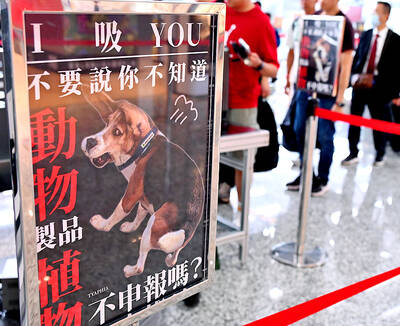
Quarantine awareness posters at Taiwan Taoyuan International Airport have gone viral for their use of wordplay. Issued by the airport branch of the Animal and Plant Health Inspection Agency, the posters feature sniffer dogs making a range of facial expressions, paired with advisory messages built around homophones. “We update the messages for holidays and campaign needs, periodically refreshing materials to attract people’s attention,” quarantine officials said. “The aim is to use the dogs’ appeal to draw focus to quarantine regulations.” A Japanese traveler visiting Taiwan has posted a photo on X of a poster showing a quarantine dog with a


 RSS
RSS