


Marathon negotiations between the Democratic Progressive Party (DPP) and Chinese Nationalist Party (KMT) caucuses narrowly averted tussles in two key legislative committees yesterday, as parrying over transitional justice legislation continued.
Following talks on Tuesday and yesterday morning with the Internal Administration Committee’s co-convener Huang Chao-shun (黃昭順) of the KMT, former legislative speaker Wang Jin-pyng (王金平) and KMT caucus whip Lin Te-fu (林德福), DPP caucus whip Ker Chien-ming (柯建銘) said an agreement was reached to overturn decisions at a meeting of the committee on Monday night in return for an adjustment to public hearings on transitional justice legislation that the KMT had demanded.
“We have both taken a step back because we want legislative business to proceed smoothly with everyone able to state their views,” Ker said. “Transitional justice legislation is unavoidable because it reflects a core DPP value — as does legislation on illicit party assets.”
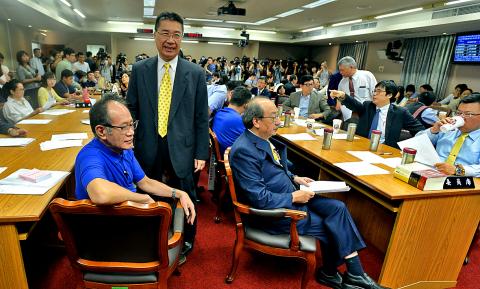
Photo: Lin Cheng-kung, Taipei Times
“This is a time for both parties to display calm, because it is not good for anyone’s public image if clashes continue,” he said.
Ker said that the committee’s passage of amendments to the Act Governing Relations Between the People of the Taiwan Area and the Mainland Area (臺灣地區與大陸地區人民關係條例) would only lead to conflict and tension if put to a vote in a general assembly.
The KMT attempted to pass the amendments late on Monday, despite a lack of a majority.
Throughout Monday afternoon, DPP and KMT committee members were in a deadlock over the proposed amendments, which would shorten residency requirements for Chinese spouses to gain national ID cards from six years to four years, with Huang repeatedly declaring recesses rather than allowing votes on DPP motions to adjourn.
After the official scheduled conclusion of the committee meeting, Huang returned to the committee room with other KMT members, taking advantage of the absence of DPP members to pass the amendments, saying later that such “guerilla warfare” was necessary to combat the DPP’s “majoritarian violence.”
“We have always said that we want the legislative process to run smoothly and allow for substantial discussion, but the opinions of both the majority and minority have to be respected,” Huang said yesterday. “You cannot use a motion to adjourn to keep us from talking.”
Huang agreed to overturn the minutes of Monday’s committee meeting, returning the amendments to the committee review process.
The DPP maintained that combining a review of the amendments with revisions to the Immigration Act (入出國及移民法), the Nationality Act (國籍法) and a proposed refugee law is inappropriate.
Controversy also erupted at a meeting of the Legislative Yuan’s Judiciary and Organic Laws and Statutes Committee this week after the committee’s DPP majority yesterday moved to convene a final public hearing on the promotion of transitional justice.
The hearing is to be held on Monday next week, according to yesterday’s agreement.
While the committee passed a resolution calling for KMT and DPP co-convers to each hold two public hearings on the legislation before substantive review begins, KMT co-convener Lin Wei-chou (林為洲) previously failed to agree to a date for his second hearing.
Monday’s passage of amendments to the Act Governing Relations Between the People of the Taiwan Area and the Mainland Area in some ways echoed an earlier passage of legislation directed at the KMT’s “illicit party assets” after the Internal Administration Committee’s DPP majority voted to extend a meeting until legislative review is completed, sparking a KMT walkout.
However, no formal resolution was passed to extend Monday’s meeting into the evening, creating controversy over whether the Internal Administration Committee was still in session on Monday night when Huang announced the end of the afternoon recess.
“The only reason the KMT was willing to make an exchange [dropping Monday’s amendment passage] is because they care most about the ‘illicit asset’ and transitional justice promotion bills,” DPP Internal Administration Committee convener Chen Chi-mai (陳其邁) said, adding that the opposition party had sought to “bind” the issues together.

The military has spotted two Chinese warships operating in waters near Penghu County in the Taiwan Strait and sent its own naval and air forces to monitor the vessels, the Ministry of National Defense (MND) said. Beijing sends warships and warplanes into the waters and skies around Taiwan on an almost daily basis, drawing condemnation from Taipei. While the ministry offers daily updates on the locations of Chinese military aircraft, it only rarely gives details of where Chinese warships are operating, generally only when it detects aircraft carriers, as happened last week. A Chinese destroyer and a frigate entered waters to the southwest
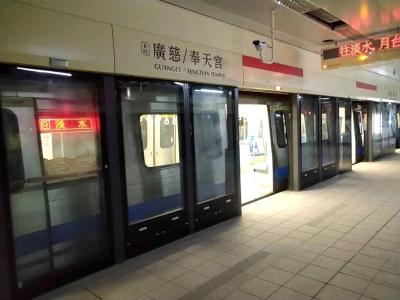
The eastern extension of the Taipei MRT Red Line could begin operations as early as late June, the Taipei Department of Rapid Transit Systems said yesterday. Taipei Rapid Transit Corp said it is considering offering one month of free rides on the new section to mark its opening. Construction progress on the 1.4km extension, which is to run from the current terminal Xiangshan Station to a new eastern terminal, Guangci/Fengtian Temple Station, was 90.6 percent complete by the end of last month, the department said in a report to the Taipei City Council's Transportation Committee. While construction began in October 2016 with an
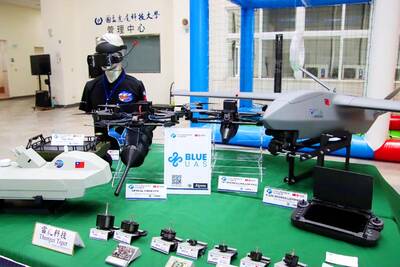
NON-RED SUPPLY: Boosting the nation’s drone industry is becoming increasingly urgent as China’s UAV dominance could become an issue in a crisis, an analyst said Taiwan’s drone exports to Europe grew 41.7-fold from 2024 to last year, with demand from Ukraine’s fight against Russian aggression the most likely driver of growth, a study showed. The Institute for Democracy, Society and Emerging Technology (DSET) in a statement on Wednesday said it found that many of Taiwan’s uncrewed aerial vehicle (UAV) sales were from Poland and the Czech Republic. These countries likely transferred the drones to Ukraine to aid it in its fight against the Russian invasion that started in 2022, it said. Despite the gains, Taiwan is not the dominant drone exporter to these markets, ranking second and fourth

Japanese Prime Minister Sanae Takaichi’s comment last year on Tokyo’s potential reaction to a Taiwan-China conflict has forced Beijing to rewrite its invasion plans, a retired Japanese general said. Takaichi told the Diet on Nov. 7 last year that a Chinese naval blockade or military attack on Taiwan could constitute a “survival-threatening situation” for Japan, potentially allowing Tokyo to exercise its right to collective self-defense. Former Japan Ground Self-Defense Force general Kiyofumi Ogawa said in a recent speech that the remark has been interpreted as meaning Japan could intervene in the early stages of a Taiwan Strait conflict, undermining China’s previous assumptions


 RSS
RSS