


Chinese Nationalist Party (KMT) Legislator Chiang Wan-an (蔣萬安) yesterday suggested that the government engage in cross-strait interactions via a “second track,” which would involve think tanks, academics and “former government officials.”
Chiang at yesterday’s legislative question-and-answer session pressed Mainland Affairs Council Minister Katherine Chang (張小月) on whether the government that took over last month has so far “maintained the [cross-strait] ‘status quo’ that it has promised to maintain.”
“Has the cross-strait status quo been maintained since May 20? [I just need] a simple answer,” Chiang asked, repeating the question several times.
Chang refused to answer the question directly, saying that cross-strait peace has been maintained and is stable, but that there is room for improvement.
Chang was also questioned on whether any direct calls via the “hotline” between her and China’s Taiwan Affairs Council Minister Zhang Zhijun (張志軍) have been made and whether negotiation on functional matters between the Straits Exchange Foundation (SEF) and China’s Association for Relations Across the Taiwan Straits (ARATS) has been ongoing since May 20.
“The hotline is for major or urgent issues,” Chang responded, saying that no direct call with Zhang has taken place since the new administration took office “as there have not been any major issues.”
As for functional negotiations between the SEF and ARATS, Chang said that would “require efforts from both sides of the Taiwan Strait.”
Chiang said he considers the current state, with no direct calls being made and the functional negotiations halted, tantamount to a “cold standoff.”
He asked whether Premier Lin Chuan (林全) has ever thought about engaging in cross-strait interactions via a “second track,” which would be carried out by non-governmental individuals, such as think tank representatives, academics and former government officials.
Lin said that he would not rule out promoting friendly communication if such interactions are undertaken on an “equal footing” and under the condition that the nation’s dignity is not compromised.
The “second track” proposal raised by Chiang echoed what KMT Vice Chairman Hau Lung-bin (郝龍斌) said on Saturday last week in Yunnan, China, about expecting the party to be a “second-track” mechanism for cross-strait peace.
Meanwhile, Democratic Progressive Party Legislator Lee Kun-tse (李昆澤) criticized the management of Taiwan Taoyuan International Airport, which suffered a water outage due to construction on Monday and several leaks in the second terminal yesterday.
Lee said that the public is now watching how the new government is going to tackle the problems of the Taoyuan airport.
“This will be an important performance indicator. If the new government cannot save the airport, how would the public have faith in us and leave the nation to us?” Lee asked.
Lin said that the airport’s management has “failed to meet [his] expectations,” adding that he has required the new president of Taoyuan International Airport Corp to file a report within a month.
Lin added that he has also talked to Minister of Transportation and Communications Hochen Tan (賀陳旦) about inviting foreign experts to examine the airport on various levels, such as its operations, architecture, emergency response and anti-terror mechanism.

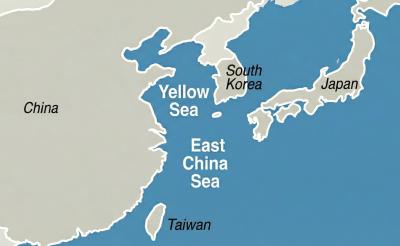
China has reserved offshore airspace in the Yellow Sea and East China Sea from March 27 to May 6, issuing alerts usually used to warn of military exercises, although no such exercises have been announced, the Wall Street Journal (WSJ) reported yesterday. Reserving such a large area for 40 days without explanation is an “unusual step,” as military exercises normally only last a few days, the paper said. These alerts, known as Notice to Air Missions (Notams), “are intended to inform pilots and aviation authorities of temporary airspace hazards or restrictions,” the article said. The airspace reserved in the alert is

NAMING SPAT: The foreign ministry called on Denmark to propose an acceptable solution to the erroneous nationality used for Taiwanese on residence permits Taiwan has revoked some privileges for Danish diplomatic staff over a Danish permit that lists “Taiwan” as “China,” Eric Huang (黃鈞耀), head of the Ministry of Foreign Affairs’ Department of European Affairs, told a news conference in Taipei yesterday. Reporters asked Huang whether the Danish government had responded to the ministry’s request that it correct the nationality on Danish residence permits of Taiwanese, which has been listed as “China” since 2024. Taiwan’s representative office in Denmark continues to communicate with the Danish government, and the ministry has revoked some privileges previously granted to Danish representatives in Taiwan and would continue to review

More than 6,000 Taiwanese students have participated in exchange programs in China over the past two years, despite the Mainland Affairs Council’s (MAC) “orange light” travel advisory, government records showed. The MAC’s publicly available registry showed that Taiwanese college and university students who went on exchange programs across the Strait numbered 3,592 and 2,966 people respectively. The National Immigration Agency data revealed that 2,296 and 2,551 Chinese students visited Taiwan for study in the same two years. A review of the Web sites of publicly-run universities and colleges showed that Taiwanese higher education institutions continued to recruit students for Chinese educational programs without

A bipartisan group of US senators has introduced a bill to enhance cooperation with Taiwan on drone development and to reduce reliance on supply chains linked to China. The proposed Blue Skies for Taiwan Act of 2026 was introduced by Republican US senators Ted Cruz and John Curtis, and Democratic US senators Jeff Merkley and Andy Kim. The legislation seeks to ease constraints on Taiwan-US cooperation in uncrewed aerial systems (UAS), including dependence on China-sourced components, limited access to capital and regulatory barriers under US export controls, a news release issued by Cruz on Wednesday said. The bill would establish a "Blue UAS


 RSS
RSS