


The Ministry of Culture said its planned “Taiwanese Trail of Democracy and Human Rights” project would stand witness to the nation’s ongoing implementation of transitional justice and would also provide future generations with lessons from the past.
The project stems from an initiative Minster of Culture Cheng Li-chun (鄭麗君) proposed in November last year when, as a Democratic Progressive Party (DPP) lawmaker, she said she hoped to emulate the Freedom Trail in Boston and link important historical sites on the path along the development of democracy and human rights in Taiwan.
Cheng’s aides said Cheng has always been interested in the preservation of sites that witnessed the development of Taiwan’s democracy and human rights, and “her dreams will guide the ministry’s policies in years to come [now that she is the minister of culture].”
The ministry said that over the past year, National Democracy and Human Rights Museum staff have been conducting on-site inspections of various historical landmarks, as well as researching historical files and housing records to better understand how sites related to the White Terror era are preserved.
The White Terror era refers to a period of repression that began after the 228 Incident in 1947, when an anti-government uprising was violently suppressed by the then-Chinese Nationalist Party (KMT) government, which later declared martial law and initiated purges.
Historians estimate that between 10,000 and 30,000 people were killed during the crackdown.
Ministry officials said the museum is also looking into the geographical location and the history of these sites, as well as asking political victims or local elders the stories of the time. The museum has completed research and investigation for 45 locations.
Twenty-three of the 45 locations were in Taipei, ministry officials said, adding that the ministry would arrange the locations into categories, such as judgment area, transition, serving of sentence, execution squares, sites of historical events, and memorial sites.
Some of the buildings in the areas no longer exist — such as the Dongbenyuan Temple, which was used to interrogate and torture political prisoners, or the Martial Law Detention Center on Qingdao E Road — either due to deterioration or urban renewal projects, the ministry said.
Excluding sites related to the White Terror era that have already been designated as heritage sites or cultural assets, the ministry said it would help local governments register other White Terror-era related areas as cultural assets, such as Taipei’s Huashan Terminal that served as a transport point for political prisoners.
The Liuzhangli Public Cemetery, known as a burial site for many political victims in the White Terror era, last month was designated by the Taipei City Government as a cultural asset, ministry officials said, adding that it is “an important step in preserving historical sites in relation to the fight for human rights.”

The manufacture of the remaining 28 M1A2T Abrams tanks Taiwan purchased from the US has recently been completed, and they are expected to be delivered within the next one to two months, a source said yesterday. The Ministry of National Defense is arranging cargo ships to transport the tanks to Taiwan as soon as possible, said the source, who is familiar with the matter. The estimated arrival time ranges from late this month to early next month, the source said. The 28 Abrams tanks make up the third and final batch of a total of 108 tanks, valued at about NT$40.5 billion
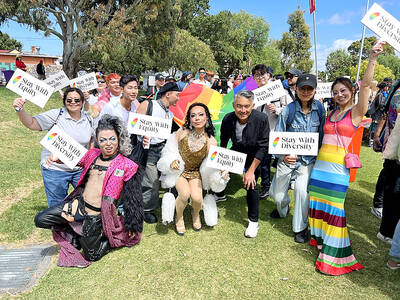
A group from the Taiwanese Designers in Australia association yesterday represented Taiwan at the Midsumma Pride March in Melbourne. The march, held in the St. Kilda suburb, is the city’s largest LGBTQIA+ parade and the flagship event of the annual Midsumma Festival. It attracted more than 45,000 spectators who supported the 400 groups and 10,000 marchers that participated this year, the association said. Taiwanese Designers said they organized a team to march for Taiwan this year, joining politicians, government agencies, professionals and community organizations in showing support for LGBTQIA+ people and diverse communities. As the first country in Asia to legalize same-sex
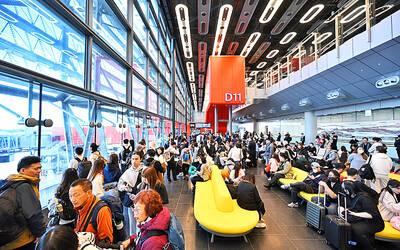
Travel agencies in Taiwan are working to secure alternative flights for travelers bound for New Zealand for the Lunar New Year holiday, as Air New Zealand workers are set to strike next week. The airline said that it has confirmed that the planned industrial action by its international wide-body cabin crew would go ahead on Thursday and Friday next week. While the Auckland-based carrier pledged to take reasonable measures to mitigate the impact of the workers’ strike, an Air New Zealand flight arriving at Taipei from Auckland on Thursday and another flight departing from Taipei for Auckland on Saturday would have to
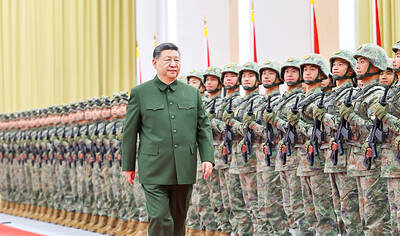
MOTIVES QUESTIONED The PLA considers Xi’s policies toward Taiwan to be driven by personal considerations rather than military assessment, the Epoch Times reports Chinese President Xi Jinping’s (習近平) latest purge of the Chinese People’s Liberation Army (PLA) leadership might have been prompted by the military’s opposition to plans of invading Taiwan, the Epoch Times said. The Chinese military opposes waging war against Taiwan by a large consensus, putting it at odds with Xi’s vision, the Falun Gong-affiliated daily said in a report on Thursday, citing anonymous sources with insight into the PLA’s inner workings. The opposition is not the opinion of a few generals, but a widely shared view among the PLA cadre, the Epoch Times cited them as saying. “Chinese forces know full well that


 RSS
RSS