


Taiwan should not lose sight of the big picture in its trade relations with the US, as US pork imports are only one of the many trade matters being discussed between the two sides, a US Department of State official said on Tuesday.
“We can talk about the pork issue in more detail, but we also want to make sure that we’re focused on the overall economic relationship, which is so key to people in both of our economies,” US principal deputy assistant secretary of state in the Bureau of East Asian and Pacific Affairs Susan Thornton said in an interview.
Noting that Taiwan is the US’ ninth-largest trading partner and its seventh-largest market for agricultural products, Thornton said the two sides are discussing a wide range of issues under the bilateral Trade and Investment Framework Agreement (TIFA).
These issues, for instance, include increasing trade and encouraging Taiwanese investments in the US, she said.
What Taiwan and the US are discussing under the TIFA would also “be a kind of a stepping stone to things that would need to be done by Taiwan in order to qualify itself for entry into TPP [Trans-Pacific Partnership],” Thornton added.
On the question of Taiwan’s ban on US pork that contains residues of the leanness-enhancing drug ractopamine, Thornton said Taiwan’s standards on meat imports would be one of the issues that would “come into play at some point” in bilateral talks.
The US stance is that “these kinds of standards should be based on scientific standards and things that can be shown and proven through experience and experimentation,” she said.
During President Ma Ying-jeou’s (馬英九) first term in office, the US pushed for the government to lift the ban on US beef containing ractopamine as a condition to restarting TIFA talks, which had been suspended since 2007.
The Democratic Progressive Party (DPP) adamantly opposed lifting the ban until the Codex Alimentarius Commission, a UN body that sets food standards, voted in July 2012 to allow ractopamine residues in pork, beef and turkey.
Soon after the Codex vote, the government formally eased the ban on US beef imports containing traces of ractopamine, which led to the resumption of TIFA talks.
However, the Ma administration and the DPP have continued to support “zero tolerance” for ractopamine in pork imports, which became a subject of debate ahead of the Jan. 16 presidential and legislative elections.
The DPP and president-elect Tsai Ing-wen (蔡英文) have since said that there is no preset stance on the US pork issue, but they would handled it in line with international regulations and with the goals of ensuring food safety and reducing the impact on Taiwan’s pig farming industry.

SHIPS, TRAINS AND AUTOMOBILES: The ministry has announced changes to varied transportation industries taking effect soon, with a number of effects for passengers Beginning next month, the post office is canceling signature upon delivery and written inquiry services for international registered small packets in accordance with the new policy of the Universal Postal Union, the Ministry of Transportation and Communications said yesterday. The new policy does not apply to packets that are to be delivered to China, the ministry said. Senders of international registered small packets would receive a NT$10 rebate on postage if the packets are sent from Jan. 1 to March 31, it added. The ministry said that three other policies are also scheduled to take effect next month. International cruise ship operators
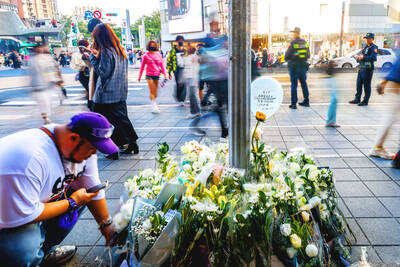
HORROR STORIES: One victim recounted not realizing they had been stabbed and seeing people bleeding, while another recalled breaking down in tears after fleeing A man on Friday died after he tried to fight the knife-wielding suspect who went on a stabbing spree near two of Taipei’s busiest metro stations, Taipei Mayor Chiang Wan-an (蔣萬安) said. The 57-year-old man, identified by his family name, Yu (余), encountered the suspect at Exit M7 of Taipei Main Station and immediately tried to stop him, but was fatally wounded and later died, Chiang said, calling the incident “heartbreaking.” Yu’s family would receive at least NT$5 million (US$158,584) in compensation through the Taipei Rapid Transit Corp’s (TRTC) insurance coverage, he said after convening an emergency security response meeting yesterday morning. National

PLANNED: The suspect visited the crime scene before the killings, seeking information on how to access the roof, and had extensively researched a 2014 stabbing incident The suspect in a stabbing attack that killed three people and injured 11 in Taipei on Friday had planned the assault and set fires at other locations earlier in the day, law enforcement officials said yesterday. National Police Agency (NPA) Director-General Chang Jung-hsin (張榮興) said the suspect, a 27-year-old man named Chang Wen (張文), began the attacks at 3:40pm, first setting off smoke bombs on a road, damaging cars and motorbikes. Earlier, Chang Wen set fire to a rental room where he was staying on Gongyuan Road in Zhongzheng District (中正), Chang Jung-hsin said. The suspect later threw smoke grenades near two exits
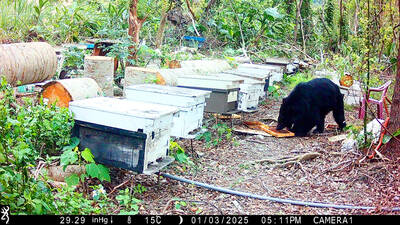
The Forestry and Nature Conservation Agency yesterday launched a gift box to market honey “certified by a Formosan black bear” in appreciation of a beekeeper’s amicable interaction with a honey-thieving bear. Beekeeper Chih Ming-chen (池明鎮) in January inspected his bee farm in Hualien County’s Jhuosi Township (卓溪) and found that more than 20 beehives had been destroyed and many hives were eaten, with bear droppings and paw prints near the destroyed hives, the agency said. Chih returned to the farm to move the remaining beehives away that evening when he encountered a Formosan black bear only 20m away, the agency said. The bear


 RSS
RSS