


The Chiang Kai-shek Memorial Hall is a symbol of autocracy and the public should decide how it can be better used, academics and legislators of the New Power Party (NPP) said yesterday as they called on the incoming government of president-elect Tsai Ing-wen (蔡英文) to set transitional justice in motion as Tsai promised during her election campaign.
NPP Legislator Hsu Yung-ming (徐永明) said that the memorial, a massive edifice located in downtown Taipei, is ironic from the perspective of transitional justice.
However, Hsu said that he is against the idea of demolishing the building, as many people whose family members were victims of the 228 Incident and the ensuing White Terror era have suggested, as it would only serve to aggravate the tensions between the pan-green and pan-blue camps.
He said that promoting transitional justice should not be a top-down effort, but rather one that requires public consensus.
Hsu said that the memorial hall would inevitably be torn down in about 20 years to meet the needs of urban development and that he hopes until that day the building can serve as a place where younger generations can learn about the nation’s totalitarian past.
Feng Chia University assistant professor Hsin Nien-feng (辛年豐) said that the hall is a symbol of authoritarianism and imperialism built on public land, and that its pillars sculpted in the shape of lions bearing messages convey the Chiang family’s desire for a hereditary regime.
He questioned the legitimacy of commemorating Chiang Kai-shek (蔣介石), whom he called a dictator who violated democratic values and human rights.
He said that the reinvention of the memorial hall should be a process of democratic values overthrowing authoritarianism, and democracy consolidated through legislative discussion.
Southern Taiwan University of Science and Technology assistant professor Charles Lo (羅承宗) said that Tsai’s administration should follow the precedent set by Kaohsiung Mayor Chen Chu (陳菊) in 2007 when her administration moved Chiang’s statue in the then-Chiang Kai-shek Cultural Center to the Tzuhu (慈湖) Presidential Burial Place in Taoyuan and renamed the park the Kaohsiung Cultural Center.
Lo said that not just officials, but also civilians had made remarkable contributions to the nation and that the building should be transformed into a memorial dedicated to all those historical figures.
He said the memorial hall managed by the Ministry of Culture has been used for commercial activities, such as holding dinosaur exhibitions, and that the complex would be more welcoming for visitors if the complex’s space is utilized better, and the National Theater and National Concert Hall — both also managed by the ministry — were allocated more exhibition halls and more commercial space for restaurants.
Social activist Peng Yang-kai (彭揚凱) said that open discussions and the ability to accommodate diverse opinions are the core values of transitional justice, and by encouraging members of the public to become involved in the debate on the reinvention of the hall it would teach people how to carry out a pluralistic dialogue, which is often disregarded in the decisionmaking process.
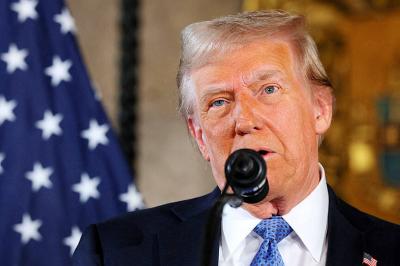
US President Donald Trump said "it’s up to" Chinese President Xi Jinping (習近平) what China does on Taiwan, but that he would be "very unhappy" with a change in the "status quo," the New York Times said in an interview published yesterday. Xi "considers it to be a part of China, and that’s up to him what he’s going to be doing," Trump told the newspaper on Wednesday. "But I’ve expressed to him that I would be very unhappy if he did that, and I don’t think he’ll do that," he added. "I hope he doesn’t do that." Trump made the comments in
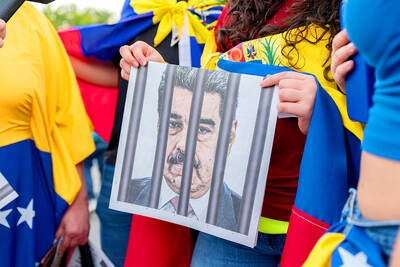
NOT AN OPENING: Trump’s violation of international law does not affect China’s consideration in attacking Taiwan; Beijing lacks capability, not precedent, an official said Taiwanese officials see the US’ capture of the president of Venezuela as a powerful deterrent to Beijing’s aggression and a timely reminder of the US’ ability to defeat militaries equipped with Chinese-made weapons. The strikes that toppled Venezuelan President Nicolas Maduro signaled to authoritarian leaders, including Chinese President Xi Jinping (習近平), US President Donald Trump’s willingness to use military might for international affairs core to US interests, one senior official in Taipei’s security circle said. That reassured Taiwan, the person said. Taipei has also dismissed the idea that Trump’s apparent violation of international law could embolden Beijing, said the official, who was not
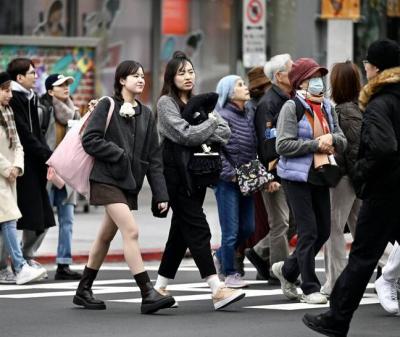
A cold surge advisory was today issued for 18 cities and counties across Taiwan, with temperatures of below 10°C forecast during the day and into tonight, the Central Weather Administration (CWA) said. New Taipei City, Taipei, Taoyuan and Hsinchu, Miaoli and Yilan counties are expected to experience sustained temperatures of 10°C or lower, the CWA said. Temperatures are likely to temporarily drop below 10°C in most other areas, except Taitung, Pingtung, Penghu and Lienchiang (Matsu) counties, CWA data showed. The cold weather is being caused by a strong continental cold air mass, combined with radiative cooling, a process in which heat escapes from
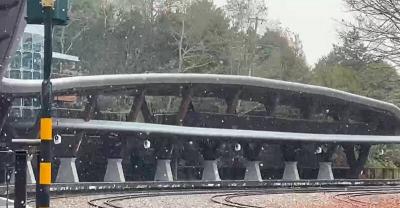
Snow this morning fell on Alishan for the first time in seven years, as a strong continental cold air mass sent temperatures plunging across Taiwan, the Central Weather Administration (CWA) said. The Alishan weather station, located at an elevation of about 2,200m in central Taiwan, recorded snowfall from 8:55am to 9:15am, when the temperature dropped to about 1°C, the CWA said. With increased moisture and low temperatures in the high-altitude Alishan area, the conditions were favorable for snow, CWA forecaster Tsai Yi-chi (蔡伊其) said. The last time snow fell at the Alishan weather station was on Jan. 10, 2018, while graupel fell there


 RSS
RSS