


Civil activists yesterday announced plans to hold local forums to pressure legislators on a draft bill to supervise cross-strait agreements, demanding that any review of the draft legislation be put on hold until after Democratic Progressive Party (DPP) president-elect Tsai Ing-wen (蔡英文) takes office.
About 10 protesters from the Economic Democracy Union, Democracy Tautin and other groups gathered in front of DPP headquarters in Taipei, calling on the party to remember the Sunflower movement, as the Legislative Yuan prepares to begin a review of a bill imposing new regulatory standards on negotiations with China.
“We should have come to DPP headquarters to ‘pound the table’ long ago, but we are not here to pound the table today,” Democracy Tautin general coordinator June Lin (林倢) said, referring to statements by Tsai that activists should not hesitate to engage in “table-pounding” if they feel the government is ignoring their views.
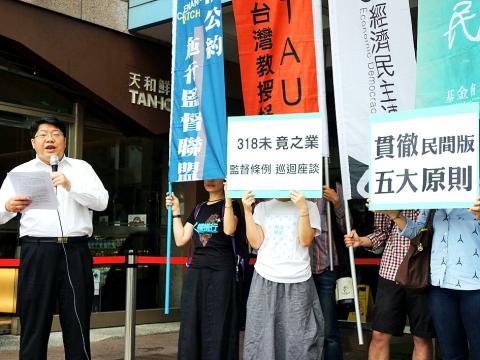
Photo: CNA
Activists last week promised to take action if the DPP refused to agree to talks and open debate over the supervisory bill, questioning the DPP draft legislation’s use of the word “area” to refer to Taiwan, as well as the exemption of the service trade agreement from the new requirements.
Forums announced yesterday are to target DPP members of the Legislative Yuan’s Internal Administration Committee — which is responsible for the supervisory bill’s initial review — demanding that legislators pass amendments to the legislation to reflect their demands.
“We will target the committee members — not just the DPP itself — because they have the real authority to determine the articles’ content, and influence between legislators and the party flows both ways,” Economic Democracy Union convener Lai Chung-chiang (賴中強) said. “We are willing to discuss the articles within the framework of the DPP’s official version, but politics by nature includes diversity.”
The DPP caucus has asked party lawmakers to withdraw individual versions of supervisory articles and support the party’s official version.
“I have to remind the DPP that ‘the same water which floats boats also sinks boats,’” he said, urging the party not to forget the Sunflower movement’s contributions to its victory in January’s elections and promising to begin “table-pounding” if the party fails to provide a response by Tsai’s inauguration on May 20.
Lai said that any review of the articles should be put on hold until Tsai takes office to allow for meaningful debate with the government officials who would be responsible for implementing the legislation.
Responding to the group’s invitation for a debate, DPP Legislator Lee Chun-yi (李俊俋) said he would not accept it.
“There are now seven different proposals [for the bill to monitor cross-strait agreements], and we should follow the Legislative Yuan’s due process by holding public hearings to collect opinions on the different versions,” Lee said. “The Economic Democracy Union’s criticism of the DPP and what they say are not always true.”
DPP Legislator Lai Jui-lung (賴瑞隆) echoed Lee’s view, saying that different opinions should be debated in legislative public hearings.
Additional reporting by Loa Iok-sin

LOUD AND PROUD Taiwan might have taken a drubbing against Australia and Japan, but you might not know it from the enthusiasm and numbers of the fans Taiwan might not be expected to win the World Baseball Classic (WBC) but their fans are making their presence felt in Tokyo, with tens of thousands decked out in the team’s blue, blowing horns and singing songs. Taiwanese fans have packed out the Tokyo Dome for all three of their games so far and even threatened to drown out home team supporters when their team played Japan on Friday. They blew trumpets, chanted for their favorite players and had their own cheerleading squad who dance on a stage during the game. The team struggled to match that exuberance on the field, with

Taiwanese paleontologists have discovered fossil evidence that pythons up to 4m long inhabited Taiwan during the Pleistocene epoch, reporting their findings in the international scientific journal Historical Biology. National Taiwan University (NTU) Institute of Ecology and Evolutionary Biology associate professor Tsai Cheng-hsiu (蔡政修) led the team that discovered the largest snake fossil ever found in Taiwan. The single trunk vertebra was discovered in Tainan at the Chiting Formation, dated to between 400,000 and 800,000 years ago in the Middle Pleistocene, the paper said. The area also produced Taiwan’s first avian fossil, as well as crocodile, mammoth, saber-toothed cat and rhinoceros fossils, it said. Discoveries

Taiwanese paleontologists have discovered fossil evidence that pythons up to 4m long inhabited Taiwan during the Pleistocene epoch, reporting their findings in the international scientific journal Historical Biology. National Taiwan University (NTU) Institute of Ecology and Evolutionary Biology associate professor Tsai Cheng-hsiu (蔡政修) led the team that discovered the largest snake fossil ever found in Taiwan. A single trunk vertebra was discovered in Tainan at the Chiting Formation, dated to between 800,000 to 400,000 years ago in the Middle Pleistocene, the paper said. The area also produced Taiwan’s first avian fossil, as well as crocodile, mammoth, sabre-toothed cat and rhinoceros fossils, it said. Discoveries

Whether Japan would help defend Taiwan in case of a cross-strait conflict would depend on the US and the extent to which Japan would be allowed to act under the US-Japan Security Treaty, former Japanese minister of defense Satoshi Morimoto said. As China has not given up on the idea of invading Taiwan by force, to what extent Japan could support US military action would hinge on Washington’s intention and its negotiation with Tokyo, Morimoto said in an interview with the Liberty Times (sister paper of the Taipei Times) yesterday. There has to be sufficient mutual recognition of how Japan could provide


 RSS
RSS