


Chinese Nationalist Party (KMT) Chairwoman Hung Hsiu-chu (洪秀柱) yesterday accused the Democratic Progressive Party (DPP) of letting its political agenda against the KMT and President Ma Ying-jeou (馬英九) take precedence over public interests, following several groups’ request that Ma be barred from leaving the country as he may have to face potential prosecution.
“We regret to see Huang Di-ying (黃帝穎) — who sometimes speaks in his capacity as the DPP spokesman, while at other times, as the DPP’s lawyer or a private citizen — file various unsubstantiated charges against Ma yesterday [Tuesday] and request that the president’s right to leave the country be restricted after his term ends,” Hung wrote on Facebook.
Hung was referring to a move by Huang, the Taiwan Forever Association, the Northern Taiwan Society and the Taiwan Association of University Professors on Tuesday calling on the Taipei District Prosecutors’ Office to launch investigations into alleged power abuse and corruption by Ma and to bar him from leaving the country.

Photo: Chien Jung-fong, Taipei Times
Ma’s presidential immunity from prosecution is set to expire on May 20, when he is due to hand over power to president-elect Tsai Ing-wen (蔡英文).
Hung said the DPP has reneged on many of its pledges and policies, including the party’s attempt to avoid any “state to state” dictum from its proposed bill on monitoring cross-strait agreements, its alleged plan to open the nation’s doors to US pork containing ractopamine residue and its welcome for more Chinese tourists to Taiwan.
“At a time when the nation’s eyes are fixed on the developments following Japan’s unreasonable confiscation of a Taiwanese fishing boat [on Monday], what these people are thinking about is how to cook up charges to bring down Ma and the KMT,” Hung said.
Following the deportation of several Taiwanese fraud suspects from Kenya to China earlier this month, a case that could have brought both sides of the Taiwan Strait together to fight crimes and strive for the wellbeing of their people, the DPP sought to obscure the issue and manipulated the incident into an issue of human rights persecution, Hung said.
“Now, in the face of Japan’s forced seizure of Taiwanese fishermen, how come the DPP has stopped caring about human rights and does not fight for these men’s rights?” she said.
Hung said it remains to be seen whether Tsai’s calls for humility in her victory speech after the Jan. 16 presidential election would be just another example of the DPP’s habit of “saying one thing, but doing another.”

LOUD AND PROUD Taiwan might have taken a drubbing against Australia and Japan, but you might not know it from the enthusiasm and numbers of the fans Taiwan might not be expected to win the World Baseball Classic (WBC) but their fans are making their presence felt in Tokyo, with tens of thousands decked out in the team’s blue, blowing horns and singing songs. Taiwanese fans have packed out the Tokyo Dome for all three of their games so far and even threatened to drown out home team supporters when their team played Japan on Friday. They blew trumpets, chanted for their favorite players and had their own cheerleading squad who dance on a stage during the game. The team struggled to match that exuberance on the field, with
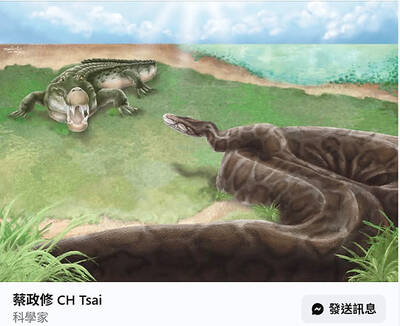
Taiwanese paleontologists have discovered fossil evidence that pythons up to 4m long inhabited Taiwan during the Pleistocene epoch, reporting their findings in the international scientific journal Historical Biology. National Taiwan University (NTU) Institute of Ecology and Evolutionary Biology associate professor Tsai Cheng-hsiu (蔡政修) led the team that discovered the largest snake fossil ever found in Taiwan. The single trunk vertebra was discovered in Tainan at the Chiting Formation, dated to between 400,000 and 800,000 years ago in the Middle Pleistocene, the paper said. The area also produced Taiwan’s first avian fossil, as well as crocodile, mammoth, saber-toothed cat and rhinoceros fossils, it said. Discoveries

Taiwanese paleontologists have discovered fossil evidence that pythons up to 4m long inhabited Taiwan during the Pleistocene epoch, reporting their findings in the international scientific journal Historical Biology. National Taiwan University (NTU) Institute of Ecology and Evolutionary Biology associate professor Tsai Cheng-hsiu (蔡政修) led the team that discovered the largest snake fossil ever found in Taiwan. A single trunk vertebra was discovered in Tainan at the Chiting Formation, dated to between 800,000 to 400,000 years ago in the Middle Pleistocene, the paper said. The area also produced Taiwan’s first avian fossil, as well as crocodile, mammoth, sabre-toothed cat and rhinoceros fossils, it said. Discoveries

Whether Japan would help defend Taiwan in case of a cross-strait conflict would depend on the US and the extent to which Japan would be allowed to act under the US-Japan Security Treaty, former Japanese minister of defense Satoshi Morimoto said. As China has not given up on the idea of invading Taiwan by force, to what extent Japan could support US military action would hinge on Washington’s intention and its negotiation with Tokyo, Morimoto said in an interview with the Liberty Times (sister paper of the Taipei Times) yesterday. There has to be sufficient mutual recognition of how Japan could provide


 RSS
RSS