

Taiwan Power Co’s (Taipower) proposal to build a coal-fired power plant in Changhua County yesterday was rejected for the second time in the project’s 12-year history, while the Environmental Protection Administration (EPA) suspended discussion of the company’s decommissioning plan for the Jinshan Nuclear Power Plant in New Taipei City as it was deemed to be “ill-defined.”
Taipower’s plan to build a two-generator plant in the Changhua Coastal Industrial Park was first submitted for review in 2004. Between 2004 and 2007, the Environmental Impact Assessment (EIA) committee concluded that the project should be rejected.
However, before the EPA could formally adopt the committee’s decision, Taipower withdrew its submission to prevent a wholesale rejection.
The company resubmitted the project in 2008, almost unchanged from its original submission, and in January, the EIA committee rejected the project, as the project does not conform to environment and national energy development plans.
At yesterday’s grand assembly, dozens of protesters criticized the Changhua project, saying the county is surrounded by the Taichung Power Plant and Formosa Plastics Group’s naphtha cracker factory in Yunlin, adding that the proposed plant would only worsen pollution.
After an hour of closed-door deliberations, the assembly rejected the proposal and asked the Ministry of Economic Affairs to reject the company’s development application.
The assembly was also set to review Taipower’s request to have plans to decommission the Jinshan plant go directly to second-phase EIA reviews, but the assembly suspended the review as the plan was unclear.
The 25-year decommissioning plan includes eight years of facility decontamination, 12 years of plant demolition, three years of monitoring and two years of site restoration.
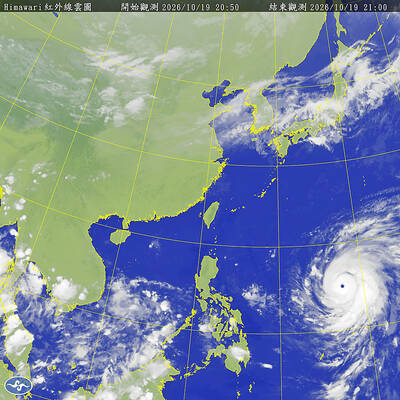
Typhoon Champi is forecast to turn northward earlier than previously expected, sparing Taiwan a direct hit but still bringing heavy rain to the north of the country on Friday and Saturday, the Central Weather Administration (CWA) said yesterday. Typhoon Champi had strengthened and increased in size over the past 12 hours, and as of yesterday afternoon, was packing sustained winds of 198kph near its center, CWA forecaster Cheng Chieh-jen (鄭傑仁) said. However, due to the weakening of a Pacific high-pressure system the storm is now expected to turn northward earlier than initially forecast, likely around Japan’s Ishigaki Island, Cheng said. As Champi brushes
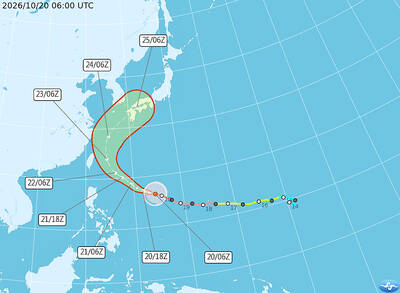
A sea warning for Typhoon Champi might be issued tonight, while the storm’s trajectory would determine whether a land warning is to be issued tomorrow night, the Central Weather Administration (CWA) said yesterday. As of 2pm yesterday, Champi was about 1,536km east-southeast of Taiwan proper’s southernmost point, Oluanpi (鵝鑾鼻), packing maximum sustained winds of 198kph, CWA forecaster Tseng Chao-cheng (曾昭誠) said. The storm was moving west-northwest at 23kph and was expected to strengthen over the next 24 hours before weakening slightly as it approaches cooler waters east of Taiwan, Tseng said. Champi is expected to turn north tomorrow, with the angle of the

A Chinese People's Liberation Army (PLA) Navy aircraft carrier group was being monitored after entering the western Pacific, the Ministry of National Defense said today, after Beijing yesterday criticized Taiwan for using a water cannon against a Chinese fishing boat near the Pratas Islands (Dongsha Islands, 東沙群島). A Chinese naval task group led by the aircraft carrier Liaoning (遼寧) yesterday sailed to the western Pacific for training, Chinese state-run Xinhua news agency quoted the PLA Navy as saying. “The drill is part of the annual routine training plan aimed at testing and improving the troops’ combat readiness and enhancing their ability to
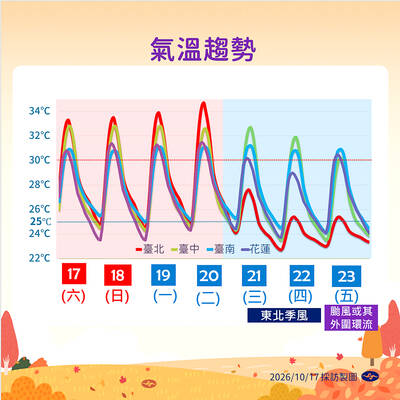
TYPHOON WATCH Champi closes to east Typhoon Champi could continue to strengthen and approach waters off eastern Taiwan by Thursday, with some forecast models suggesting it could move west and cross the nation, the Central Weather Administration (CWA) said yesterday. As of 2pm yesterday, Champi was 2,980km east-southeast of Oluanpi (鵝鑾鼻), Taiwan’s southernmost tip, and moving west at 22kph. It had maximum sustained winds of 162kph and a storm radius of 180km, CWA data showed. CWA forecaster Chang Cheng-chuan (張承傳) said Champi could intensify as it moves west before turning west-northwest toward Taiwan. The storm is expected to reach waters off eastern


 RSS
RSS