


While vinyl records were superseded by compact discs about two decades ago in terms of sales, a recent technological breakthrough in the production of vinyl records might lead to a resurgence in their popularity, especially for audiophiles.
The Taiwan branch of Japanese company Ulvac unveiled samples of its vinyl records — coated in nano-scale molybdenum — at the Hi-End Audio Show in Kaohsiung that opened on Thursday and is to run through today, with more than 200 international brands displaying products at its 80 stalls.
Ulvac demonstrated the technology’s ability to fix common problems that plague vinyl records, such as scratching, poor heat conductivity and susceptibility to static electricity.

Photo: Chang Chung-yi, Taipei Times
According to Kaohsiung Electrical Appliances Association general-director Tsai Chih-liang (蔡志亮), the traditional method of producing LPs has seen no changes since the 1940s and the accompanying problems have never been addressed.
Tsai said that new technology — commonly employed in the semiconductor industry — can be used to protect vinyl records from mold and static charges caused by handling.
Ulvac staff said that the coating helps harden the polyvinyl chloride (PVC) material that records are made of and prevents it from being easily damaged, adding that the coating also allows for more refined sound quality.
Local media reported that the coating was developed by Ulvac Taiwan vice chief executive officer Clare Wei (魏雲祥), who started listening to vinyl records last year.
After discovering the problems associated with the PVC used in the production of records, Wei spent more than NT$150 million (US$4.64 million) on laboratories, equipment and personnel to try to apply the nano-scale coating material on vinyl, the Chinese-language United Daily News reported.
The technology has since received patent rights in Taiwan, the US, Japan and China and the company is planning to participate in this year’s Japanese Good Design Award competition, it added.

The military has spotted two Chinese warships operating in waters near Penghu County in the Taiwan Strait and sent its own naval and air forces to monitor the vessels, the Ministry of National Defense (MND) said. Beijing sends warships and warplanes into the waters and skies around Taiwan on an almost daily basis, drawing condemnation from Taipei. While the ministry offers daily updates on the locations of Chinese military aircraft, it only rarely gives details of where Chinese warships are operating, generally only when it detects aircraft carriers, as happened last week. A Chinese destroyer and a frigate entered waters to the southwest
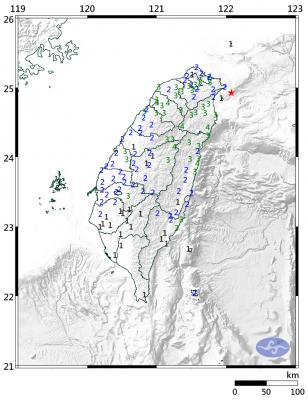
A magnitude 6.1 earthquake struck off the coast of Yilan County at 8:39pm tonight, the Central Weather Administration (CWA) said, with no immediate reports of damage or injuries. The epicenter was 38.7km east-northeast of Yilan County Hall at a focal depth of 98.3km, the CWA’s Seismological Center said. The quake’s maximum intensity, which gauges the actual physical effect of a seismic event, was a level 4 on Taiwan’s 7-tier intensity scale, the center said. That intensity level was recorded in Yilan County’s Nanao Township (南澳), Hsinchu County’s Guansi Township (關西), Nantou County’s Hehuanshan (合歡山) and Hualien County’s Yanliao (鹽寮). An intensity of 3 was

Japanese Prime Minister Sanae Takaichi’s comment last year on Tokyo’s potential reaction to a Taiwan-China conflict has forced Beijing to rewrite its invasion plans, a retired Japanese general said. Takaichi told the Diet on Nov. 7 last year that a Chinese naval blockade or military attack on Taiwan could constitute a “survival-threatening situation” for Japan, potentially allowing Tokyo to exercise its right to collective self-defense. Former Japan Ground Self-Defense Force general Kiyofumi Ogawa said in a recent speech that the remark has been interpreted as meaning Japan could intervene in the early stages of a Taiwan Strait conflict, undermining China’s previous assumptions
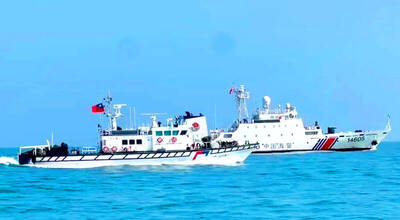
Instead of focusing solely on the threat of a full-scale military invasion, the US and its allies must prepare for a potential Chinese “quarantine” of Taiwan enforced through customs inspections, Stanford University Hoover fellow Eyck Freymann said in a Foreign Affairs article published on Wednesday. China could use various “gray zone” tactics in “reconfiguring the regional and ultimately the global economic order without a war,” said Freymann, who is also a nonresident research fellow at the US Naval War College. China might seize control of Taiwan’s links to the outside world by requiring all flights and ships entering or leaving Taiwan


 RSS
RSS