


President Ma Ying-jeou (馬英九) is facing accusations that he has squandered state funds for personal use, including purchasing concert and movie tickets.
A report by the Chinese-language online news platform SETN.com late on Thursday said Ma has used more than 99 percent of the state affairs fund earmarked for his discretionary use over the past eight years, and that the money was not always spent properly.
For example, the report said Ma used NT$39.958 million (US$1.22 million at current exchange rates) of the NT$40 million state affairs funds allocated in 2012, while there were only about NT$20,000 and NT$30,000 left in the funds in 2013 and 2014 respectively.
Even in the last year of his presidential term, Ma has spent more than half of the NT$30 million allocated for the year in the first six months, the report said.
In addition to using the money to pay for a birthday party banquet for former Chinese Nationalist Party (KMT) chairman Lien Chan (連戰) in 2008, the article also said that the president has used the funds to purchase concert and movie tickets, as well as to treat KMT lawmakers to a meal during each legislative session.
Regulations stipulate that the state affairs fund is to be used by a president for certain purposes, including overseas or local inspection tours, rewards and gifts for guests.
Presidential Office spokesman Charles Chen (陳以信) denied the report in a news release issued later yesterday, saying that Ma has only used the fund for “charitable purposes,” such as inviting his guests to attend cultural events, and has never spent them on recreational activities for himself.
“For instance, in an effort to promote the nation’s cultural activities, Ma invited the spouses of Cabinet members to enjoy a performance by Taiwanese Zen drumming troupe U-Theatre (優人神鼓) in September 2008,” Chen said.
Chen said the president also invited children from disadvantaged families and participants in the 2009 Taipei Deaflympics to a Cirque du Soleil show in January 2009, among others.

The military has spotted two Chinese warships operating in waters near Penghu County in the Taiwan Strait and sent its own naval and air forces to monitor the vessels, the Ministry of National Defense (MND) said. Beijing sends warships and warplanes into the waters and skies around Taiwan on an almost daily basis, drawing condemnation from Taipei. While the ministry offers daily updates on the locations of Chinese military aircraft, it only rarely gives details of where Chinese warships are operating, generally only when it detects aircraft carriers, as happened last week. A Chinese destroyer and a frigate entered waters to the southwest

A magnitude 6.1 earthquake struck off the coast of Yilan County at 8:39pm tonight, the Central Weather Administration (CWA) said, with no immediate reports of damage or injuries. The epicenter was 38.7km east-northeast of Yilan County Hall at a focal depth of 98.3km, the CWA’s Seismological Center said. The quake’s maximum intensity, which gauges the actual physical effect of a seismic event, was a level 4 on Taiwan’s 7-tier intensity scale, the center said. That intensity level was recorded in Yilan County’s Nanao Township (南澳), Hsinchu County’s Guansi Township (關西), Nantou County’s Hehuanshan (合歡山) and Hualien County’s Yanliao (鹽寮). An intensity of 3 was

Japanese Prime Minister Sanae Takaichi’s comment last year on Tokyo’s potential reaction to a Taiwan-China conflict has forced Beijing to rewrite its invasion plans, a retired Japanese general said. Takaichi told the Diet on Nov. 7 last year that a Chinese naval blockade or military attack on Taiwan could constitute a “survival-threatening situation” for Japan, potentially allowing Tokyo to exercise its right to collective self-defense. Former Japan Ground Self-Defense Force general Kiyofumi Ogawa said in a recent speech that the remark has been interpreted as meaning Japan could intervene in the early stages of a Taiwan Strait conflict, undermining China’s previous assumptions
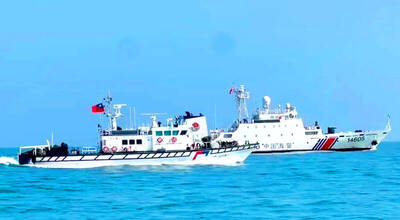
Instead of focusing solely on the threat of a full-scale military invasion, the US and its allies must prepare for a potential Chinese “quarantine” of Taiwan enforced through customs inspections, Stanford University Hoover fellow Eyck Freymann said in a Foreign Affairs article published on Wednesday. China could use various “gray zone” tactics in “reconfiguring the regional and ultimately the global economic order without a war,” said Freymann, who is also a nonresident research fellow at the US Naval War College. China might seize control of Taiwan’s links to the outside world by requiring all flights and ships entering or leaving Taiwan


 RSS
RSS