


Chinese Nationalist Party (KMT) Chairwoman Hung Hsiu-chu (洪秀柱) is reportedly planning to expel former KMT spokesperson Yang Wei-chung (楊偉中) and appoint former KMT legislators Wu Yu-sheng (吳育昇) and Chiu Yi (邱毅) to crucial party positions.
It was reported by Chinese-language magazine the Journalist that while Hung is prepared to make some compromises on her cross-strait stance, she plans to implement some controversial personnel changes.
The magazine said Hung would be a weak chairperson, considering that she was elected with the lowest percentage of votes obtained in a KMT chairperson election — with the lowest voter turnout rate.
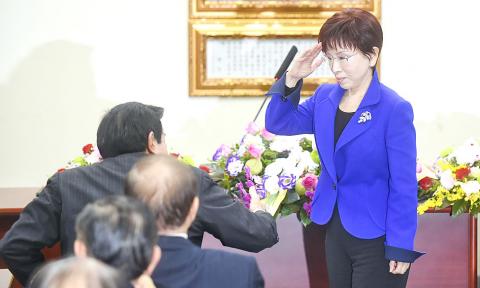
Photo: Liu Hsin-de, Taipei Times
The low turnout rate shows that many members are pessimistic about the party’s future, the article said, citing an anonymous high-level party official as saying that the apathy of party members is the greatest threat facing the KMT.
It might have looked like a landslide victory, as Hung had a 23 percentage-point advantage over the runner-up and won in all six special municipalities, but in truth Hung secured less than a quarter of the votes, the report said.
In places where the party’s “local” faction holds sway, such as Changhua, Yunlin and Chiayi counties, Hung’s support lagged behind that of Huang Min-hui (黃敏惠), who was considered a more “local” candidate.
The article cited sources as saying that Hung would not accentuate her pro-unification stance after inauguration in order to assuage the worries of the party’s “local” faction, and would continue President Ma Ying-jeou’s (馬英九) cross-strait approach of the so-called “1992 consensus” and “one China, different interpretations.”
The “1992 consensus,” refers to a tacit understanding between the KMT and the Chinese government that both sides acknowledge there is “one China,” with each side having its own interpretation of what “China” means.
It remains in question whether Hung will have the KMT legislative caucus’ full support — with the caucus to elect its own caucus whip instead of accepting the party headquarters’ appointment.
The report said that Hung has decided to assign former KMT lawmakers to important party positions who are combative enough and have a positive enough public image to assist the party caucus in legislative battles.
The magazine quoted a KMT official as saying that a “combat intelligence center” has been established in which Wu Yu-sheng and Chiu Yi are prominent.
The center played a crucial role stoking the recent OBI Pharma Inc controversy when the party headquarters had its hands tied with a by-election, the report cited the official as saying.
The magazine cited another source as saying that Hung is unhappy with Yang, who has repeatedly criticized the party, and she is likely to expel Yang.
Yang yesterday said he has faith in the chairperson’s wisdom, but if he is expelled, he would not criticize the party in public.
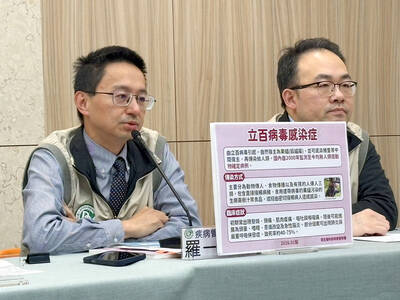
Nipah virus infection is to be officially listed as a category 5 notifiable infectious disease in Taiwan in March, while clinical treatment guidelines are being formulated, the Centers for Disease Control (CDC) said yesterday. With Nipah infections being reported in other countries and considering its relatively high fatality rate, the centers on Jan. 16 announced that it would be listed as a notifiable infectious disease to bolster the nation’s systematic early warning system and increase public awareness, the CDC said. Bangladesh reported four fatal cases last year in separate districts, with three linked to raw date palm sap consumption, CDC Epidemic Intelligence
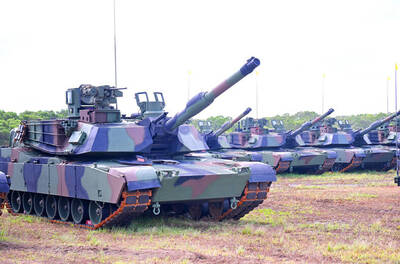
The manufacture of the remaining 28 M1A2T Abrams tanks Taiwan purchased from the US has recently been completed, and they are expected to be delivered within the next one to two months, a source said yesterday. The Ministry of National Defense is arranging cargo ships to transport the tanks to Taiwan as soon as possible, said the source, who is familiar with the matter. The estimated arrival time ranges from late this month to early next month, the source said. The 28 Abrams tanks make up the third and final batch of a total of 108 tanks, valued at about NT$40.5 billion

Two Taiwanese prosecutors were questioned by Chinese security personnel at their hotel during a trip to China’s Henan Province this month, the Mainland Affairs Council (MAC) said yesterday. The officers had personal information on the prosecutors, including “when they were assigned to their posts, their work locations and job titles,” MAC Deputy Minister and spokesman Liang Wen-chieh (梁文傑) said. On top of asking about their agencies and positions, the officers also questioned the prosecutors about the Cross-Strait Joint Crime-Fighting and Judicial Mutual Assistance Agreement, a pact that serves as the framework for Taiwan-China cooperation on combating crime and providing judicial assistance, Liang
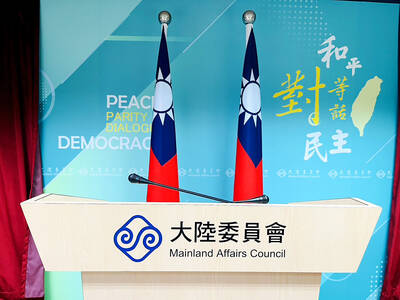
Reports of Taiwanese going missing, being detained or interrogated, or having their personal liberties restricted in China increased about fourfold annually last year, the Mainland Affairs Council (MAC) said yesterday. Last year, 221 Taiwanese who traveled to China were reported missing, were detained and interrogated, or otherwise had their personal freedom restricted, up from 55 the previous year, the council said. Reopening group tours to China would be risky, as it would leave travelers with no way to seek help through official channels after Beijing shut down dialogue between the associations tasked with handling cross-strait tourism, the MAC said. Taipei’s Taiwan Strait Tourism


 RSS
RSS