


There is nothing wrong with the Chinese Nationalist Party (KMT) following in the footsteps of the New Party under the leadership of KMT chairperson-elect Hung Hsiu-chu (洪秀柱), New Party Chairman Yok Mu-ming (郁慕明) said yesterday.
Yok made the remarks at a news conference at New Party headquarters in Taipei.
“Look at Taipei Deputy Mayor Teng Chia-chi (鄧家基) and many other KMT members in the political forefront. Which one of them was not cultivated by the New Party? At least my party has a clear ideology and serves as the benchmark for other parties in terms of vision and general ideology,” Yok said.
With Hung — the KMT’s first female chairperson and a proponent of unification with China — scheduled to assume party leadership today, Yok said some New Party members have expressed the hope that he could lead them in rejoining the KMT to consolidate support for Hung.
However, such a plan would require thorough consideration and planning, Yok said, adding that any talk of KMT-New Party cooperation should wait until Hung makes up her mind on the matter first.
The New Party was established in 1993 by Yok and several other former KMT members who opposed then-KMT chairman and president Lee Teng-hui’s (李登輝) localization policies.
The party’s stated goals are to achieve ethnic harmony and national unification.
Meanwhile, the New Party yesterday released the results of a survey it conducted on Thursday and Friday last week to gauge the Taiwanese public’s awareness of national identity and perception of cross-strait ties.
When asked about the nature of cross-strait relations, 62.4 percent of respondents said it is a “state-to-state” relationship, followed by 18.3 percent who said the two sides of the Taiwan Strait were “split since the end of the Chinese Civil War in 1949 and have yet to be united.”
Although China and President Ma Ying-jeou (馬英九) have said the so-called “1992 consensus” is the foundation for peaceful cross-strait development, 40.3 percent of respondents said president-elect Tsai Ing-wen (蔡英文) does not need to accept the “1992 consensus” to maintain the cross-strait “status quo.”
About 32 percent of respondents said the opposite, while 27.8 percent declined to express an opinion, the survey showed.
The “1992 consensus,” a term former Mainland Affairs Council chairman Su Chi (蘇起) admitted making up in 2000, refers to a supposed understanding between the KMT and the Chinese government that both sides acknowledge there is “one China,” with each side having its own interpretation of what “China” means.
The respondents were divided on whether Tsai should publicly pledge not to declare independence, with 34.9 percent saying Tsai should do so and 34.4 percent saying she should not.
About 30.7 percent said they did not have an opinion.
The poll collected 1,081 valid samples and has a margin of error of 3 percentage points.

LOUD AND PROUD Taiwan might have taken a drubbing against Australia and Japan, but you might not know it from the enthusiasm and numbers of the fans Taiwan might not be expected to win the World Baseball Classic (WBC) but their fans are making their presence felt in Tokyo, with tens of thousands decked out in the team’s blue, blowing horns and singing songs. Taiwanese fans have packed out the Tokyo Dome for all three of their games so far and even threatened to drown out home team supporters when their team played Japan on Friday. They blew trumpets, chanted for their favorite players and had their own cheerleading squad who dance on a stage during the game. The team struggled to match that exuberance on the field, with
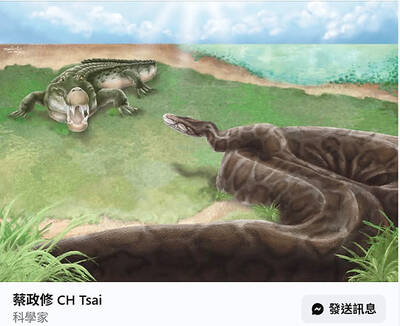
Taiwanese paleontologists have discovered fossil evidence that pythons up to 4m long inhabited Taiwan during the Pleistocene epoch, reporting their findings in the international scientific journal Historical Biology. National Taiwan University (NTU) Institute of Ecology and Evolutionary Biology associate professor Tsai Cheng-hsiu (蔡政修) led the team that discovered the largest snake fossil ever found in Taiwan. The single trunk vertebra was discovered in Tainan at the Chiting Formation, dated to between 400,000 and 800,000 years ago in the Middle Pleistocene, the paper said. The area also produced Taiwan’s first avian fossil, as well as crocodile, mammoth, saber-toothed cat and rhinoceros fossils, it said. Discoveries

Taiwanese paleontologists have discovered fossil evidence that pythons up to 4m long inhabited Taiwan during the Pleistocene epoch, reporting their findings in the international scientific journal Historical Biology. National Taiwan University (NTU) Institute of Ecology and Evolutionary Biology associate professor Tsai Cheng-hsiu (蔡政修) led the team that discovered the largest snake fossil ever found in Taiwan. A single trunk vertebra was discovered in Tainan at the Chiting Formation, dated to between 800,000 to 400,000 years ago in the Middle Pleistocene, the paper said. The area also produced Taiwan’s first avian fossil, as well as crocodile, mammoth, sabre-toothed cat and rhinoceros fossils, it said. Discoveries
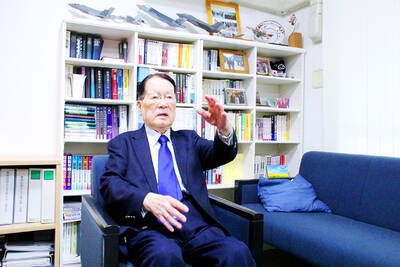
Whether Japan would help defend Taiwan in case of a cross-strait conflict would depend on the US and the extent to which Japan would be allowed to act under the US-Japan Security Treaty, former Japanese minister of defense Satoshi Morimoto said. As China has not given up on the idea of invading Taiwan by force, to what extent Japan could support US military action would hinge on Washington’s intention and its negotiation with Tokyo, Morimoto said in an interview with the Liberty Times (sister paper of the Taipei Times) yesterday. There has to be sufficient mutual recognition of how Japan could provide


 RSS
RSS