


President-elect Tsai Ing-wen (蔡英文) should take advantage of her historic election to use women to fill at least one-third of Cabinet posts, women’s rights advocates said yesterday.
Campaigners from 14 women’s rights organizations gathered at a news conference inside the Legislative Yuan to call on Tsai to make good on a 2012 electoral promise to appoint women to at least one-third of all Cabinet and committee posts.
“We have a lot of hope in [Tsai], because Taiwan’s presidents have done such an awful job and also because her election represents the culmination of the efforts of Taiwan’s entire feminist movement. That a woman like her — without any special political background — could become Taiwan’s president is the fruit of the work of all of our organizations,” Awakening Foundation Chairperson Shen Hsiu-hua (沈秀華) said.
“Because she is the product of progressive forces, we hope that she will continue to push the movement forward,” she added.
Taiwan Women’s Link executive secretary Hsiung Chen-yu (熊晨妤) said that the percentage of women in Cabinets under the administration of President Ma Ying-jeou (馬英九) had fallen almost continuously, reaching a low of 11.4 percent, which was well below the 25 percent Ma promised before taking office.
Most of the Cabinets of the local governments elected last year also failed to reach the 25 percent threshold, she said.
Awakening Foundation board member Chiang Chen-yin (姜貞吟) said representation across ministries was important to allow female voices to be heard in tackling complex interdepartmental issues, such as gender wage gaps and public childcare, adding that the percentage of female national legislators had already reached 38 percent.
Activists also condemned rules against bring children into the Legislative Yuan’s main chamber.
“Many people in society — especially men — say: ‘You women already have enough because we have given you plenty — so there is no need for society to give women any more guarantees,’” National Alliance of Taiwan Women’s Associations secretary-general Hsu Chia-tien said, adding that the criticism of Democratic Progressive Party (DPP) Legislator Karen Yu (余宛如) showed the stubbornness of societal attitudes. “We need to say it is not enough, and we will have to work long and hard to finish everything we need to do.”
“In reality, this is just another unfriendly work environment which discourages female entry,” Chiang Chen-yin said, adding that Legislative Yuan rules reflected a broader neglect of female rights to childcare.
While corporations are legally obligated to provide breastfeeding rooms, there is no penalty if they fail to comply, she said.

FUKUOKA SITUATION: Japanese media reported that the pathogen is expected to be identified by the summer, while the CDC downplayed the idea that it was hMPV A “mysterious cold-like illness” reported in Japan’s Fukuoka Prefecture does not seem to be a new disease, but Japanese authorities have been asked about the situation, the Centers for Disease Control (CDC) said yesterday. The Fukuoka Prefectural Medical Association on Wednesday told a news conference that a “mystery cold” that has become a hot topic on social media is “highly likely to be caused by some kind of viral infection,” Japan’s KBC News reported. “Many people are experiencing symptoms starting with a sore throat, followed by a runny nose, phlegm and a severe cough,” KBC News reported, citing association officials. Health authorities are

Nvidia Corp CEO Jensen Huang (黃仁勳) arrived in Taiwan yesterday ahead of upcoming AI and technology events, saying he plans to meet with clients and Taiwan Semiconductor Manufacturing Co Chairman C.C. Wei (魏哲家) during his visit. After landing at Taipei Songshan Airport, Huang posed for photos with fans and handed out Yakult drinks to reporters and supporters waiting at the scene, saying he has “a lot to do” during the trip. Asked about reports that Nvidia’s planned headquarters site in Taipei’s Beitou Shilin Technology Park could break ground on May 27, Huang said that if the company holds an event, he would

Carrefour Taiwan is to begin using a new name from the start of July, but it cannot divulge the name until then, the chairman of the supermarket chain's parent company said today. President Chain Store Co chairman Lo Chih-hsien (羅智先) was asked by reporters after a shareholders' meeting to confirm whether the company has settled on a new name for the supermarket brand. In March, the government-registered name of two Carrefour Taiwan branches was quietly changed to "Le Chia Kang" (樂家康) in Chinese, raising speculation that has been selected as the name. Lo said that because of local regulations and contractual obligations, the
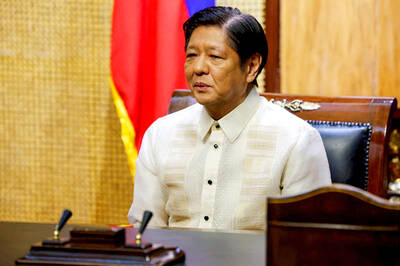
The Philippines would likely be involved in any conflict over Taiwan due to its proximity to the democracy claimed by China, President Ferdinand Marcos Jr said, reiterating a stance that risks angering Beijing. “In the Philippines, we do not have a choice because Taiwan is so close to the Philippines and we have almost 200,000 Filipino nationals living and working in Taiwan,” Marcos said in an interview with Japanese media in Manila on Monday. The Philippine leader’s comments come ahead of a state visit to Japan next week, where he is to meet with Japanese Prime Minister Sanae Takaichi to discuss security


 RSS
RSS