


The Chinese Nationalist Party (KMT) caucus is today expected to put forward its own version of a draft bill on the regulation of political parties’ assets as a counterproposal to similar bills proposed by the Democratic Progressive Party (DPP) caucus, which the KMT said clearly target certain parties.
The KMT caucus yesterday held a meeting at the Taipei-based National Policy Foundation, a KMT think tank, in response to the DPP caucus’ planned second attempt to send its draft bills aimed at dealing with ill-gotten party assets to legislative committees for review today.
The bills proposed by DPP lawmakers were blocked by their KMT counterparts at a legislative plenary session on Friday last week and were sent back to the Procedure Committee.
“The DPP’s bills are apparently tailor-made for certain parties,” KMT caucus secretary-general Lin Te-fu (林德福) said after the meeting. “Nevertheless, the KMT’s assets can undoubtedly withstand scrutiny and we have decided to also refer our drafted regulations on the supervision and administration of political parties’ assets tomorrow [today] for a legislative committee review.”
Lin said that when the DPP was last in power, several Control Yuan members, including Huang Huang-hsiung (黃煌雄), had investigated the KMT’s assets and that the party had also handled parts of its properties that were deemed “problematic.”
President-elect Tsai Ing-wen (蔡英文) has repeatedly pledged to promote rapprochement among political parties, yet her party’s draft bills have indicated otherwise, Lin said.
“The public is welcome to take legal action against the KMT if it suspects impropriety in the party’s assets. We will accept the confiscation of any such assets and that is a consensus of the entire party,” Lin said.
KMT caucus whip Lai Shyh-bao (賴士葆) said the party planned to invite KMT Administration Committee director Lin Yu-hsien (林祐賢) to next week’s caucus meeting and to give KMT lawmakers detailed transaction information on each party asset.
“We also do not rule out releasing such information to the public at a later date,” Lai said.
In a statement issued later yesterday, KMT Acting Chairperson Huang Min-hui (黃敏惠) expressed hopes that the KMT caucus would endeavor to push for significant bills concerning people’s livelihood and serve as a mouthpiece for the people in the Legislative Yuan.
“The KMT should also play its role as a loyal opposition. As the largest opposition party, the party’s future stage will be the Legislative Yuan,” Huang said, adding that the KMT leadership and its think tank would offer unreserved support to party lawmakers in the hope of regaining public trust and returning to power.

FUKUOKA SITUATION: Japanese media reported that the pathogen is expected to be identified by the summer, while the CDC downplayed the idea that it was hMPV A “mysterious cold-like illness” reported in Japan’s Fukuoka Prefecture does not seem to be a new disease, but Japanese authorities have been asked about the situation, the Centers for Disease Control (CDC) said yesterday. The Fukuoka Prefectural Medical Association on Wednesday told a news conference that a “mystery cold” that has become a hot topic on social media is “highly likely to be caused by some kind of viral infection,” Japan’s KBC News reported. “Many people are experiencing symptoms starting with a sore throat, followed by a runny nose, phlegm and a severe cough,” KBC News reported, citing association officials. Health authorities are

Nvidia Corp CEO Jensen Huang (黃仁勳) arrived in Taiwan yesterday ahead of upcoming AI and technology events, saying he plans to meet with clients and Taiwan Semiconductor Manufacturing Co Chairman C.C. Wei (魏哲家) during his visit. After landing at Taipei Songshan Airport, Huang posed for photos with fans and handed out Yakult drinks to reporters and supporters waiting at the scene, saying he has “a lot to do” during the trip. Asked about reports that Nvidia’s planned headquarters site in Taipei’s Beitou Shilin Technology Park could break ground on May 27, Huang said that if the company holds an event, he would

The Ministry of Finance this afternoon announced the winning numbers for the March-April uniform invoice lottery. The winning number for the NT$10 million (US$318,060) special prize is 19531471, and the winning number for the NT$2 million grand prize is 85941329. Three numbers were drawn for the NT$200,000 first prize: 07225810, 20231230 and 83518781. Those with receipts matching the last seven digits of any of the first-prize numbers will win the NT$40,000 second prize, while those matching the last six digits will win the NT$10,000 third prize. Those whose receipts match the last five digits of the first-prize numbers can claim the NT$4,000 fourth prize,
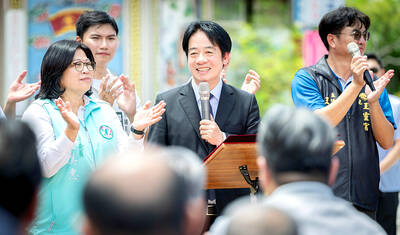
SIX SUBSIDIES: The monthly allowance for older farmers is to increase to NT$10,000, and NT$5,000 is to be given to homemakers under the national pension system, Lai said The government is to implement major welfare policies for disadvantaged groups, including raising the monthly allowance for older farmers to NT$10,000 and providing homemakers with NT$5,000 per month, President William Lai (賴清德) said yesterday. Lai made the remarks during a visit to Wangling Temple in Chiayi County, saying that the planned increases were being introduced amid economic growth and an increase in tax revenue. Touting a policy, in which the government plans to provide a monthly allowance of NT$5,000 for every child under the age of 18 in a bid to address Taiwan’s low birthrate, Lai said that if received for the


 RSS
RSS