


Premier Simon Chang (張善政) yesterday said that between 20 and 30 bills among the 149 bills sent to the Legislative Yuan have been marked as “priority bills,” including controversial drafts establishing an oversight mechanism for the cross-strait agreements and long-term care service insurance bill.
Chang said in a radio interview yesterday that the priority bills the Executive Yuan identified are those that are deemed important, adding that the government understands that the bills might not be completely accepted by the legislature, but hopes the two sides could have an open mind when discussing them.
“For example, the long-term care service insurance act: The Executive Yuan upholds the version using the idea of insurance [for the funding of the service] while the Democratic Progressive Party [DPP] calls for increasing [certain] taxes,” Chang said, adding that the Executive Yuan’s version is not “worthless” and has its pluses.
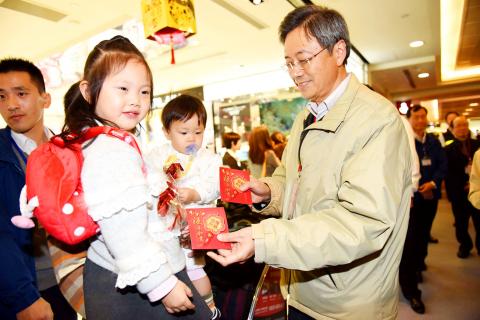
Photo: CNA
“I wish to pass a version that condenses the strong points of the two proposals,” he said.
However, the most controversial bill is for institutionalizing a cross-strait agreement oversight mechanism.
“There are versions that call for the participation of legislators in the cross-strait negotiations, or holding civil servants legally accountable when the negotiation yields unacceptable outcomes, which would place great pressure on civil officials,” Chang said.
When asked about the idea of a “two-state doctrine” being embedded in the version proposed by civil groups, in which the wording presupposes the negotiation takes place between two states (the Republic of China and the People’s Republic of China), the premier said the DPP should act pragmatically.
“Unless you plan to stop talking to [China] in the years to come, I think we need to take [China’s] stance into consideration. You have to be practical. However, how and to what extent are the questions that need be carefully weighed by the DPP and Chairperson Tsai Ing-wen (蔡英文),” he said.
In response to the DPP and the New Power Party caucuses’ call for a suspension of the review of an application to acquire cable and Internet services provider China Network Systems Co, the premier said the Ministry of Economic Affairs’ Investment Commission has not scheduled a review for the case, adding that because the commission is an independent committee, the Executive Yuan would not intervene in its operation.
“However, if the legislature reaches a resolution requiring the commission to halt the review before the committee schedules a review, it is very likely that the commission would respect the decision,” Chang added.
He nevertheless said he was concerned about Taiwanese mistrust of foreign acquisition, which might hinder the nation’s entry into regional economic organizations.
“When I was dealing with [the country’s intended application for joining] the TPP [Trans-Pacific Partnership] and RCEP [Regional Comprehensive Economic Partnership], some told us that Taiwan’s review of foreign investment is not transparent enough. This clearly shows that, for Taiwan to be a member of the TPP or RCEP, a lack of transparency would be a barrier.”

The manufacture of the remaining 28 M1A2T Abrams tanks Taiwan purchased from the US has recently been completed, and they are expected to be delivered within the next one to two months, a source said yesterday. The Ministry of National Defense is arranging cargo ships to transport the tanks to Taiwan as soon as possible, said the source, who is familiar with the matter. The estimated arrival time ranges from late this month to early next month, the source said. The 28 Abrams tanks make up the third and final batch of a total of 108 tanks, valued at about NT$40.5 billion
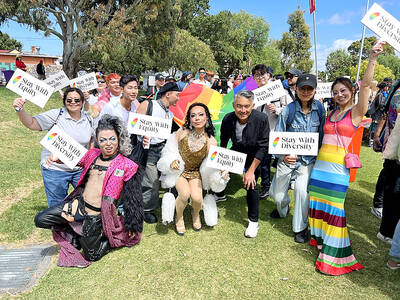
A group from the Taiwanese Designers in Australia association yesterday represented Taiwan at the Midsumma Pride March in Melbourne. The march, held in the St. Kilda suburb, is the city’s largest LGBTQIA+ parade and the flagship event of the annual Midsumma Festival. It attracted more than 45,000 spectators who supported the 400 groups and 10,000 marchers that participated this year, the association said. Taiwanese Designers said they organized a team to march for Taiwan this year, joining politicians, government agencies, professionals and community organizations in showing support for LGBTQIA+ people and diverse communities. As the first country in Asia to legalize same-sex
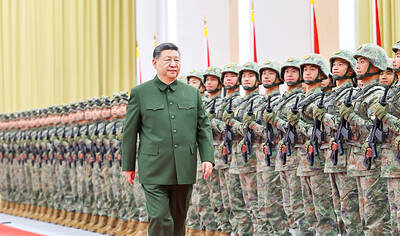
MOTIVES QUESTIONED The PLA considers Xi’s policies toward Taiwan to be driven by personal considerations rather than military assessment, the Epoch Times reports Chinese President Xi Jinping’s (習近平) latest purge of the Chinese People’s Liberation Army (PLA) leadership might have been prompted by the military’s opposition to plans of invading Taiwan, the Epoch Times said. The Chinese military opposes waging war against Taiwan by a large consensus, putting it at odds with Xi’s vision, the Falun Gong-affiliated daily said in a report on Thursday, citing anonymous sources with insight into the PLA’s inner workings. The opposition is not the opinion of a few generals, but a widely shared view among the PLA cadre, the Epoch Times cited them as saying. “Chinese forces know full well that
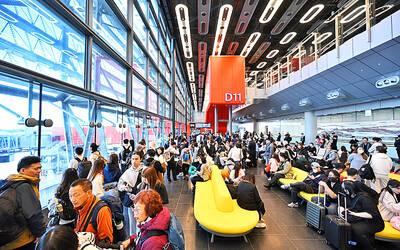
Travel agencies in Taiwan are working to secure alternative flights for travelers bound for New Zealand for the Lunar New Year holiday, as Air New Zealand workers are set to strike next week. The airline said that it has confirmed that the planned industrial action by its international wide-body cabin crew would go ahead on Thursday and Friday next week. While the Auckland-based carrier pledged to take reasonable measures to mitigate the impact of the workers’ strike, an Air New Zealand flight arriving at Taipei from Auckland on Thursday and another flight departing from Taipei for Auckland on Saturday would have to


 RSS
RSS