


The Chinese Nationalist Party (KMT) caucus yesterday nominated outgoing party caucus whip Lai Shyh-bao (賴士葆) as its candidate for the legislative speakership, while it nominated legislator-elect William Tseng (曾銘宗) as deputy speaker.
The KMT caucus reached a consensus at a meeting at KMT headquarters in Taipei, which was attended by 28 of the party’s 35 legislators who won seats in the elections on Jan. 16.
“Two plans were discussed at the meeting. One was that the caucus put forward its own candidates for the speakership and deputy speakership and the other was that we allow lawmakers to vote for themselves,” Lai said on the sidelines of the meeting.
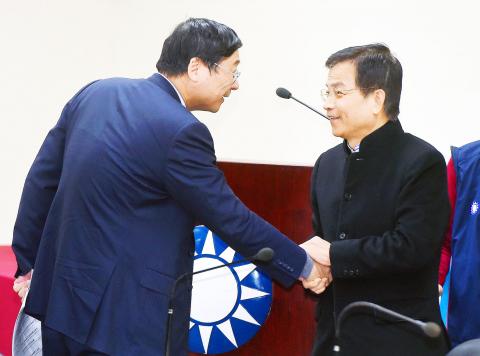
Photo: Liao Chen-huei, Taipei Times
Lai said the legislators in attendance opted for the first plan and agreed to select candidates based on seniority.
However, Lai said that most KMT legislators with more seniority than him all said they were not interested in joining the speakership election on Monday next week, including incumbent Legislative Speaker Wang Jin-pyng (王金平), as well as Huang Chao-shun (黃昭順) and Lo Ming-tsai (羅明才).
As the party’s caucus whip, Lai said he could not run away and must assume the responsibility.
“I did not foresee such an outcome, nor did I plan for it,” he said.
As for the nomination of Tseng, the outgoing chairman of the Financial Supervisory Commission, who does not have any prior legislative experience, Lai said he was nominated because it was later agreed that it was not necessary to adhere to the principle of seniority.
The nominations are set to bring an end to Wang’s long hold on the speakership.
Wang is the nation’s longest-serving legislative speaker, a post he has occupied since 1999. He was re-elected as a legislator-at-large on Jan. 16.
Lai’s chances of winning the speakership election are slim, as the KMT only holds 35 seats in the 113-seat legislature, compared with 68 seats held by the Democratic Progressive Party (DPP), which is to nominate its own speakership candidate by the end of this week.
Asked what role Wang would play in the legislature, Lai said the matter was not discussed at the meeting, but Wang is expected to continue helping others.
Lai downplayed questions regarding some pan-blue supporters’ call that Wang resign as a legislator-at-large to take responsibility for the KMT’s landslide defeat in the elections.
“People who look at one thing from a different angle would certainly reach a different conclusion. I do not have much opinion on this matter and I think we should respect and listen to more opinions,” Lai said.

The Ministry of Finance this afternoon announced the winning numbers for the March-April uniform invoice lottery. The winning number for the NT$10 million (US$318,060) special prize is 19531471, and the winning number for the NT$2 million grand prize is 85941329. Three numbers were drawn for the NT$200,000 first prize: 07225810, 20231230 and 83518781. Those with receipts matching the last seven digits of any of the first-prize numbers will win the NT$40,000 second prize, while those matching the last six digits will win the NT$10,000 third prize. Those whose receipts match the last five digits of the first-prize numbers can claim the NT$4,000 fourth prize,

SIX SUBSIDIES: The monthly allowance for older farmers is to increase to NT$10,000, and NT$5,000 is to be given to homemakers under the national pension system, Lai said The government is to implement major welfare policies for disadvantaged groups, including raising the monthly allowance for older farmers to NT$10,000 and providing homemakers with NT$5,000 per month, President William Lai (賴清德) said yesterday. Lai made the remarks during a visit to Wangling Temple in Chiayi County, saying that the planned increases were being introduced amid economic growth and an increase in tax revenue. Touting a policy, in which the government plans to provide a monthly allowance of NT$5,000 for every child under the age of 18 in a bid to address Taiwan’s low birthrate, Lai said that if received for the

NATIONAL SECURITY: Authorities are working to confirm the identities of the military personnel involved and investigating possible illegal conduct and regulatory violations Authorities are probing possible national security implications after Kinmen police and immigration officers on Sunday found a Chinese woman allegedly posing as a tourist while engaging in prostitution involving more than 10 military personnel. The woman, surnamed Chen (陳), has since been deported, authorities said, adding that investigators are still working to confirm the identities of those implicated, as the records only listed code names and aliases. The case stemmed from a report received by the Kinmen District Prosecutors’ Office on Friday last week from the Jinhu Precinct of the Kinmen County Police Bureau. On Sunday, police, along with the National Immigration
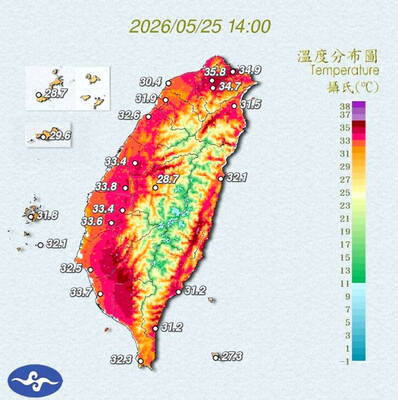
STAY COOL: The HPA recommended that people stay hydrated, use air-conditioning or fans while indoors, wear loose-fitting clothes and walk in the shade while outdoors Employers must implement measures such as installing cooling equipment, and providing drinking water and rest breaks for outdoor workers starting from Monday next week, the Taipei Department of Labor said on Sunday. Employers who fail to comply could face fines of NT$30,000 to NT$300,000 under the Occupational Safety and Health Act (職業安全衛生法), the department said. Businesses in Taipei employing fewer than 100 workers, as well as registered self-employed workers with labor insurance coverage, could receive on-site assessments and guidance from occupational safety consultants to help them apply for central government subsidies to implement or improve heat-protection measures, it said. Under the Ministry of


 RSS
RSS