


A China-based Taiwanese singer who drew public ire after criticizing a Taiwanese K-pop singer for waving a Republic of China (ROC) flag said he would hold a news conference in Taiwan on Feb. 3 to tell his side of the story.
Huang An (黃安) accused 16-year-old Chou Tzu-yu (周子瑜), the Taiwanese member of the South Korean girl band TWICE, of supporting Taiwanese independence after she waved an ROC flag on a South Korean TV show.
The tip-off led to widespread criticizm of Chou in China.
An endorsement deal her group had with Chinese smartphone maker Huawei was jeopardized by Chou’s so-called pro-Taiwanese independence attitude.
Chou apologized to her management company JYP Entertainment and her Chinese and Taiwanese fans in a video released on YouTube on Friday, saying: “There is only one China... I have always felt proud of being Chinese.”
Park Jin-young, head of JYP Entertainment, also apologized.
The incident caused outrage among Taiwanese, who saw it as China bullying a teenager who was waving her nation’s flag.
The incident might have boosted president-elect Tsai Ing-wen’s (蔡英文) votes by 1 to 2 percentage points in Saturday’s election, said Michael Hsiao (蕭新煌), a research fellow at Academia Sinica’s Institute of Sociology.
Huang wrote on Weibo on Sunday that he was not the culprit in the incident, saying that he was “lucky to become” a singer who could influence “Taiwan’s election.”
He said he would explain “the whole story” behind the incident and present the truth.
Huang said in a Weibo post on Monday last week that he was not associating waving the ROC flag with Taiwan independence, but the issue was what the person waving the flag stood for.
Pro-independence Taiwanese media were using the incident to manufacture provocative headlines to incite Chinese, Huang said, adding that Chou must be working with them unless she says otherwise.
There are many people who could trigger sensitive issues between China and Taiwan, since almost everyone has a Facebook account, former Mainland Affairs Council chairman and Chinese Nationalist Party (KMT) Lawmaker Su Chi (蘇起) said on Sunday.
People should remain calm and set their sights on the common good when dealing with issues regarding cross-strait relations, Su said.
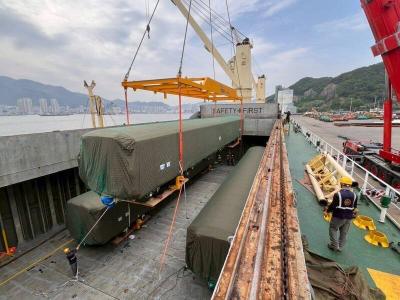
The first of 10 new high-capacity trains purchased from South Korea’s Hyundai Rotem arrived at the Port of Taipei yesterday to meet the demands of an expanding metro network, Taipei Rapid Transit Corp (TRTC) said yesterday. The train completed a three-day, 1,200km voyage from the Port of Masan in South Korea, the company said. Costing NT$590 million (US$18.79 million) each, the new six-carriage trains feature a redesigned interior based on "human-centric" transportation concepts, TRTC said. The design utilizes continuous longitudinal seating to widen the aisles and optimize passenger flow, while also upgrading passenger information displays and driving control systems for a more comfortable
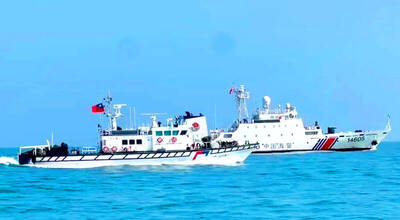
Instead of focusing solely on the threat of a full-scale military invasion, the US and its allies must prepare for a potential Chinese “quarantine” of Taiwan enforced through customs inspections, Stanford University Hoover fellow Eyck Freymann said in a Foreign Affairs article published on Wednesday. China could use various “gray zone” tactics in “reconfiguring the regional and ultimately the global economic order without a war,” said Freymann, who is also a nonresident research fellow at the US Naval War College. China might seize control of Taiwan’s links to the outside world by requiring all flights and ships entering or leaving Taiwan
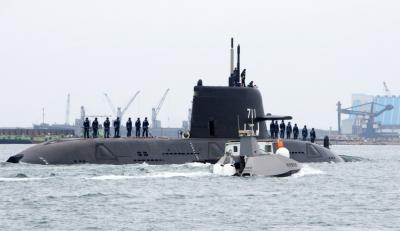
Taiwan's first indigenous defense submarine, the SS-711 Hai Kun (海鯤, or Narwhal), departed for its 13th sea trial at 7am today, marking its seventh submerged test, with delivery to the navy scheduled for July. The outing also marked its first sea deployment since President William Lai (賴清德) boarded the submarine for an inspection on March 19, drawing a crowd of military enthusiasts who gathered to show support. The submarine this morning departed port accompanied by CSBC Corp’s Endeavor Manta (奮進魔鬼魚號) uncrewed surface vessel and a navy M109 assault boat. Amid public interest in key milestones such as torpedo-launching operations and overnight submerged trials,
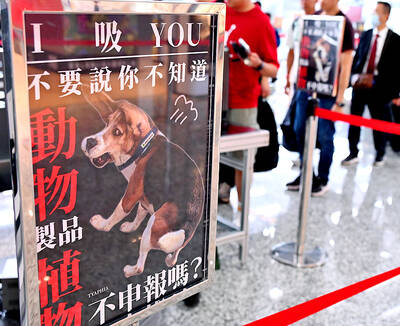
Quarantine awareness posters at Taiwan Taoyuan International Airport have gone viral for their use of wordplay. Issued by the airport branch of the Animal and Plant Health Inspection Agency, the posters feature sniffer dogs making a range of facial expressions, paired with advisory messages built around homophones. “We update the messages for holidays and campaign needs, periodically refreshing materials to attract people’s attention,” quarantine officials said. “The aim is to use the dogs’ appeal to draw focus to quarantine regulations.” A Japanese traveler visiting Taiwan has posted a photo on X of a poster showing a quarantine dog with a


 RSS
RSS