


Dropping salary requirements for foreign white-collar worker would force down local wages, labor rights advocates said yesterday at a protest outside the Ministry of Labor, calling for the withdrawal of plans to abandon absolute salary thresholds for work permits.
Members of the Taiwan Labour Front, Economic Democracy Union and other groups shouted slogans saying that the proposed changes go against the spirit of the Employment Service Act (就業服務法) and calling for the government to “hold firm” on the NT$47,971 monthly salary threshold in the face of corporate pressure.
In addition to the salary threshold, regulations require foreign white-collar workers to have either two years of relevant work experience or an advanced degree to be eligible for a work permit.
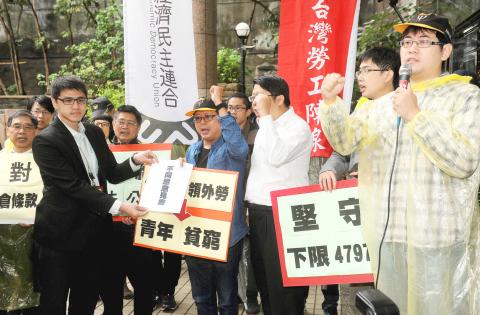
Photo: CNA
Proposed changes announced by the ministry last month would drop the absolute requirements in favor of a points-based system that would take into consideration language ability, professional training and other factors in addition to education and work experience.
The groups said the changes would benefit business interests by leading to an influx of low-cost foreign white-collar workers, which would put pressure on wages.
“The [proposed] change [to the salary requirement] is about servicing corporations and bosses by cutting labor costs,” Taiwan Labour Front secretary-general Son Yu-lian (孫友聯) said. “The passage of the Employment Service Act (就業服務法) was to protect local jobs, so thresholds were set up. However, all the thresholds would be canceled under the proposed changes.”
Switching to a points-based system would “open the floodgates” to foreign white-collar workers by giving the ministry greater flexibility over work permit approval, allowing for substantial increases, Son said, adding that the ministry had failed to demonstrate that foreign labor would mainly fill positions for which there was a lack of qualified domestic workers.
Economic Democracy Union convener Lai Chung-chiang (賴中強) said the proposed changes broke with the spirit of past regulations by not strictly limiting the number of white-collar workers moving to Taiwan to those with professional knowledge, experience or technological skills.
“In the past, there was the protection of the NT$47,971 salary threshold, but [with the changes] corporations would be able to hire for anything more than the minimum wage,” Lai said. “That would definitely affect the jobs available for young people.”
The Ministry of Labor said that the new regulations were intended to allow for greater flexibility in evaluating white-collar workers and have yet to be finalized.
“Previous regulations were inflexible; someone might have graduated with a masters or been awarded patents or have other relevant skills, but would lack the required number of years of work experience or have other unique circumstances,” Cross-Border Workforce Management Division Senior Executive Officer Hou Song-yen (候松延) said.
“Because of this, we think there might be a more flexible way to determine professional skills beyond the current criteria, while the ministry will continue to conduct careful verification” of applicants, Hou said.
After the period for public comment on the proposed changes expires on Wednesday next week, the final version of the amendments are to be sent to the ministry’s legal affairs committee for approval before being filed with the Legislative Yuan, Hou said.
The ministry estimates that the changes would increase the issuance of new work permits for foreign white-collar workers by roughly 17 percent, with about 2,000 new permits issued annually, he said.

SECURITY: Starlink owner Elon Musk has taken pro-Beijing positions, and allowing pro-China companies to control Taiwan’s critical infrastructure is risky, a legislator said Starlink was reluctant to offer services in Taiwan because of the nation’s extremely high penetration rates in 4G and 5G services, the Ministry of Digital Affairs said yesterday. The ministry made the comments at a meeting of the legislature’s Transportation Committee, which reviewed amendments to Article 36 of the Telecommunications Management Act (電信管理法). Article 36 bans foreigners from holding more than 49 percent of shares in public telecommunications networks, while shares foreigners directly and indirectly hold are also capped at 60 percent of the total, unless specified otherwise by law. The amendments, sponsored by Chinese Nationalist Party (KMT) Legislator Ko

The eastern extension of the Taipei MRT Red Line could begin operations as early as late June, the Taipei Department of Rapid Transit Systems said yesterday. Taipei Rapid Transit Corp said it is considering offering one month of free rides on the new section to mark its opening. Construction progress on the 1.4km extension, which is to run from the current terminal Xiangshan Station to a new eastern terminal, Guangci/Fengtian Temple Station, was 90.6 percent complete by the end of last month, the department said in a report to the Taipei City Council's Transportation Committee. While construction began in October 2016 with an

NON-RED SUPPLY: Boosting the nation’s drone industry is becoming increasingly urgent as China’s UAV dominance could become an issue in a crisis, an analyst said Taiwan’s drone exports to Europe grew 41.7-fold from 2024 to last year, with demand from Ukraine’s fight against Russian aggression the most likely driver of growth, a study showed. The Institute for Democracy, Society and Emerging Technology (DSET) in a statement on Wednesday said it found that many of Taiwan’s uncrewed aerial vehicle (UAV) sales were from Poland and the Czech Republic. These countries likely transferred the drones to Ukraine to aid it in its fight against the Russian invasion that started in 2022, it said. Despite the gains, Taiwan is not the dominant drone exporter to these markets, ranking second and fourth

The military has spotted two Chinese warships operating in waters near Penghu County in the Taiwan Strait and sent its own naval and air forces to monitor the vessels, the Ministry of National Defense (MND) said. Beijing sends warships and warplanes into the waters and skies around Taiwan on an almost daily basis, drawing condemnation from Taipei. While the ministry offers daily updates on the locations of Chinese military aircraft, it only rarely gives details of where Chinese warships are operating, generally only when it detects aircraft carriers, as happened last week. A Chinese destroyer and a frigate entered waters to the southwest


 RSS
RSS