


Chinese Nationalist Party (KMT) presidential candidate Eric Chu (朱立倫) yesterday urged the Chinese and Hong Kong governments to make an unequivocal statement over the reported disappearances of several people working for a Hong Kong publishing house and a related bookstore.
“Democracy has become the inevitable trend of all nations. In light of the incidents [of missing people] in Hong Kong, the Hong Kong or Chinese governments must give the public a clear answer,” Chu said during street canvassing in Yunlin County yesterday morning.
Asked whether the missing persons case could set democratic alarm bells ringing in Taiwan, Chu said that the ideals of democracy and freedom are widely held among the international community.
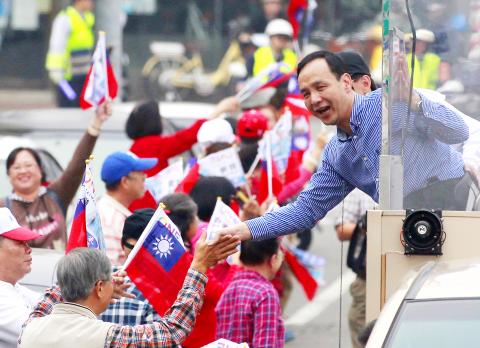
Photo: Reuters
Democracy and freedom are particularly valued by Taiwanese, Chu added.
Chu’s remarks came one day after Hong Kong Chief Executive Leung Chun-ying (梁振英) dismissed allegations that outside agents could have been involved in the disappearance of five booksellers specializing in publications critical of China.
According to the Hong Kong Alliance in Support of Patriotic Democratic Movements in China, five shareholders and employees of Causeway Bay Books — one of the few bookstores in Hong Kong that sells publications banned in China — have gone missing on separate occasions since October last year.
The alliance said it suspects that one of the shareholders, Lee Bo (李波), who disappeared in Hong Kong on Wednesday last week, could have been kidnapped by Chinese law enforcement officials.
On Monday, the Taiwan Solidarity Union (TSU) held a press conference deploring what it said was China’s disrespect for human rights and its deprivation of the right to freedom of expression.
The TSU also expressed concerns that President Ma Ying-jeou’s (馬英九) China-leaning policies could see Taiwan go down the same path as Hong Kong.
Regarding the thorny issue of US pork imports containing ractopamine, Chu said that many consumer groups and pig farms in Yunlin, Pingtung and Chiayi counties have spoken strongly against the idea of lifting the import ban.
“We will surely respect their opinions. Of all the concerns they have brought up, they are most worried about the health impact of relaxing the ban,” Chu said.
Asked whether he agreed that supporting Democratic Progressive Party (DPP) presidential candidate Tsai Ing-wen (蔡英文) is tantamount to supporting imports of ractopamine-laced US pork, Chu said that many pig farmers across the nation are of that opinion.
Chu has interpreted Tsai’s comment that Taiwan should consider Japan’s and South Korea’s standards for ractopamine in imported pork an indication that if elected, she would open up the nation to US pork containing ractopamine residue.
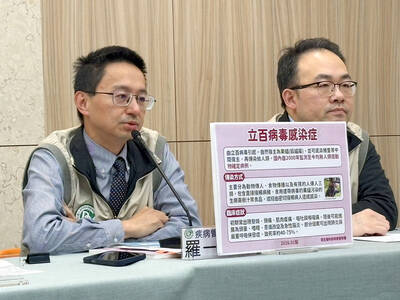
Nipah virus infection is to be officially listed as a category 5 notifiable infectious disease in Taiwan in March, while clinical treatment guidelines are being formulated, the Centers for Disease Control (CDC) said yesterday. With Nipah infections being reported in other countries and considering its relatively high fatality rate, the centers on Jan. 16 announced that it would be listed as a notifiable infectious disease to bolster the nation’s systematic early warning system and increase public awareness, the CDC said. Bangladesh reported four fatal cases last year in separate districts, with three linked to raw date palm sap consumption, CDC Epidemic Intelligence

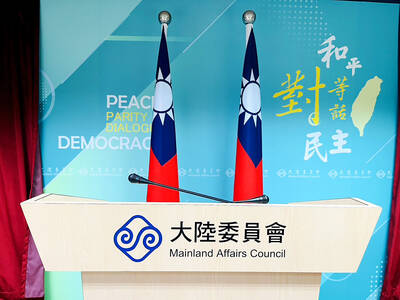
Two Taiwanese prosecutors were questioned by Chinese security personnel at their hotel during a trip to China’s Henan Province this month, the Mainland Affairs Council (MAC) said yesterday. The officers had personal information on the prosecutors, including “when they were assigned to their posts, their work locations and job titles,” MAC Deputy Minister and spokesman Liang Wen-chieh (梁文傑) said. On top of asking about their agencies and positions, the officers also questioned the prosecutors about the Cross-Strait Joint Crime-Fighting and Judicial Mutual Assistance Agreement, a pact that serves as the framework for Taiwan-China cooperation on combating crime and providing judicial assistance, Liang
Reports of Taiwanese going missing, being detained or interrogated, or having their personal liberties restricted in China increased about fourfold annually last year, the Mainland Affairs Council (MAC) said yesterday. Last year, 221 Taiwanese who traveled to China were reported missing, were detained and interrogated, or otherwise had their personal freedom restricted, up from 55 the previous year, the council said. Reopening group tours to China would be risky, as it would leave travelers with no way to seek help through official channels after Beijing shut down dialogue between the associations tasked with handling cross-strait tourism, the MAC said. Taipei’s Taiwan Strait Tourism
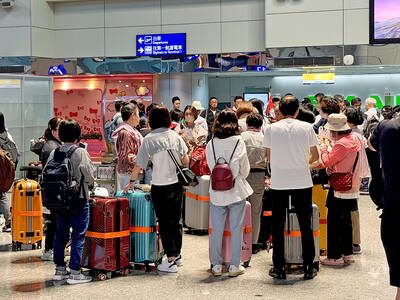
SHIFT: Taiwan is evolving from a transit stop into a tourist destination, with more international travelers willing to spend on tours, dining and cultural activities Taiwan rose three places in the World Tourism Barometer to 36th globally in 2024, with international tourism revenue of US$10.028 billion, the Tourism Administration said on Monday. The UN Tourism Organization publication said that its focus has switched from whether a country has returned to pre-COVID-19 levels of tourism to the amount spent by a tourist during an overseas trip. The nation last year welcomed 8.57 million international tourists, about 9 percent more than in 2024, with most tourists coming from Japan, South Korea, and Hong Kong and Macau, all of which accounted for at least 1 million tourists each. During the first


 RSS
RSS