


Officials and advisors of the Democratic Progressive Party (DPP), led by lawyer Wellington Koo (顧立雄), yesterday headed to the Taipei District Prosecutors’ Office to launch a lawsuit against the Chinese Nationalist Party (KMT) and KMT Chairman Eric Chu (朱立倫) over alleged vote buying at a banquet event in Hsinchu last weekend.
Koo said that the year-end “thanksgiving” banquet with 1,035 tables and free meals for over 10,000 Hsinchu City residents at a night market plaza was a clear attempt at vote buying to influence the election outcome.
DPP officials have estimated the event would have cost about NT$8 million (US$243,532), including food and drinks, caterers, venue rental and service personnel.
Koo said that if the event’s bill payments can be traced to the KMT, he would consider launching a lawsuit to nullify qualifications for all KMT nominated candidates for legislator-at-large seats.
DPP spokesman Yang Chia- liang (楊家俍) said the event was organized by the KMT’s Hsinchu City Chapter, and co-organized by Chu’s support organizations, as well as people associated with KMT legislative candidate for Hsinchu City Cheng Cheng-chien (鄭正鈐) campaign activities. Yang added that KMT Secretary-General Lee Shu-chuan (李四川) also attended the event on behalf of Chu.
“We are asking the judicial agencies to find out who paid the expenses for the banquet, was it Eric Chu? Or the KMT?” Yang said. “The Ministry of Justice has not been proactive in investigating. Are they just going to slack off on this case? Are they permitting the KMT to openly buy votes with such events?”
The Hsinchu District Prosecutors’ Office has summoned 36 people for questioning in relation to the case, including KMT officials in Hsinchu City, invited officials, caterers and companies that provided services at the event.
The KMT yesterday fired back with its own salvo, accusing the DPP of mudslinging in the lead up to the election in order to tarnish the party’s candidates.
Cheng Cheng-chien brushed aside the vote-buying accusations, urging the judiciary to conduct a thorough investigation, which he said would find him innocent of any wrongdoing as he was merely visiting the KMT-hosted banquet to greet and talk with residents.
Lee Ming-hsien (李明賢), a KMT Communications and Broadcasting Committee official, said that the banquet was a goodwill event organized by the Hsinchu City Government, and this year the host changed to the KMT Hsinchu City Chapter.
“All residents of Hsinchu City can attend the dinner, regardless of their party affiliation,” Lee said.
According to Lee, the banquet did not constitute a campaign event as there were no campaign banners or political slogans at the event.
He said that the KMT supports the judiciary conducting an investigation and urged the DPP to stop engaging in negative election tactics.

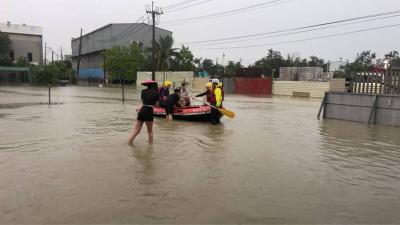
Torrential rains from a passing tropical storm shut down a swathe of southern Taiwan today, forcing more than 5 million people to stay home from work or school. Typhoon Mekkhala, now a tropical storm and nearing southern Japan's Ryukyu Islands, did not make direct landfall in Taiwan, but its outer bands brought heavy rain to parts of the nation, especially Kaohsiung, Tainan and Pingtung in the south. The governments of all three regions, where more than 5 million people live, ordered offices and schools closed today. Severe flooding in Tainan shut down a section of the main north-south railway line. No casualties have been
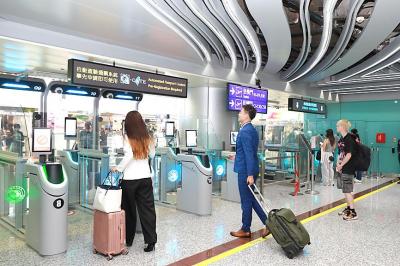
A Chinese man who uploaded video footage of restricted areas at Taiwan Taoyuan International Airport would be barred from entering Taiwan for two years, the National Immigration Agency (NIA) said today. The man uploaded a video to the Shanghai-based platform Bilibili on Thursday last week under the account name "White Sheep in the Sky" (天上白羊), documenting his arrival at the airport. The video included footage of security screening and immigration inspection areas, where photography is clearly prohibited. The video also repeatedly referred to Taiwan as "China Taiwan" and appeared to intentionally cover the Republic of China (Taiwan's official name) flag with a
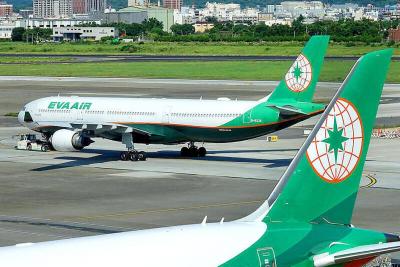
Taiwanese airline EVA Air and its sister airline UNI Air announced yesterday that they will raise booking service fees for international flights starting Aug. 1. EVA Air said in a statement that the two carriers' flights departing from the Philippines or Hong Kong, booking fees would be set at US$28 per ticket, while other flights would be charged US$33. Taiwan's major airlines, including EVA Air, China Airlines (CAL), Starlux Airlines and Tigerair Taiwan, charge booking service fees on a per-ticket basis to cover the cost of using global distribution systems for reservations. CAL also recently announced that it will raise its booking service
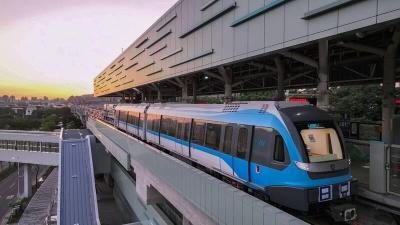
The new MRT Sanying Line in New Taipei City is scheduled to open on Tuesday next week, with rides free through Aug. 31 as part of a two-month trial period, New Taipei City Mayor Hou You-yi (侯友宜) said today. The New Taipei City Government’s Department of Rapid Transit Systems and New Taipei Metro Corp are to operate a new 14.29km-long metro line connecting 12 stations across the city’s Tucheng (土城), Sansia (三峽) and Yingge (鶯歌) districts. The commute time from the Sanying area into Taipei and New Taipei City is expected to be cut by up to 20 minutes, Hou


 RSS
RSS