


Starting today, instrumental music is to be broadcast at eight stations along the MRT’s Tamsui-Xinyi Line to notify passengers of services and lighten their moods, the metro operator said.
The eight stations are Taipei 101/World Trade Center, Xinyi Anhe, Daan Park, NTU Hospital, Taipei Main Station, Zhongshan, Shuanglian and Minquan W Road, with each station featuring a unique theme, Taipei Rapid Transit Corp said.
The music features harpsichords, xylophones, kalimbas and celestas using light motifs and uplifting melodies, which will likely lighten passengers’ mood, the company said.
The company said that the new feature is the result of a collaboration with the Taipei Department of Cultural Affairs, while plans to play piped-in music at stations along the Bannan, Songshan-Xindian and Zhonghe-Xinlu lines have been made.
To avoid disturbing people living close to MRT stations or causing confusion, music will not be played at elevated stations, terminal stations or stations with platforms taking services on different lines at the same level — such as the Chiang Kai-shek Memorial Hall and Ximen stations — the company said.
The department said that it had asked composers to create “MRT-inspired” music in an effort to bring an artistic touch to commuter’s lives.
The department said it hopes this feature will allow people to see Taipei’s unique urban vibes in a new light.
Summer Lei (雷光夏), a musician who wrote and played music for the stations, said that she wanted to create the feeling of taking a day trip out of town for passengers.
Lei said that as a Tamkang University student, she often had to ride trains along what is now the Tamsui-Xinyi Line and it always felt like an excursion, as the train would pass by rice paddies, mango gardens and swamps.
“I wrote four versions of the music and made at least five to six revisions to each,” Lei said.
“I, too, use the MRT line, so it would be me suffering if I had not done my best,” the musician added.
Additional reporting by Loa Iok-sin
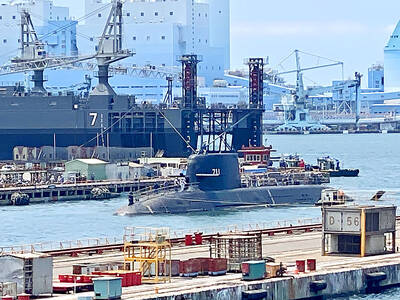
AGING: While Japan has 22 submarines, Taiwan only operates four, two of which were commissioned by the US in 1945 and 1946, and transferred to Taiwan in 1973 Taiwan would need at least 12 submarines to reach modern fleet capabilities, CSBC Corp, Taiwan chairman Chen Cheng-hung (陳政宏) said in an interview broadcast on Friday, citing a US assessment. CSBC is testing the nation’s first indigenous defense submarine, the Hai Kun (海鯤, Narwhal), which is scheduled to be delivered to the navy next month or in July. The Hai Kun has completed torpedo-firing tests and is scheduled to undergo overnight sea trials, Chen said on an SET TV military affairs program. Taiwan would require at least 12 submarines to establish a modern submarine force after assessing the nation’s operational environment and defense
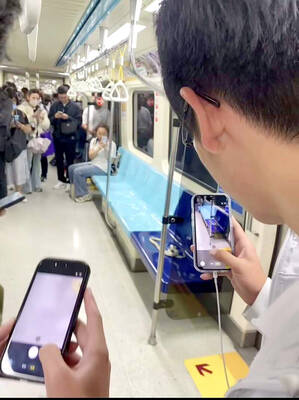
A white king snake that frightened passengers and caused a stir on a Taipei MRT train on Friday evening has been claimed by its owner, who would be fined, Taipei Rapid Transit Corp (TRTC) said yesterday. A person on Threads posted that he thought he was lucky to find an empty row of seats on Friday after boarding a train on the Bannan (Blue) Line, only to spot a white snake with black stripes after sitting down. Startled, he jumped up, he wrote, describing the encounter as “terrifying.” “Taipei’s rat control plan: Release snakes on the metro,” one person wrote in reply, referring
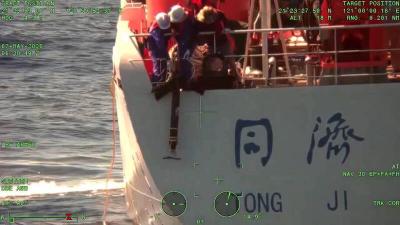
The coast guard today said that it had disrupted "illegal" operations by a Chinese research ship in waters close to the nation and driven it away, part of what Taipei sees a provocative pattern of China's stepped up maritime activities. The coast guard said that it on Thursday last week detected the Chinese ship Tongji (同濟號), which was commissioned only last year, 29 nautical miles (54km) southeast of the southern tip of Taiwan, although just outside restricted waters. The ship was observed lowering ropes into the water, suspected to be the deployment of scientific instruments for "illegal" survey operations, and the coast
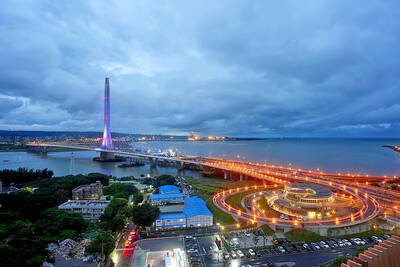
An inauguration ceremony was held yesterday for the Danjiang Bridge, the world’s longest single-mast asymmetric cable-stayed bridge, ahead of its official opening to traffic on Tuesday, marking a major milestone after nearly three decades of planning and construction. At the ceremony in New Taipei City attended by President William Lai (賴清德), Premier Cho Jung-tai (卓榮泰), Minister of Transportation and Communications Chen Shih-kai (陳世凱) and New Taipei City Mayor Hou Yu-ih (侯友宜), the bridge was hailed as both an engineering landmark and a long-awaited regional transport link connecting Tamsui (淡水) and Bali (八里)


 RSS
RSS