


Opening the semiconductor industry to Chinese investment without adequate safeguards would deepen Chinese influence and lead to a hollowing out of the industry, several academics said yesterday.
“China holds a knife in one hand and money in the other and then says to us: ‘You are my person and would you like money? Because otherwise I’ll knife you,’” Chang Shun-chih (張順志), a professor of electronics engineering at National Cheng Kung University. “However, many people only see the money and do not see the knife.”
Chang made the remarks at a joint press conference by several academics and the Economic Democracy Union to protest Minister of Economic Affairs John Deng’s (鄧振中) statement late last month that President Ma Ying-jeou’s (馬英九) government intends to open the sector to Chinese investment before his term expires in the May.
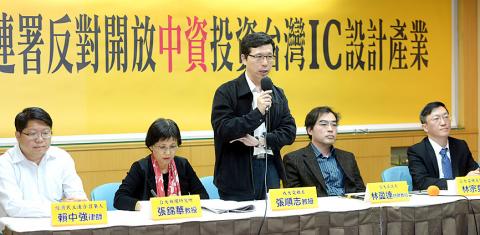
Photo: Lin Cheng-kung, Taipei Times
His remarks were followed last week by the announcement that China’s Tsinghua Unigroup would seek to purchase stakes in Siliconware Precision Industries Co and MediaTek — two key semiconductor firms.
Chang said that IC designer MediaTek faces substantial pressure to agree to Chinese investment because of its exposure to the Chinese market, making it vulnerable to sanctions by the Beijing government, such as forbidding Chinese phone makers from using the Taiwanese company’s chips.
While Deng has said the government would implement safeguards to protect business secrets and prevent the local industry from being undermined if the investment ban is dropped, such promises are “wishful thinking,” with the government failing to provide specific measures of how they would be implemented, Chang said.
“The Chinese are not interested in playing a ‘win-win’ game with us in the IC sector. They are seeking to use the Chinese market to force us to allow them to invest. They will continue to use the same means to gradually take control of IC design companies to gain access to our technology,” he said, adding that Taiwanese firms would be hollowed out and cast aside as soon as Chinese investors master their technology.
“If they get a hold of operating authority, there is nothing you can do,” he said.
Economic Democracy Union convener Lai Chung-chiang (賴中強) said that if Chinese firms were allowed to purchase stakes in IC companies, there would be no way to prevent “technological dialogue” between the firms, with Taiwanese firms likely to be required to provide training to Chinese workers.
Deng’s statements reflected overly broad executive discretion over the bounds of Chinese investment, he said, calling for the passage of a law similar to the Statute for Investment by Foreign Nationals (外國人投資條例) that requires major changes to receive legislative approval. Currently opening new sectors can be determined by executive fiat, he said.
A petition opposing the opening of the sector had attracted 246 signatures as of noon yesterday, including 80 from professors of electrical engineering or information related fields, the group said.
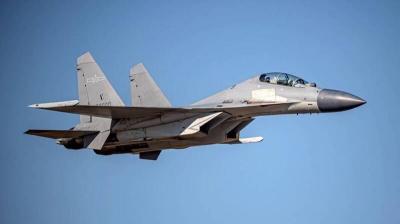
Eight Chinese naval vessels and 24 military aircraft were detected crossing the median line of the Taiwan Strait between 6am yesterday and 6am today, the Ministry of National Defense said this morning. The aircraft entered Taiwan’s northern, central, southwestern and eastern air defense identification zones, the ministry said. The armed forces responded with mission aircraft, naval vessels and shore-based missile systems to closely monitor the situation, it added. Eight naval vessels, one official ship and 36 aircraft sorties were spotted in total, the ministry said.
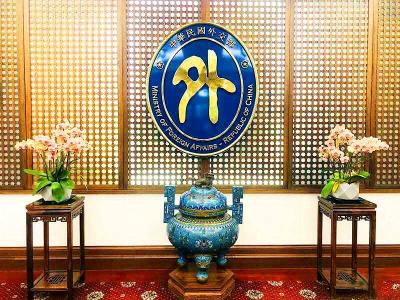
The Ministry of Foreign Affairs (MOFA) today said that if South Korea does not reply appropriately to its request to correct Taiwan’s name on its e-Arrival card system before March 31, it would take corresponding measures to alter how South Korea is labeled on the online Taiwan Arrival Card system. South Korea’s e-Arrival card system lists Taiwan as “China (Taiwan)” in the “point of departure” and “next destination” fields. The ministry said that it changed the nationality for South Koreans on Taiwan’s Alien Resident Certificates from “Korea” to “South Korea” on March 1, in a gesture of goodwill and based on the
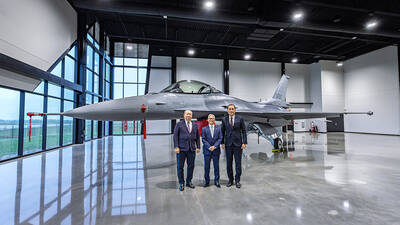
Taiwanese officials were shown the first of 66 F-16V fighter jets purchased by Taiwan from the United States, the Ministry of National Defense said yesterday, adding the aircraft has completed an initial flight test and is expected to be delivered later this year. A delegation led by Deputy Minister of National Defense Hsu Szu-chien (徐斯儉) visited Lockheed Martin’s F-16 C/D Block 70 (also known as F-16V) assembly line in South Carolina on March 16 to view the aircraft. The jet will undergo a final acceptance flight in the US before being delivered to Taiwan, the
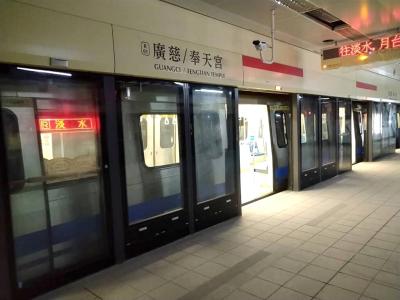
The New Taipei Metro's Sanyin Line and the eastern extension of the Taipei Metro's Tamsui-Xinyi Line (Red Line) are scheduled to begin operations in June, the National Development Council said today. The Red Line, which terminates at Xiangshan Station, would be connected by the 1.4km extension to a new eastern terminal, Guangci/Fengtian Temple Station, while the Sanyin Line would link New Taipei City's Tucheng and Yingge stations via Sanxia District (三峽). The council gave the updates at a council meeting reviewing progress on public construction projects for this year. Taiwan's annual public infrastructure budget would remain at NT$800 billion (US$25.08 billion), with NT$97.3


 RSS
RSS