


National Chengchi University students yesterday boycotted the university’s controversial school anthem at the university’s Culture Cup choir competition, in which the school anthem is a required song.
The school anthem’s lyrics, panned by critics as a propaganda piece for “party-state ideology,” was written in the 1940s by Chinese Nationalist Party (KMT) member Chen Kuo-fu (陳國府) and contains passages such as: “Implementing the Three Principles of the People is our party’s mission,” and “Building the Republic of China is our party’s responsibility.”
At least four departmental choirs boycotted the school anthem by singing a vowel in lieu of certain lyrics, or by not singing at all. One department’s choir omitted the word “party” from its rendition of the anthem.
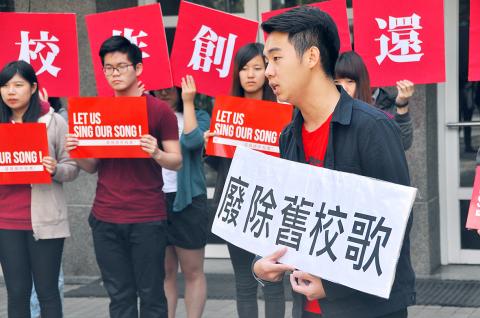
Photo provided by Lin Pei-yu
Several choirs held banners bearing the slogan, “Hey, give us back the school anthem we made,” referring to an alternative anthem that the university’s administration rejected.
“We call on the university to stop resisting change, and restore to the students the right to manage the competition and the right to choose the school anthem,” said Lin Pei-yu (林佩諭), deputy director of the Student Rights Department at the National Chengchi University Student Association, which had protested against the school anthem yesterday morning.
Event organizers had attempted to allow choirs to sing either the controversial school anthem, or the tentative new anthem, Pilot (領航), composed by a member of the university, Culture Cup convener Liu Chih-chia (劉芝嘉) said.
The school ultimately rejected the organizers’ proposal, citing purported “procedural errors,” Liu said, adding that she is “extremely displeased” with the decision and that she supports the boycott.
Although the university had referred a motion to abolish the school anthem’s lyrics to the university affairs board, those measures are not enough to satisfy the student organization, said Yang Tzu-hsien (楊子賢), spokesman for the Wildfire Front, the student group that initiated the boycott in October.
“We had hoped the school would respond positively to the demands of the university department choirs boycotting the school anthem [in a timely manner] by dealing with the issue in the university affairs board meeting before the Culture Cup event. However, it only now decides to pass the issue ‘to be addressed by the board,’ which is tantamount to ignoring the concerned members of the student body and faculty by pretending to do something about it,” Yang said.
During the past decade, the anthem survived nine attempts to abolish it by members of the school’s board of university affairs.

Considering that most countries issue more than five denominations of banknotes, the central bank has decided to redesign all five denominations, the bank said as it prepares for the first major overhaul of the banknotes in more than 24 years. Central bank Governor Yang Chin-lung (楊金龍) is expected to report to the Legislative Yuan today on the bank’s operations and the redesign’s progress. The bank in a report sent to the legislature ahead of today’s meeting said it had commissioned a survey on the public’s preferences. Survey results showed that NT$100 and NT$1,000 banknotes are the most commonly used, while NT$200 and NT$2,000

The Centers for Disease Control (CDC) yesterday reported the first case of a new COVID-19 subvariant — BA.3.2 — in a 10-year-old Singaporean girl who had a fever upon arrival in Taiwan and tested positive for the disease. The girl left Taiwan on March 20 and the case did not have a direct impact on the local community, it said. The WHO added the BA.3.2 strain to its list of Variants Under Monitoring in December last year, but this was the first imported case of the COVID-19 variant in Taiwan, CDC Deputy Director-General Lin Ming-cheng (林明誠) said. The girl arrived in Taiwan on

South Korea is planning to revise its controversial electronic arrival card, a step Taiwanese officials said prompted them to hold off on planned retaliatory measures, a South Korean media report said yesterday. A Yonhap News Agency report said that the South Korean Ministry of Foreign Affairs is planning to remove the “previous departure place” and “next destination” fields from its e-arrival card system. The plan, reached after interagency consultations, is under review and aims to simplify entry procedures and align the electronic form with the paper version, a South Korean ministry official said. The fields — which appeared only on the electronic form

The Ministry of Foreign Affairs (MOFA) is suspending retaliation measures against South Korea that were set to take effect tomorrow, after Seoul said it is updating its e-arrival system, MOFA said today. The measures were to be a new round of retaliation after Taiwan on March 1 changed South Korea's designation on government-issued alien resident certificates held by South Korean nationals to "South Korea” from the "Republic of Korea," the country’s official name. The move came after months of protests to Seoul over its listing of Taiwan as "China (Taiwan)" in dropdown menus on its new online immigration entry system. MOFA last week


 RSS
RSS